
Local service guide
Business Plan Consulting in Charlotte, NC
For Business Plan Consulting in Charlotte, define who will read your plan and hire for the work you need: research, financial modeling, writing, or review. Before commissioning a full draft, consider Central Piedmont’s free, confidential advising for Mecklenburg County entrepreneurs. Its advisors help refine business plans and improve cash flow. Use that review to identify gaps, then request a written consulting scope with deliverables, revision terms, and a schedule tied to your submission deadline. [1]
Choose the scope before choosing a consultant
Write a short brief that states your business concept, current stage, intended reader, and decision you need to make. For internal planning, ask for help testing sales assumptions and cash needs. For a financing submission, obtain the recipient’s document checklist and give it to each consultant quoting the work. For expansion, identify the proposed location, staffing changes, and spending you want to evaluate.
Ask each consultant to distinguish research, writing, financial modeling, and presentation work in the proposal. Specify whether you want a review of an existing draft or a plan written from your records. Request an editable document and spreadsheet, along with a walkthrough of the assumptions. Agree on who supplies missing information and how the consultant will price additional work.
Use local advising to identify gaps
Central Piedmont’s Small Business Center supports entrepreneurs and small-business owners across Mecklenburg County. It offers free, confidential advising that includes business-plan refinement and cash-flow help. You can meet an advisor in person, by phone, or online. Bring your draft and a list of unresolved questions so you can discuss the areas where you need help. [1]
For a small or mid-size business examining capital needs or expansion, consider the SBTDC at UNC Charlotte. Its listed services include access to capital and financing, evaluation of financial performance, and exploration of market opportunities. The office accepts visits by appointment. Ask about the assistance available for your situation before arranging a separate writing or modeling engagement. [2]
Keep an issue list after any advising session. Record which assumptions need evidence, which documents you lack, and which tasks you want to retain yourself. Give a prospective consultant that list and ask them to quote the remaining work. Confirm whether their role includes gathering evidence, revising your figures, or reviewing figures you provide.
Prepare figures the consultant can test
Gather your existing sales and expense records, supplier quotes, proposed rent, staffing costs, and available owner funding. For a startup, label each figure as a quote, an assumption, or a commitment. Describe how you calculated expected sales: customer volume, purchase frequency, and average transaction value. Ask the consultant to explain any changes they make to those inputs.
Request a cash-flow model that separates the timing of receipts from the timing of payments. Ask for a base case and a slower-sales case, then review how much cash you would need under each. Specify the forecast period and level of detail with the intended reader. Before accepting the work, change an input with the consultant and check that you understand the resulting figures.
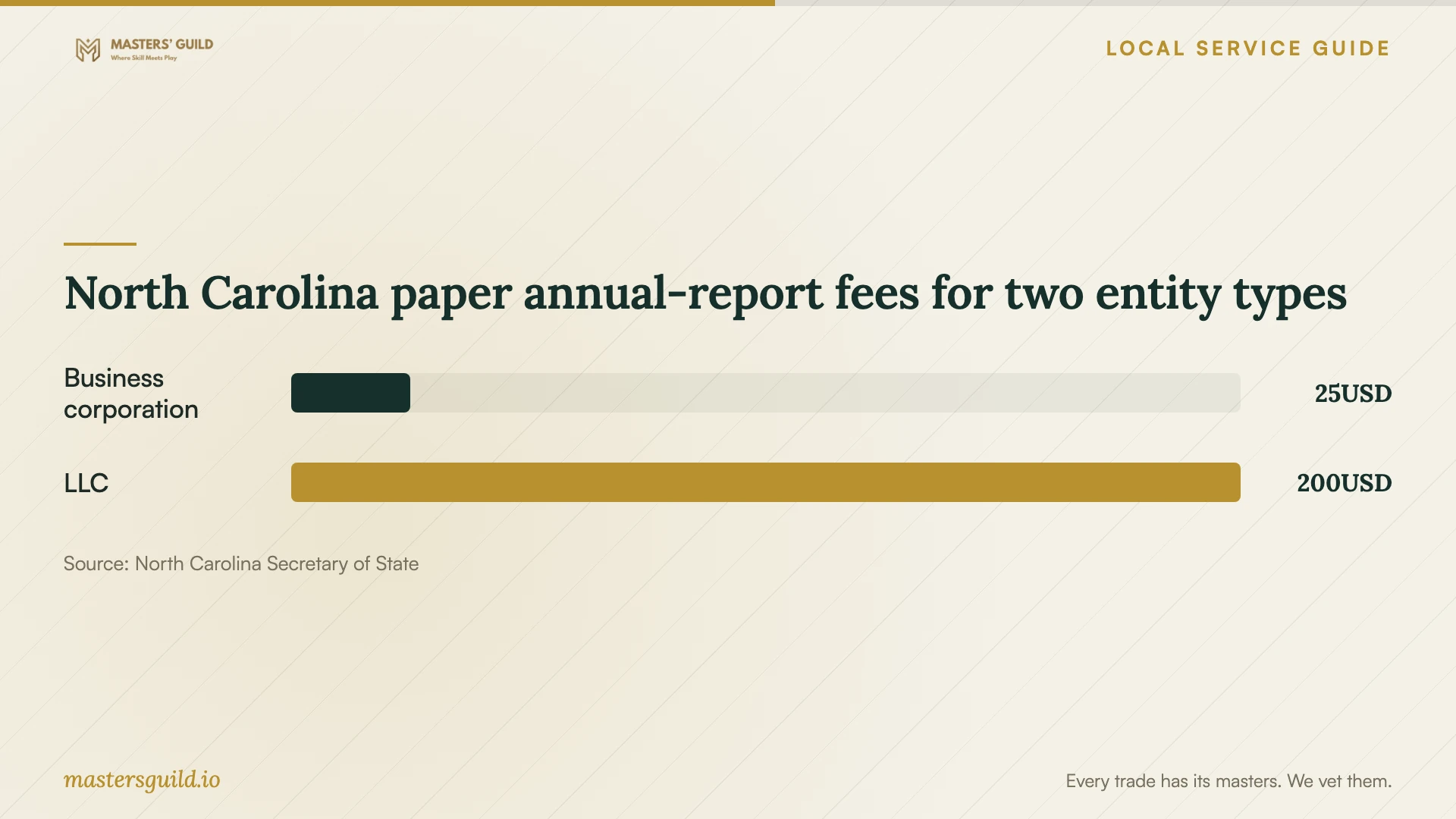
Include applicable state filing expenses in the operating budget. The North Carolina Secretary of State lists paper annual-report fees of $25 for business corporations and $200 for LLCs. LLC reports are due April 15 each year after the year of creation. Business corporations use the 15th day of the fourth month after their fiscal year ends. Confirm your entity type before applying either schedule. [3]
Compare proposals and agree on acceptance
Request quotes against the same brief. Compare the research tasks, spreadsheet detail, revision allowance, meetings, and handover materials. Ask for a redacted work sample and have the consultant explain how they developed its assumptions. Describe your industry and business stage, then ask which parts of your assignment they would handle themselves.
Agree on milestones for the outline, assumptions, draft, and final handover. Leave time for your review before the external deadline. Define acceptance in concrete terms: the requested sections are complete, you can trace financial inputs to their sources, and you receive the agreed editable files. Ask the consultant to document unresolved assumptions rather than fill gaps with unexplained figures.
Request a written quote and schedule for your defined assignment. Ask how the consultant charges for new research, changes to your business concept, or revisions requested by an outside reader. Separate those charges from any expenses you must pay to other parties. Confirm who will answer follow-up questions after handover and whether the quoted fee includes that work.
North Carolina paper annual-report fees for two entity types
Local details that affect your job
Mecklenburg County: choose your advising format
Central Piedmont’s Small Business Center offers free, confidential advising for Mecklenburg County entrepreneurs and small-business owners, with in-person, phone, and online meetings. Its listed location is the Levine IT Building at Central Campus, 1125 Charlottetowne Avenue. Choose the meeting format that fits your schedule and prepare questions about your plan or cash flow. [1]
UNC Charlotte: arrange an appointment for financing questions
The Charlotte SBTDC office lists financing, financial-performance, and market-opportunity assistance. It operates by appointment at the PORTAL Building, 9319 Robert D. Snyder Road, Suite 204A. Its service area includes Mecklenburg, Cabarrus, Union, and southern Iredell, among other listed counties. If your business operates outside Mecklenburg, check that coverage before choosing where to seek advising. [2]
Choose the next step for your plan
| Your situation | Suggested next step | Clarify before proceeding |
|---|---|---|
| You need feedback on a startup draft | Consider Central Piedmont’s free, confidential advising | Prepare the draft and questions about your assumptions |
| You need to examine financing or expansion | Arrange an appointment with the Charlotte SBTDC | Ask which listed financing or market services fit your business |
| You have requirements but need someone to produce the documents | Request a paid consulting proposal against your brief | Specify research, writing, spreadsheets, revisions, and editable files |
| You need an internal planning document | Draft your assumptions and identify specific review tasks | Decide which work you can complete and which questions need help |
Your hiring checklist
- Identify the plan’s intended reader and obtain their requirements.
- Prepare your draft, business concept, and unresolved questions for an advising session.
- Collect financial records and quotes; label assumptions that lack evidence.
- Request separate descriptions of research, writing, modeling, and review work.
- Agree on editable files, forecast detail, revision terms, and handover meetings.
- Confirm milestones and allow time to review before your submission deadline.
- Check your entity’s applicable annual-report expense and filing schedule.
Frequently Asked Questions
Can I get free business-plan help locally?
Central Piedmont’s Small Business Center offers free, confidential one-on-one advising for Mecklenburg County entrepreneurs and small-business owners, including business-plan refinement and cash-flow help. It offers in-person, phone, and online meetings. Ask what assistance fits your needs and prepare your draft for discussion. [1]
How much should I budget for a consultant?
Request a written quote and schedule for your defined assignment. Ask about revision limits, research expenses, and additional meetings. Compare proposals using the same deliverables so you can judge what each fee includes. Agree on how you will approve and pay for work outside the original scope.
Does a completed plan guarantee financing?
No. Do not treat a completed plan as a financing guarantee. Ask the intended funding recipient to explain its requirements and decision process. Define acceptance of the consultant’s work around what you can inspect: supported assumptions, complete sections, and usable financial files. Keep that acceptance separate from the recipient’s funding decision.
Do I need an annual report if my company had no activity?
For entities subject to annual reporting, the North Carolina Secretary of State says the report remains required while the entity exists, even if it did no business that year. The office also lists entity types exempt from annual reports. Check your entity type before budgeting a fee or setting a deadline. [3]
Sources and scope
This guide combines the sources below with practical planning guidance. Figures apply to the stated geography and period; request a written quote for your property.