
Local service guide
Snow removal in Charleston, WV: Hiring and Planning
Arrange snow removal in Charleston, WV by asking for a written quote that names the areas to clear, the snowfall trigger, the arrival window, ice-treatment charges, and return-visit terms. Give the provider photos of your driveway and steps, identify a snow-storage area, and explain when you need access. Ask how the crew will handle a blocked approach road and a new ridge of snow at the driveway entrance after public plowing.
Define the areas and equipment before comparing quotes
Send the same description to each provider: driveway dimensions, surface material, slope, turning space, parked-car locations, and the paths and steps you want cleared. Include photos of gates, retaining walls, low branches, and edges that snow could hide. Ask the provider to confirm whether its equipment can reach each area.
Separate driveway clearing from hand work and ice treatment in the quote. Name the route you need from the house to the car or street. If you need access for a caregiver or an early departure, state that requirement before booking and ask whether the provider can commit to it.
Compare the full charge for a storm
Ask for a total tied to your property and a clear billing unit. A visit-based quote should explain what triggers another charge. A storm-based quote should define when the storm ends and whether the crew makes multiple passes. For a seasonal agreement, request start and end dates, included services, exclusions, and cancellation terms.
Have the provider list separate charges for steps, deicer, compacted snow, driveway-entrance ridges, and moving or hauling stored snow. Ask how it authorizes extra work and whether the quoted total includes applicable taxes. Request proof of insurance and a written process for reporting damage.
Agree on a trigger and an arrival window
Write down the accumulation depth that starts service and where the provider measures it. Ask whether the crew clears during snowfall, after snowfall, or both. Set a separate arrangement for ice treatment when little snow accumulates, and ask who checks conditions between visits.
For state-maintained approach roads, account for WVDOH's route priorities. Crews treat major thoroughfares first, then secondary connections, then lower-volume local roads. During active snowfall, crews may return to major routes and delay work elsewhere. Ask your provider to explain its delay notification and rescheduling process rather than assuming a fixed arrival time. [1]
Plan for repeat clearing and the contract's end date
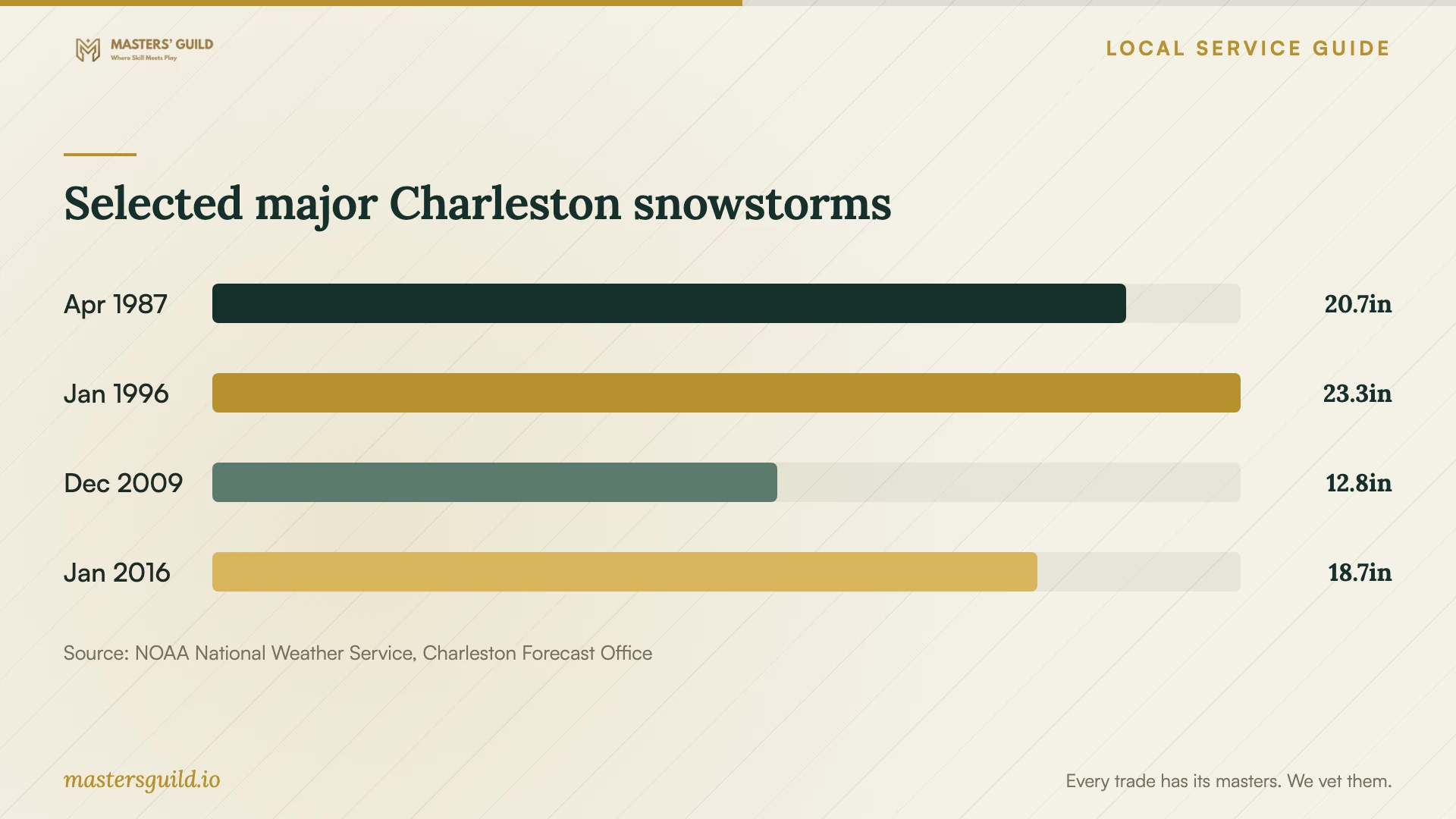
NWS lists Charleston storm totals of 23.3 inches for January 6-8, 1996, and 18.7 inches for January 21-23, 2016. Use these historical examples to ask about repeated passes, additional charges above the agreed trigger, and the point at which the provider would need to relocate stored snow. [2]
Check coverage outside the core winter months. Across the Charleston forecast office's regional area, NWS says snow occurs mainly during December through February but can occur from October into April or May. Charleston's own historical list includes a 20.7-inch storm on April 2-5, 1987. Ask how the provider handles a storm outside your contract dates. [2] [3]
Prepare the property and confirm completion
Before a visit, move vehicles as agreed, unlock gates, and mark driveway edges and obstacles. Choose a snow-storage area with the provider and identify places to keep clear, including your walking route, drains, utility equipment, and sightlines at the entrance. Ask how the crew will protect gravel, pavers, or other surfaces on your property.
Name the ice-treatment product and areas to treat in the agreement. Tell the provider about pets, plants, and surface-care instructions that affect product selection. After service, check the agreed access route and request a completion message or photo if you cannot inspect it. Report missed areas or damage through the agreed process.
Selected major Charleston snowstorms
Local details that affect your job
Separate city-street questions from state-road delays
For a city-street access problem, Charleston lists the Street Department at 304-348-6850 and says it accepts calls 24 hours a day, seven days a week. WVDOH publishes a separate winter priority system for state-maintained roads. Confirm who maintains your approach road before applying that policy, and give your private provider the road name when discussing access delays. [1] [4]
Request a late-season service option
Charleston's official historical storm list includes 20.7 inches on April 2-5, 1987. Ask a provider whose agreement ends before April to state whether it accepts later storm calls, how it prices them, and whether contract customers retain any scheduling preference. The historical event supports planning for that possibility; it does not establish how often you will need April service. [2]
Use your property's conditions when setting the trigger
NWS explains that terrain and elevation cause wide snowfall differences across its regional forecast area and notes that localized amounts can differ from county averages. Its site list identifies Charleston observations at Yeager Airport. Ask the provider to use an agreed measurement location for your property rather than treating an airport or regional total as your driveway's accumulation. [3]
Choose service terms around your access needs
| Your situation | Arrangement to discuss | Term to confirm |
|---|---|---|
| You can wait until snowfall ends | An on-demand clearing visit | Booking confirmation, arrival window, and total charge |
| You need access for a scheduled departure | A recurring agreement with an explicit access requirement | Whether the provider can meet your deadline and how it reports delays |
| Snow continues after the first clearing | Multiple passes during the storm | Whether each pass creates another charge |
| Public plowing leaves snow at the entrance | A driveway-entrance return visit | Whether the return visit is included and how to request it |
| Your agreement ends before spring | An option for service outside contract dates | Availability, billing, and scheduling terms |
Your hiring checklist
- Photograph the driveway, paths, steps, gates, and obstacles.
- Specify the clearing areas and snow-storage location.
- Record the snowfall trigger and measurement location.
- Confirm arrival windows, access-delay notices, and return visits.
- List ice treatment and extra charges in writing.
- Request insurance proof and damage-reporting terms.
- Confirm contract dates and service outside those dates.
Frequently Asked Questions
How much should I budget?
Request a property-specific written quote before setting your budget. Compare the same clearing areas and ask for the total under both a single-visit scenario and a storm requiring return visits. Include ice treatment, hand work, and entrance-ridge clearing in the comparison.
Can I expect the provider to arrive before the road clears?
Ask the provider to assess its route and explain what it can commit to. On state-maintained roads, WVDOH gives major routes priority and may return to them during active snowfall, delaying secondary and local roads. Put access-delay notifications and the revised arrival process in your agreement. [1]
Who can I contact about a blocked city street?
Charleston's Street Department lists 304-348-6850 and accepts telephone calls around the clock. Describe the street and access problem. For snow within your private driveway or walking route, use the service scope and contact process you agreed with your provider. [4]
Do the historic storm totals tell me how many visits I will need?
They do not establish a visit count for your property. NWS reports totals for historical Charleston storms, while its regional climatology explains variation with terrain and elevation. Agree on a property measurement location, service trigger, and repeat-clearing terms with the provider. [2] [3]
Sources and scope
This guide combines the sources below with practical planning guidance. Figures apply to the stated geography and period; request a written quote for your property.