
Local service guide
Bricklaying and Masonry in Charleston, WV
For Bricklaying and Masonry in Charleston, choose a contractor who explains the repair scope, proposed materials, access arrangements, and permit responsibility in writing. The city requires a permit before construction work begins, including repairs and maintenance. Before accepting a quote for older brick, ask how the contractor will establish mortar compatibility; for an original East End Historic District property, check the city's design review process before committing to exterior changes. [1] [2] [4]
Define the repair before requesting quotes
Give bidders photographs of the whole wall and close views of the areas that concern you. Describe where you see missing joints, damaged bricks, cracks, or moisture indoors. Include the approximate height and explain whether the contractor can reach the work from your yard, driveway, or a shared passage. Ask for an on-site assessment before agreeing to a repair method.
Ask the contractor to distinguish joint repair from brick replacement or rebuilding. For a leaning wall, displaced masonry, or loose material overhead, request an assessment of stability and ask whether an engineer should review the work. Keep people away from areas where material could fall, and avoid climbing to inspect a chimney yourself.
For new masonry, give each bidder the same proposed dimensions and intended use. Request a drawing or written description that identifies the wall, steps, or other structure to be built. Ask who will resolve questions about foundations, drainage, and connections to the existing building before construction starts.
Settle permits and contractor credentials
Charleston's Building Department lists repairs, maintenance, and retaining walls among the work it permits. The city tells homeowners not to obtain a permit on someone else's behalf because of possible legal issues. Ask your contractor to identify who will apply, provide the permit number before work starts, and arrange required inspections, including the final inspection. [1]
West Virginia's Contractor Licensing Act defines covered contracting to include compensated repair and related scaffolding when the undertaking costs $5,000 or more for residential work. Use that threshold as a prompt to check the contractor's state credential and scope with the licensing board. Ask the city about its contractor requirements as a separate step, including for a smaller repair. [3] [1]
Request proof of insurance and make sure the business name matches the written agreement. Ask who will perform the masonry work and who will supervise subcontractors. Keep copies of the quote, material specification, permit information, and agreed changes together so you can check the finished work against the contract.
Choose compatible materials for older masonry
For historic masonry, request an explanation of how the contractor will select replacement mortar. NPS describes historic mortar as a sacrificial material that helps moisture move through joints. Its research warns that harder, less permeable modern mortar can force moisture into historic brick or stone and cause cosmetic or structural damage. [4]
Ask whether the contractor recommends analyzing an existing mortar sample, and request the reason for that recommendation. NPS uses sampling and analysis to identify a compatible replacement recipe. Do not assume that a mortar choice suits your house because a bidder used it on another older building. [4]
Request a small sample area before authorizing broad repointing or replacement. Agree on the mortar color, texture, joint finish, and replacement brick appearance. Ask the bidder to describe how workers will remove existing mortar without damaging surrounding masonry, and include your sample approval in the agreement.
Compare the full cost and weather plan
Request an itemized quote that separates masonry work, material matching, scaffolding or other access, debris removal, and permit charges. Ask each bidder to state quantities and identify any areas they have excluded. For hidden damage, agree on how the contractor will document the discovery and obtain your approval for added work.
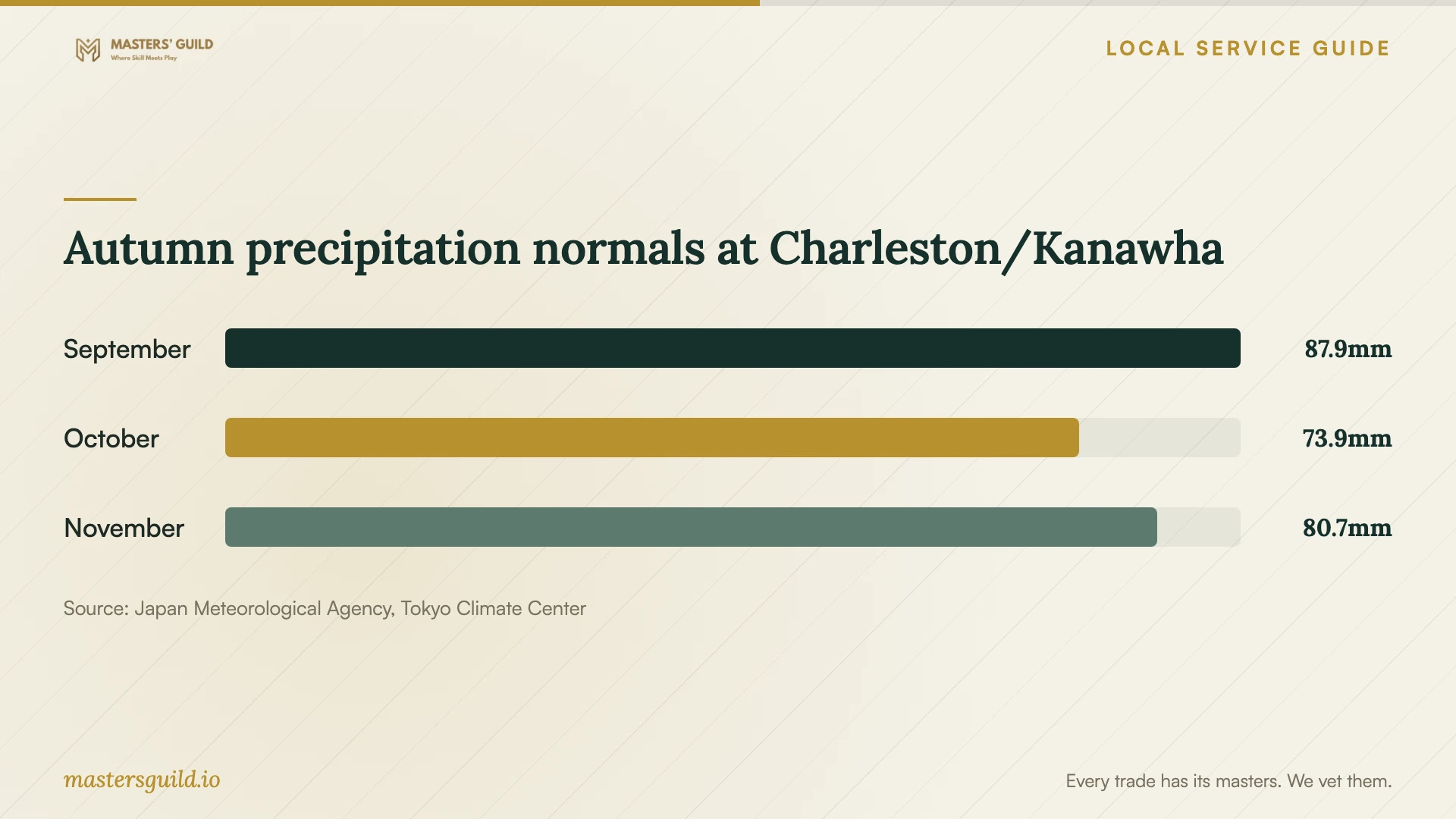
Ask for a proposed work window and a plan for protecting unfinished work. The Charleston/Kanawha station's published monthly normals include precipitation in each month; the chart compares three autumn months. Use those observations to discuss weather allowances, while asking the contractor to follow the requirements of the selected mortar and other materials. [5]
Avoid choosing a start date based on a promised number of dry days. Ask who will decide when conditions require a pause, how workers will protect the repair, and whether that protection carries a separate charge. Put the payment stages and completion criteria in writing before the crew arrives.
Autumn precipitation normals at Charleston/Kanawha
Local details that affect your job
Charleston permit application and small-job fees
Submit permit applications to the Permit Coordinator at the City Building Department, 915 Quarrier St Suite 5, Charleston, WV 25301. The Permit Office number is 304-348-6833. The city waives construction permit fees for total job costs up to $2,500, while stating that construction work requires a permit before starting. Confirm both the application and fee treatment for your repair rather than treating the waiver as permission to skip the permit. [1]
Original East End boundaries affect planning
The city distinguishes the original East End Historic District from its expansion and other nationally listed districts. Its preservation page says only properties within the original district undergo CHLC design review. Check your property's boundary with Planning and ask whether your proposed masonry work needs review before approving replacement materials or scheduling the crew. [2]
Match your situation to the next step
| Situation | Next step | Question for the bidder |
|---|---|---|
| Missing joints in older brick | Request a mortar compatibility assessment and sample area. | How will you select and document the replacement mortar? |
| Leaning wall or loose masonry overhead | Request a stability assessment before agreeing to surface repairs. | Should an engineer review the proposed repair? |
| Property in the original East End Historic District | Check CHLC design review before committing to exterior work. | Who will coordinate any required review? |
| Construction job costing up to $2,500 | Confirm the permit application despite the city's fee waiver. | Who will obtain the permit and arrange inspections? |
| Residential undertaking costing $5,000 or more | Check state contractor credentials against the covered contracting definition. | What credential covers this scope? |
Your hiring checklist
- Photograph the repair areas from a safe position and describe any interior moisture.
- Give each bidder the same scope and access information.
- Confirm permit responsibility and obtain the permit number before work starts.
- Check the property's historic review status before approving exterior changes.
- Request contractor credentials, insurance proof, and the name of the site supervisor.
- Agree on mortar and replacement brick samples before broad repairs.
- Put weather protection, change approvals, cleanup, and payment stages in writing.
Frequently Asked Questions
Does a small masonry repair need a Charleston permit?
The city states that construction work requires a permit before work begins and lists repairs and maintenance among permitted work. Its fee waiver for construction jobs costing up to $2,500 concerns fees. Confirm the application requirements with the Building Department before starting. [1]
Does every historic district require city design review?
Charleston's preservation page says only properties within the original East End Historic District undergo CHLC design review. Check the exact property boundary rather than relying on a neighborhood name or assuming the expansion follows the same process. [2]
Should I ask for the hardest available mortar?
For historic masonry, ask for a compatible mortar specification. NPS explains that harder, less permeable modern repairs can damage historic brick and stone by changing how moisture moves through the masonry. Ask the contractor to explain the proposed mix and whether analysis would help select it. [4]
How can I compare quotes with different totals?
Ask bidders to price the same repair areas and identify quantities, materials, access arrangements, cleanup, and exclusions. Request a written process for approving hidden damage. If one bidder proposes rebuilding and another proposes joint repair, ask each to explain the assessment behind that scope.
Sources and scope
This guide combines the sources below with practical planning guidance. Figures apply to the stated geography and period; request a written quote for your property.