
Local service guide
Tree Cutting and Arborist Services in Charleston
Arrange Tree Cutting and Arborist Services by checking city removal approval and contacting your electric provider about nearby lines before setting a cutting date. Hire an arborist to assess a tree you want to retain, then compare written scopes for pruning or removal. Within City of Charleston limits, review the tree's diameter, property use, acreage, and buffer location. Include contractor debris removal in the agreement. [1] [3] [4]
Choose the assessment before the cutting scope
Describe the problem you want to solve: a limb over the roof, concern about tree condition, clearance for a project, or removal. Have the assessor explain whether pruning could meet your goal and which branches they recommend retaining. Separate the assessment, written report, and cutting work in the quote so you can decide what to authorize.
Charleston's Zoning Administrator may require qualified arborist documentation when staff question whether a tree is hazardous, diseased, irreparably injured, or causing damage to a habitable building that cannot be remedied without removal. The city names an International Society of Arboriculture certified arborist or an otherwise qualified arborist. For those questions, establish whether your assessor can prepare a report for city review. [1]
Identify who will assess the tree and who will supervise the crew. Obtain liability insurance and workers' compensation documentation, then have the insurer clarify coverage for the proposed work. Discuss equipment setup and protection of the roof, fences, driveway, and trees you intend to keep.
Check removal rules against your parcel
Establish the parcel's jurisdiction before applying City of Charleston guidance. The city defines Protected Trees as trees at least 8 inches in diameter at 4.5 feet above grade, except multi-stem crepe myrtles. It defines Grand Trees as trees at least 24 inches in diameter at that height, excluding pines and sweet gums. Have zoning staff resolve uncertain species or measurements. [1]
The city's guidance exempts trees under 24 inches from removal permits on lots zoned Single-Family Residential or Single and Two Family Residential, or used exclusively for single-family or duplex dwellings. It also requires residentially zoned lots of at least one acre, commercially zoned lots, and lots with three or more dwelling units to maintain 15 Protected Trees per acre. For those properties, the city says a permit is unnecessary if the property can maintain that number. [1]
Before relying on an exception, give zoning staff the acreage, property use, remaining tree information, and possible buffer location. Charleston says pruning Grand or Protected Trees does not require a permit, but directs a qualified tree service to use the National Arborist Association's Pruning Standards for Shade Trees. Put the branches and pruning objectives in the work agreement. [1]
Coordinate electrical clearance with the utility
Contact your electric provider before arranging work near wires. Dominion says only utility line-clearance contractors meeting OSHA qualifications may work within 10 feet of power lines or on a tree with branches within 10 feet of those lines. Have the provider determine the coordination needed before hiring a crew for that work. [3]
If Dominion serves your home, discuss the service line with it. Dominion says it does not remove live or dead trees on or near the service line to a residence or business. It offers disconnection at no cost so the owner or contractor can remove limbs or trees safely. Coordinate that appointment with the contractor rather than assuming the crew can proceed around an energized line. [3]
Clarify cleanup after utility work. Dominion says larger limbs and trunks remain on the landowner's property under its described maintenance and hazard-tree practices, and it assigns storm tree debris to the property owner. Include any remaining wood in your private contractor's cleanup scope. [3]
Compare quotes and prepare the work area
Give each bidder the same identified trees and desired outcome. Compare cutting, equipment, stump treatment, hauling, disposal, and surface restoration as separate items. For grinding, specify depth, removal of grindings, and who will fill the area. Agree on how you will authorize additional charges before signing.
Charleston says contractors must remove and dispose of debris they generate within the city, including tree-surgeon and landscaping waste. Its resident yard-waste preparation instructions do not replace that obligation. Have the agreement name the contractor responsible for hauling and disposal. [4]
Walk the access route with the crew leader. Point out gates, irrigation, paving, and areas where you want to prevent equipment traffic. Decide who will move obstacles and how you will handle wet-ground delays. Before accepting completion, compare the finished work and cleanup with the agreed scope.
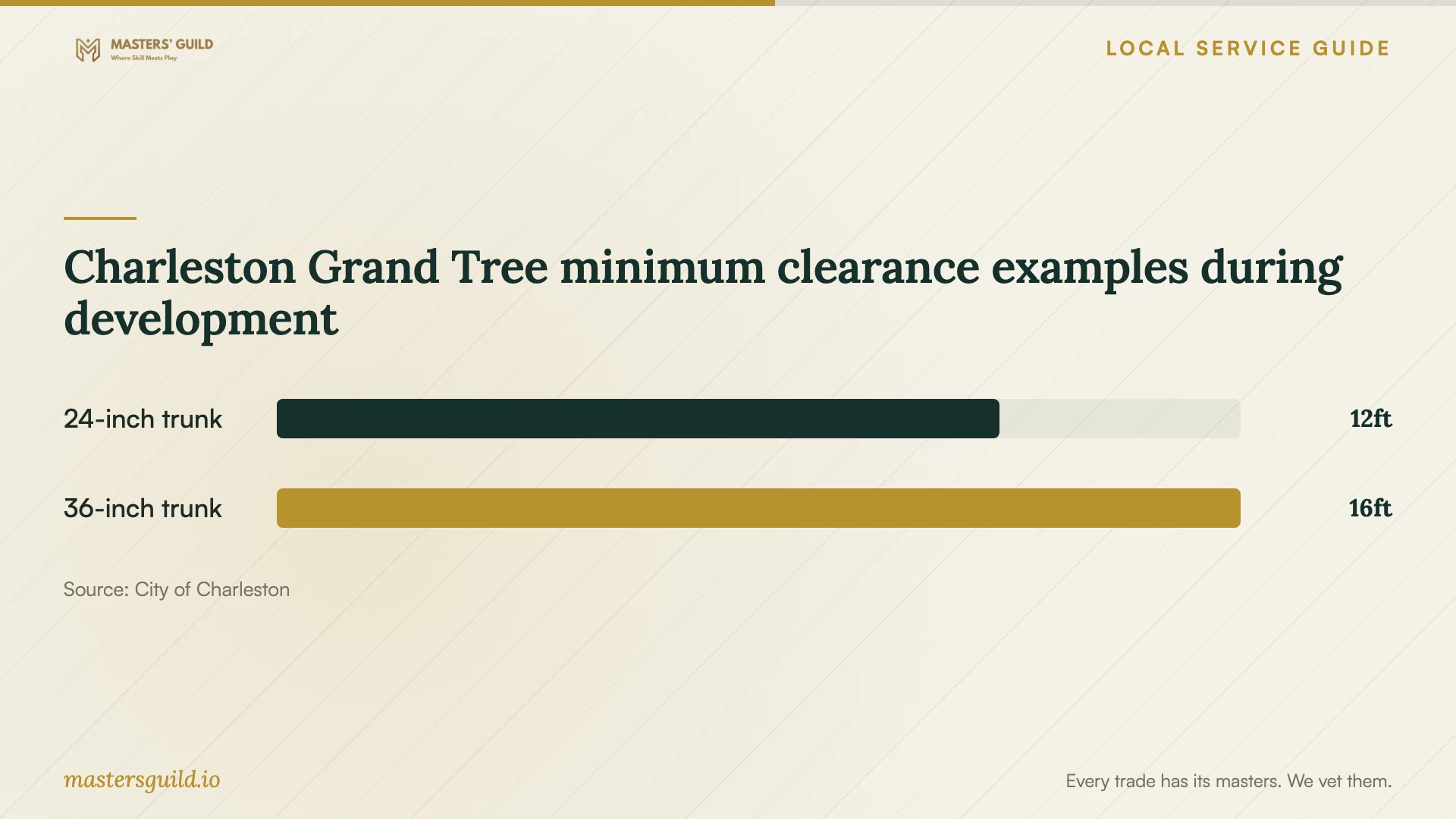
Charleston Grand Tree minimum clearance examples during development
Local details that affect your job
Prepare the city inspection application
The Tree Removal Request form collects the address and TMS number, applicant and owner details, species, diameter at 4.5 feet above grade, location on the lot, and reason for removal. The city directs applicants to mark requested trees with ribbon or tape and allows uploads of photos, arborist reports, and supporting documents. Zoning staff state they will contact you with inspection results within 17 business days of the request. Treat that as the stated inspection response period, not a promised approval or cutting date. [2]
Resolve buffer location before authorizing removal
Charleston's guidance says trees in the critical line buffer are not permitted to be removed. Its OCRM Critical Line Buffer answer refers readers to zoning sections 54-347.1 and 54-348. Have zoning staff establish the tree's location and applicable requirements before authorizing work. On Daniel Island, the city identifies Board of Zoning Appeals Site Design approval for removal of trees at least 8 inches in diameter within the Visual Buffer Zone when specified conditions apply. [1]
Protect a retained Grand Tree during a project
If you plan construction alongside tree work, Charleston specifies a protective zone around retained Grand Trees that excludes land disturbance, impervious surfaces, stored materials, debris, vehicles, and heavy machinery. The city specifies a barrier at least 4 feet high. Review the chart's published clearance examples with the contractor when planning equipment access, storage, or a new paved surface. [1]
Choose the next step before cutting
| Situation | Next step | Reason |
|---|---|---|
| Staff question hazard, disease, irreparable injury, or specified building damage | Discuss an arborist report with zoning staff | The city may require qualified arborist documentation for these removal-condition questions. |
| Removal needs city review | Complete the Tree Removal Request | The city states contact with inspection results within 17 business days. |
| Branches lie within 10 feet of power lines | Contact the electric provider | Dominion specifies qualified utility line-clearance contractors under this condition. |
| Removal involves a Dominion service line | Coordinate disconnection with Dominion | Dominion offers a no-cost disconnection for safe owner or contractor work. |
| A hired crew will generate tree debris within city limits | Include contractor hauling and disposal | Charleston assigns removal and disposal of that debris to the contractor. |
Your hiring checklist
- Establish the parcel's jurisdiction, zoning, acreage, and possible buffer location.
- Identify each tree and have the assessor verify species and trunk diameter.
- Decide whether you need an assessment, a report for city review, pruning, or removal.
- Resolve required city approval and utility coordination before setting the cutting date.
- Obtain insurance documentation and identify the crew supervisor.
- Compare matching scopes for stump treatment, hauling, access protection, and restoration.
- Agree on weather delays, additional-charge approval, and the completion walkthrough.
Frequently Asked Questions
Does a hazardous tree qualify for removal?
Charleston says it will approve removal of qualifying hazardous, diseased, or irreparably injured Protected and Grand Trees, and trees causing damage to a habitable building that cannot be remedied without removal. For work requiring approval, follow the inspection process before cutting. Staff may require qualified arborist documentation when they question those conditions. [1]
Can I prune a Grand Tree without a permit?
Charleston says a pruning permit is unnecessary for Grand or Protected Trees. The city directs a qualified tree service to follow the named National Arborist Association pruning standards. Have the contractor document the proposed branches and objectives before work. [1]
Will city crews collect my contractor's branches and logs?
Charleston says the contractor must remove and dispose of debris it generates. Include hauling in the agreement rather than arranging municipal curbside collection for the hired crew's waste. [4]
How should I budget for the job?
Obtain a site-based written quote that separates assessment, cutting, equipment, stump treatment, disposal, and restoration. Give bidders the same scope and have each explain which circumstances could change the total. Decide which optional work you want before comparing prices.
Sources and scope
This guide combines the sources below with practical planning guidance. Figures apply to the stated geography and period; request a written quote for your property.