
Local service guide
Tax Preparation and Accounting in Charleston, SC
Arrange Tax Preparation and accounting in Charleston by asking for a written scope that covers your income-tax returns, bookkeeping cleanup, and applicable city and county filings. Check the preparer's IRS Preparer Tax Identification Number, verify any claimed CPA credential, and name who will handle each filing and payment. The IRS requires a PTIN for paid tax preparation; South Carolina allows nonlicensees to prepare tax returns, so choose credentials and experience that fit the work. [4] [5]
Choose help that matches your business
Start the conversation with your business activity, ownership structure, locations, employees, and the condition of your records. Ask whether the candidate has handled your type of return and the bookkeeping software you use. Request an explanation of how they would divide the work between tax preparation, record cleanup, and ongoing accounting.
The IRS recognizes several types of preparers, including CPAs, enrolled agents, attorneys, and preparers without a professional credential. A PTIN permits paid preparation but does not identify a particular level of education or expertise. Use the IRS credentialed-preparer directory as one check, then ask the candidate about the work you need. [5]
If you need an audit, review, compilation, or another report on financial statements, describe that requirement before requesting a quote. South Carolina regulates attest and compilation work and the use of the CPA title. The Board also requires firm registration in specified circumstances, including a sole proprietor using CPA in the firm name or providing attest or compilation services. Check the individual credential and any applicable firm registration. [4]
Get a quote you can compare
Ask for a written list of returns, reporting periods, and business locations covered by the fee. Separate the annual return from monthly bookkeeping, payroll work, sales-tax filings, and local reporting. Ask whether the accountant will prepare forms, submit them, arrange payments with your approval, or leave those steps to you.
For cleanup work, describe the missing months, unreconciled accounts, and personal transactions mixed into business accounts. Request a separate estimate and an approval point before the accountant exceeds it. For recurring work, agree on the reports you will receive and the date you will receive them.
Ask what happens after filing: who answers a notice, what that service costs, and who holds copies of your returns and supporting records. Agree on a secure document-transfer method and the person who will answer your questions. These details give you a basis for comparing proposals without relying on a headline fee.
Prepare records before the accountant starts
Gather prior returns, current bookkeeping reports, bank and credit-card statements, income documents, payroll reports, and notices. Identify missing records rather than asking the preparer to infer transactions. Give the accountant a list of opened, closed, or moved locations and explain any ownership changes.
For county property reporting, gather your federal and state depreciation schedules and a location-by-location asset list. Charleston County's form asks for original cost, accumulated depreciation, and net book value for furniture, fixtures, and equipment. Its instructions exclude leased or rented property from the original-cost entry and exclude state- or federally licensed property such as motor vehicles and watercraft. [2]
Ask the accountant to review the asset information against the county's instructions. The form caps depreciation at 90% of original cost, sets a minimum net book value of 10%, and requires a written explanation for zero values. Avoid substituting a guessed resale value for the requested figures. [2]
Agree on deadlines and responsibility
Before signing, agree on your document-delivery date, the accountant's review date, and who will authorize submission. Ask them to identify outstanding filings and any deadline that requires attention before the rest of the work. Request a filing calendar that names a responsible person for each obligation.
Keep city licensing and county property reporting as distinct tasks. Charleston city business licenses expire on April 30, while the Charleston County Auditor requires the business personal property valuation report on or before April 30. The county states that a return postmarked after that date triggers a 10% penalty on the assessment. [1] [2]
If you sell prepared food or beverages within the city, ask whether the engagement includes hospitality-tax reporting. The city publishes a 2% hospitality tax on the specified gross proceeds, due on the 20th of each month, and a 25% late fee for payments submitted after the 20th. Have the accountant confirm how the rule applies to your activity. [1]
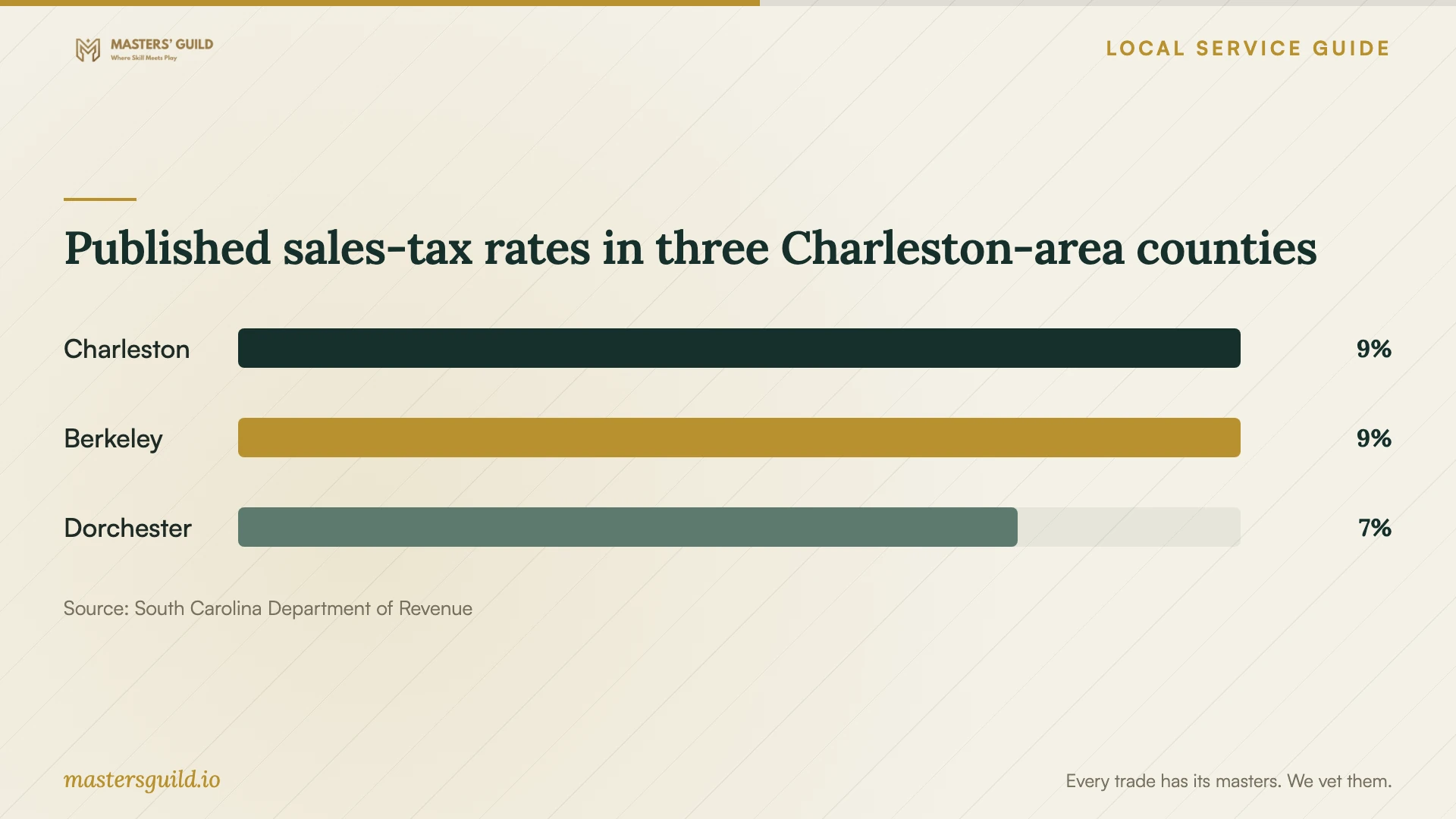
Published sales-tax rates in three Charleston-area counties
Local details that affect your job
City license work depends on where you earn income
Charleston requires a business license for businesses operating or generating income within city limits, including businesses without a physical city location. The city bases annual fees on gross income and the NAICS rate class; for businesses located outside city limits, it uses the prior year's income collected inside the city. Give your accountant a breakdown of city receipts and ask whether license renewal is included. For city process questions, Revenue Collections lists 843-724-3711. [1]
County asset reporting needs its own deliverable
The Charleston County Auditor requires separate business personal property returns when property sits at more than one location. Ask your accountant to quote each applicable location and gather depreciation documentation before preparation. Confirm who will submit the return and retain proof of submission; an income-tax engagement should spell out whether it includes this county form. [2]
Metro sales-tax setup requires an address check
SCDOR's table for May 1, 2026 and after lists Charleston County at 9%, Berkeley County at 9%, and Dorchester County at 7%. SCDOR also directs readers to an address-based rate search and notes that industries and municipalities may have additional sales taxes. If you sell from multiple locations, ask the accountant to check each address and applicable transaction type before configuring tax collection. [3]
Match the engagement to your task
| Your task | Ask for | Confirm before hiring |
|---|---|---|
| Income-tax preparation | A preparer with a PTIN and relevant experience | Which federal and state returns the fee covers |
| Monthly bookkeeping | A defined reconciliation and reporting scope | Cleanup charges, report delivery dates, and software access |
| City and county reporting | Named business-license and property-return deliverables | Applicable locations and who submits each form |
| Attest or compilation services | A provider qualified under South Carolina accountancy rules | Individual credentials and applicable firm registration |
Your hiring checklist
- Describe your business activity, ownership structure, and each operating location.
- Ask for the preparer's PTIN and verification of any claimed professional credential.
- List the returns and reporting periods you want included in the quote.
- Separate cleanup costs from recurring bookkeeping and annual preparation.
- Gather depreciation schedules and identify assets by location.
- Assign responsibility for submission, payment approval, and filing confirmations.
- Agree on document delivery, review dates, and notice-support charges.
Frequently Asked Questions
Do I need a CPA for a business tax return?
South Carolina allows nonlicensees to prepare tax returns, and the IRS requires paid preparers to have a PTIN. Ask about experience with your business and verify any credential the preparer claims. Specify attest or compilation work at the outset because South Carolina regulates those services. [4] [5]
Does an annual tax-preparation quote include local filings?
Ask the provider to name them in writing. City business-license work and the county business personal property return have separate requirements. Request a line item for each applicable filing, with preparation, submission, and payment responsibilities stated. [1] [2]
Can I use one sales-tax rate across the Charleston area?
Check each address and transaction type. SCDOR's current table lists different county rates: Charleston and Berkeley at 9%, and Dorchester at 7%. The agency notes additional industry and municipal taxes and provides an address-based rate search. [3]
Sources and scope
This guide combines the sources below with practical planning guidance. Figures apply to the stated geography and period; request a written quote for your property.