
Local service guide
Plumbing services in Charleston, SC: Hiring Guide
Arrange Plumbing services by matching the plumber to your repair, checking their license and requesting a written scope before approving work. South Carolina requires a license for residential plumbing work exceeding $500. For a household sewer backup, confirm your sewer provider and contact that provider or a plumber without delay. If Charleston Water System provides your sewer service, its backup guidance gives 843-727-6800 as the contact number. [1] [2]
Match the plumber to your repair
Describe the problem before asking for a price: which fixtures have symptoms, where you see water and when the problem started. Send photos of accessible pipes, the fixture or the water heater label. Ask whether the plumber will quote a diagnosis first or can define the repair from that information.
Request the license number, the name of the person responsible for the work and proof of insurance. South Carolina’s Residential Builders Commission states that residential plumbing work exceeding $500 requires a license. Use the Licensee Lookup linked from its Residential Plumber License page to check the credential. Ask the contractor to explain how their license covers your proposed work. [1]
For a fixture replacement, specify who supplies the fixture and removes the old one. For concealed leaks, ask how the plumber will locate the leak, gain access and coordinate wall or floor repair. For a water heater, include the proposed model, removal, connections and any separately priced work in the written scope.
Identify your sewer provider before reporting a backup
Confirm who provides sewer service to your property. CWS advises its customers with wastewater backing up into drains or toilets to contact it at 843-727-6800 or a plumber immediately. CWS explains that a blockage can occur in private plumbing or its sewer main in the street. If another utility serves you, contact that provider or a plumber without delay. [2]
For wastewater overflowing a manhole on the CWS system, report the location to CWS and keep clear of the affected area. For another sewer system, report it to the responsible provider. CWS identifies heavy rainfall, sewer blockages and pump station problems as possible causes of overflows and advises avoiding contact with stormwater during heavy rainfall. [2]
Locate your sewer cleanout without opening it and tell the plumber where it is. CWS advises keeping cleanouts marked and accessible, replacing damaged caps to prevent debris entry and watching for tree-root damage to private sewer lines. Ask the plumber to document the condition they find and explain their recommendation before you approve excavation or replacement. [2]
Settle permits and access before scheduling
For property within City of Charleston jurisdiction, consult the city’s Applications & Guidelines page. The city lists residential standalone applications and sub-permits for plumbing, plus separate fuel-gas applications. Ask the plumber and permit staff which route applies to your scope. The application list does not establish whether a particular repair requires a permit. Outside city jurisdiction, ask your responsible permitting office. [3]
Write down who will submit applications, pay fees, arrange inspections and provide completion records. If the work includes gas connections, ask the contractor to address that scope separately. The City of Charleston’s non-licensed owner permit option excludes fuel-gas work. [3]
Show the plumber cabinets, stored items, paving or landscaping around the work area. Ask how long to plan for a water shutoff, what you need to move and who will restore disturbed surfaces. Agree on how the contractor will seek approval for additional work after opening a wall or exposing a pipe.
Compare complete quotes and separate utility charges
Compare quotes for the same scope. Ask each plumber to separate diagnosis, labor, materials, equipment, permit handling, disposal and restoration. Request the initial visit charge and terms for additional work. For drain work, ask whether the quote covers clearing alone or includes an inspection and written findings.
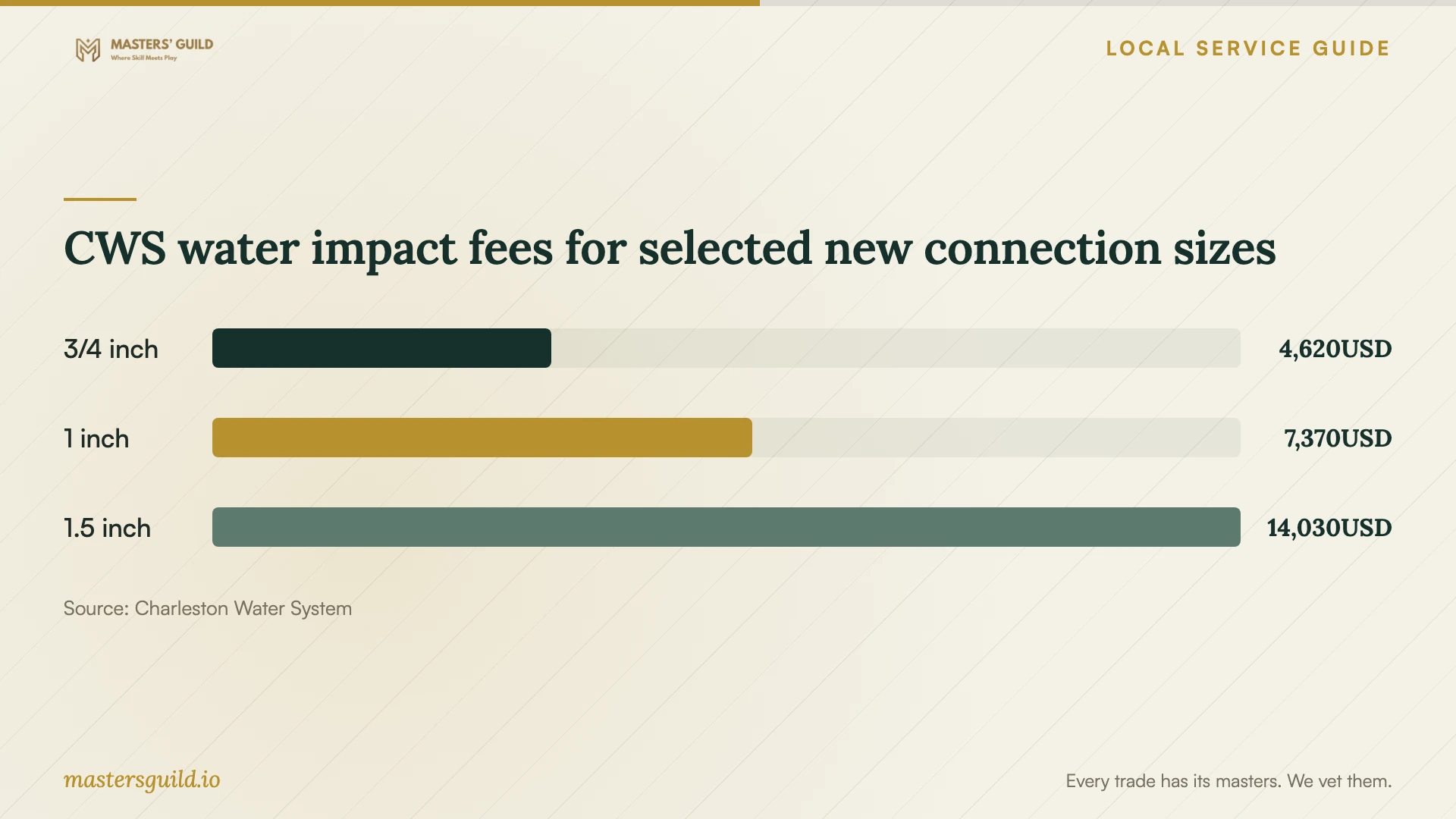
If your project includes a new CWS connection, budget utility charges separately from the plumber’s work. CWS applies tap and impact fees to new connections. It bases water impact fees on tap size and residential sewer impact fees on Equivalent Residential Units. The chart shows selected water impact fees, which represent one part of a connection budget. [5]
Ask CWS to confirm the required service size and applicable charges before approving a new CWS connection scope. Its published schedule excludes account origination fees and includes engineering service fees within impact fee totals. These figures do not establish prices for faucet repairs, drain clearing or water heater replacement. For another utility, request that provider’s applicable charges. [5]
CWS water impact fees for selected new connection sizes
Local details that affect your job
Seek CWS authorization before eligible clay lateral work
CWS offers its vitrified clay pipe lateral grant across its system and gives West Ashley applicants priority because of known infiltration and inflow problems. Eligible single-family residential sewer customers must meet the income limit and replace the full service lateral; repairs and partial replacements do not qualify. Apply and obtain CWS authorization before arranging the grant-funded scope. CWS requires completion within one year of the application date, an itemized plumber receipt, material lengths and before-and-after photos. It reimburses up to $2,000 per homeowner, capped at actual replacement cost. CWS allocates $50,000 per calendar year and ends the program December 31, 2030. Confirm eligibility and available funding before including reimbursement in your budget. [4]
Confirm city jurisdiction and the application route
For property within City of Charleston jurisdiction, the city provides residential standalone and project sub-permit routes for plumbing. It lists fuel-gas applications separately and excludes fuel gas from its non-licensed owner permit option. Before booking an installation, ask city permit staff to confirm the route for your address and proposed work, then name the person responsible for filing and inspections in the contract. If the property falls outside city jurisdiction, confirm requirements with its responsible permitting office. [3]
Choose your next step
| Situation | First step | Question before approving work |
|---|---|---|
| Wastewater backs up into drains or toilets | Confirm your sewer provider and contact that provider or a plumber without delay. CWS sewer customers can call 843-727-6800. | Who will determine whether the blockage involves private plumbing or the provider’s street main? |
| Wastewater overflows a manhole | Avoid the affected area and report it to the responsible sewer provider. For CWS infrastructure, call 843-727-6800. | Have you given the provider the location? |
| You plan a plumbing installation | Within City of Charleston jurisdiction, confirm the city’s standalone or sub-permit route. Elsewhere, consult the responsible permitting office. | Who will file, arrange inspections and provide completion records? |
| You plan full clay lateral replacement as a CWS sewer customer | Ask CWS about grant eligibility and obtain authorization before arranging grant-funded work. | Does the quote include the full lateral and required documentation? |
| You need a new CWS utility connection | Confirm service requirements and tap and impact fees with CWS. | Which utility charges sit outside the plumber’s quote? |
Your hiring checklist
- Record affected fixtures, visible damage and when the problem started.
- Confirm your sewer provider before reporting a sewer problem.
- Request the contractor’s license number and proof of insurance.
- Ask who will diagnose the problem and document findings.
- Confirm permit requirements with the office responsible for your address.
- Get a written scope covering materials, access, removal and restoration.
- Agree on approval procedures for additional charges.
- Keep estimates, approvals, receipts, photos and completion records together.
Frequently Asked Questions
Does a residential plumber need a South Carolina license?
South Carolina requires a license for residential plumbing work exceeding $500. Ask for the license number and use the regulator’s Licensee Lookup to check the credential before approving the work. [1]
Should I call the utility or a plumber for a sewer backup?
Confirm your sewer provider and contact that provider or a plumber without delay. For CWS sewer customers, CWS advises calling 843-727-6800 or a plumber immediately when wastewater backs up into household drains or toilets. CWS identifies private plumbing and its street main as possible blockage locations. Ask who will locate the problem before you approve a permanent repair. [2]
Can the clay sewer lateral grant pay for a partial repair?
CWS excludes repairs and partial replacements. Its program covers eligible full service lateral replacement and may consider full lateral cured-in-place lining case by case. Ask CWS to authorize participation before arranging the work. [4]
Are utility impact fees part of an ordinary repair price?
CWS applies tap and impact fees to new connections. These published fees do not establish ordinary repair prices. If your project includes a new CWS connection, ask CWS which charges apply and ask the plumber whether their estimate includes them. [5]
Sources and scope
This guide combines the sources below with practical planning guidance. Figures apply to the stated geography and period; request a written quote for your property.