
Local service guide
Legal Document Preparation in Charleston, SC
For Legal Document Preparation in Charleston, identify your intended outcome and agree who will advise you, review the draft, arrange signing, and handle filing or recording. Choose legal counsel for estate planning, as Charleston County Probate Court advises. Request a written scope separating professional fees from government charges. Bring existing powers of attorney for counsel to assess before replacing them. [1]
Define the document and the help you need
Describe your intended outcome before requesting a price: arranging financial help during incapacity, preparing an estate plan, opening a relative’s estate, or completing a property transaction. Bring existing documents and explain missing originals, disagreements, and deadlines. Ask counsel to identify the appropriate documents before choosing a package.
Charleston County Probate Court recommends legal counsel for estate planning and says its staff cannot provide legal advice. The court provides samples of statutory living will and health care power of attorney documents as a public service. Use those samples to prepare questions for counsel about your circumstances. [1]
Name the tasks you want the provider to complete. Include consultation, drafting, review of existing papers, revisions, signing arrangements, copies, and submission where relevant. Request the responsible attorney’s name and a contact for questions after signing. Ask who will correct an error discovered during filing or recording.
Compare scope, charges, and completion dates
Request an itemized quote naming each document and the attorney’s role. Clarify whether the provider charges a fixed fee or bills for time, how revisions affect the price, and whether signing and recording require separate appointments. For a package, request the document names and included tasks.
The Estate Division’s published instructions list an opening filing fee of $25 to $95 based on probate asset value and creditor-publication charges of $40 to $120. The court also describes later inventory-related court costs. These published figures do not establish current payable amounts or a complete estate budget. Confirm the applicable charges and case requirements with the court before payment. [1]
Agree on dates for receiving the draft, returning corrections, signing, and submitting documents. Give the provider your actual deadline and request a list of information they need from you. Decide who will check names, addresses, and asset descriptions before the signing appointment. Request confirmation of submission as part of the agreed scope.
Check which power of attorney rules apply
The South Carolina Uniform Power of Attorney Act took effect January 1, 2017. Section 62-8-403 preserves applicable prior law for powers created or restated before that date. Section 62-8-103 excludes certain powers, including specified government forms and financial-institution forms intended for use solely by that institution. Have counsel determine the governing law before applying the Act’s signing, recording, or termination rules to your document. [2]
For a power of attorney whose execution must comply with Section 62-8-105, the statute requires the principal’s signature or a directed signature in the principal’s presence, witness formalities matching a South Carolina will, and acknowledgment or proof under Section 30-5-30. Have counsel arrange the requirements that apply to your document. Section 62-8-106 recognizes qualifying out-of-state executions, so bring the existing document and its signing details for assessment. [2]
For powers governed by the Act, Section 62-8-109 prevents an agent from exercising authority after the principal’s incapacity until the required recording. For a South Carolina resident, that section specifies recording in the county where the principal resides when recording occurs. Ask counsel whether this rule applies to your document, who will record it, and who will deliver your recorded copy. [2]
For powers governed by the Act, Section 62-8-201 requires express authority for actions including gifts, beneficiary changes, and specified trust actions, subject to other restrictions. Discuss the powers you intend to grant and their limits with counsel. Section 62-8-110 states that a power governed by the Act terminates when the principal dies. [2]
Assign responsibility for property documents
South Carolina Bar Ethics Advisory Opinion 05-18 advises attorneys handling limited real estate closing work to obtain assurances about attorney supervision of other transaction phases, including recording and disbursement. The committee discusses judicial decisions, but its opinion is advisory and the committee has no disciplinary authority. [4]
For a closing involving several firms, request the attorney’s name for each phase: title review, document preparation, closing, recording, and disbursement. Clarify who will confirm recording and send the final papers. Include those responsibilities when comparing service scopes, and ask whom to contact if the receiving office returns a document.
For inherited real estate, the Estate Division recommends attorney assistance with a Deed of Distribution. Its published instructions direct an attorney preparing a deed for Charleston County property to record it and provide the Probate Court with a recorded copy. For a non-attorney-prepared deed, the instructions direct submission of the original to the Probate Court for forwarding to the Register of Deeds. Confirm the applicable route with counsel and your assigned clerk. Property in another county requires recording in that county. [1]
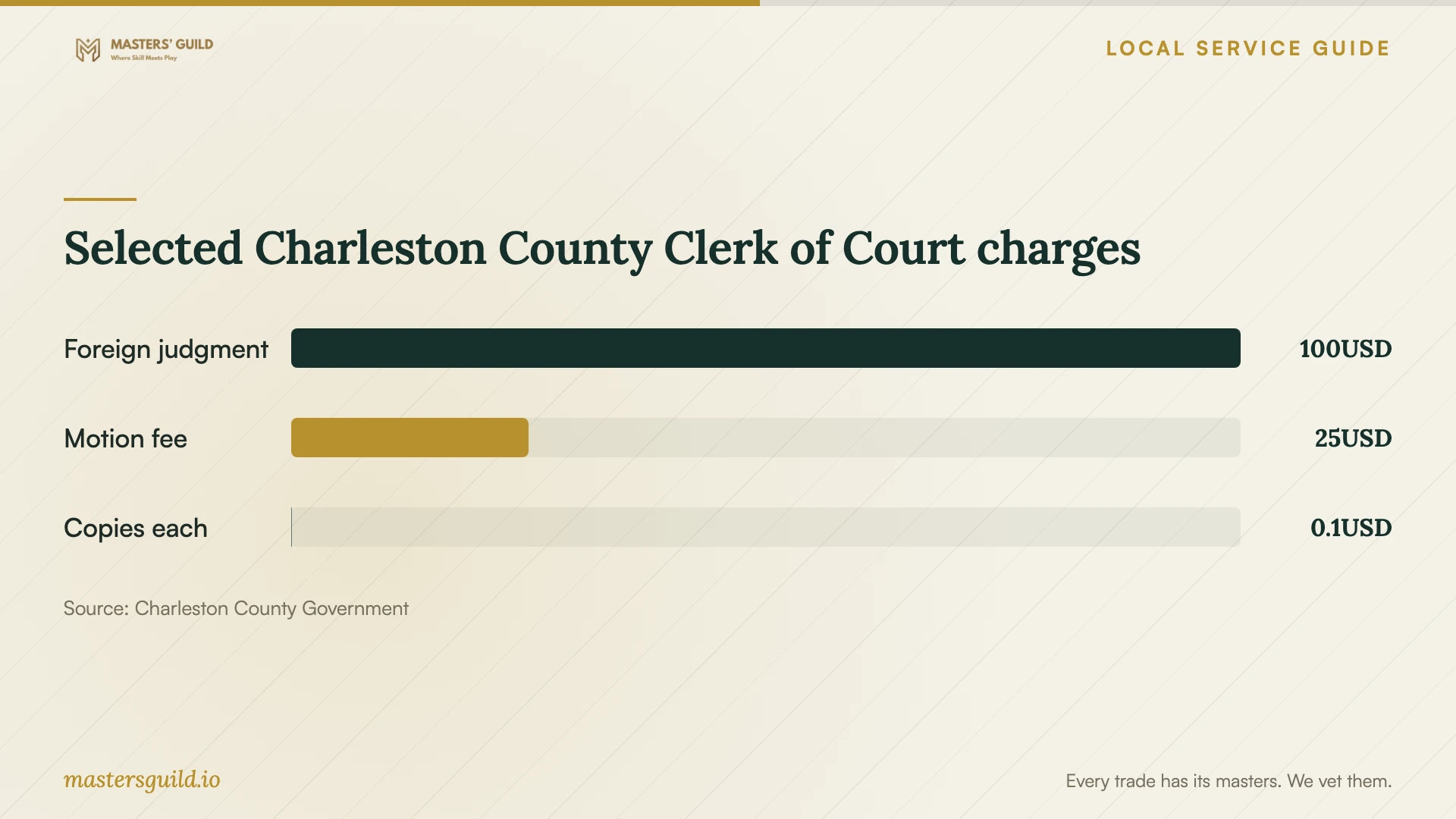
Selected Charleston County Clerk of Court charges
Local details that affect your job
Confirm the estate appointment and required originals
The Estate Division instructs applicants to file an informal estate application in the county where the deceased was a permanent resident. Its office is on the third floor of the Historic Courthouse at 84 Broad Street. Call 843-958-5030 before visiting to confirm the documents for your case; the court encourages an appointment. Its opening instructions identify Form 300ES, the original death certificate, and the original will if applicable. Confirm venue before paying someone to prepare a Charleston County filing. [1]
Schedule recording before the walk-in cutoff
The Register of Deeds operates at 101 Meeting Street, Suite 200, with listed Monday through Friday hours of 8:30 a.m. to 5 p.m. Staff do not record walk-in documents after 4:30 p.m. Account for that cutoff when arranging an afternoon signing and delivery. The office provides certified copies of recorded documents, including powers of attorney, and states that staff do not advise on executing its sample forms. [3]
Choose help for the document task
| Your task | Help to arrange | Question before booking |
|---|---|---|
| Estate planning | Legal counsel, as the Probate Court advises | Which documents, revisions, and signing arrangements does the quote include? |
| Opening an informal estate | Form 300ES preparation and collection of required originals | Have we confirmed the deceased’s county of permanent residence? |
| Formal probate proceeding | Attorney assistance, as the Probate Court recommends | Who handles the petition, service, and hearing? |
| Existing power of attorney | Counsel’s assessment of execution date, location, and applicable law | Is this power governed by the Act, prior law, or an excluded category? |
| Real estate closing | Clarification of attorney supervision across phases discussed in the Bar advisory opinion | Who confirms recording and oversees disbursement? |
Your hiring checklist
- Describe your intended outcome and disclose deadlines or disagreements.
- Gather existing documents and confirm which originals counsel needs.
- Identify who provides legal advice and reviews the final draft.
- Compare itemized quotes covering the same documents and tasks.
- Ask counsel which law applies to an existing power of attorney.
- Confirm revision charges, witnesses, and signing arrangements with counsel.
- Assign filing or recording responsibility and request confirmation of completion.
- Confirm government charges, submission requirements, and payment arrangements with the receiving office.
Frequently Asked Questions
Can court staff choose estate-planning documents for me?
The Probate Court says its staff cannot provide legal advice and recommends legal counsel for estate planning. Staff can provide information and assistance within the limits of South Carolina law. Prepare questions about your goals before meeting counsel. [1]
Must I replace a power of attorney signed in another state?
Have counsel assess it before replacing it. Section 62-8-106 recognizes qualifying out-of-state executions. The Act took effect January 1, 2017, preserves applicable prior law for powers created or restated before that date, and excludes certain categories of powers. Provide the document’s execution date, location, and intended use so counsel can determine the applicable law. [2]
Can an agent use a power of attorney after the principal dies?
For a power governed by the South Carolina Uniform Power of Attorney Act, Section 62-8-110 states that it terminates when the principal dies. Counsel must determine the governing law for older or excluded powers. Discuss authority to handle the deceased’s affairs with counsel before acting. [2]
Can I obtain a certified copy of a recorded power of attorney?
Charleston County’s Register of Deeds provides certified true copies of documents in its records, including powers of attorney. Confirm that the office holds your document and request its copy procedure and applicable charge. [3]
Sources and scope
This guide combines the sources below with practical planning guidance. Figures apply to the stated geography and period; request a written quote for your property.