
Local service guide
Concrete Work in Charleston, SC: Hiring and Planning
To arrange Concrete Work in Charleston, get a site visit and an itemized bid that distinguishes your private patio or driveway from the public sidewalk and driveway apron. Confirm approvals before setting the pour date: the city requires permits for sidewalk work or blocking and a licensed contractor for work in city-owned right of way. Choose a contractor who explains the preparation, drainage, access and inspection responsibilities in writing. [1]
Define the project before collecting bids
Describe the intended use: vehicle parking, outdoor seating, an entrance or support for a structure. Give bidders the same sketch, photographs and dimensions. Mark surfaces you want retained and photograph standing water, uneven edges or damage that concerns you.
For existing concrete, have the contractor assess the cause of damage before proposing patching, leveling or replacement. Discuss what each option would address and what would remain unresolved. If the work involves house foundations or steps connected to the building, discuss whether you need a structural assessment before choosing the scope.
Separate the private driveway from its entrance across the sidewalk or right of way on the proposed plan. Charleston applies its right-of-way finish requirements to that portion of the work. Confirm your property's permitting jurisdiction before applying these City of Charleston requirements. [1]
Compare complete scopes and payment terms
Have each bidder specify dimensions and thickness by area, demolition, disposal, excavation, base preparation, reinforcement, joints and finish. Include delivery access and any pumping allowance. The contractor should explain how the proposed construction suits your intended use.
Discuss where water should drain and how the surface will meet doors, steps and existing pavement. Use a sketch of finished elevations to resolve those connections before signing. Price drainage changes as a separate item, and identify whether the contractor includes restoring disturbed landscaping.
Set your budget using itemized bids after site visits. Resolve differences in specifications before comparing totals. Record exclusions, the process for approving extra work, payment milestones and warranty terms. For uncertain excavation conditions, agree on how the contractor will document a problem and obtain your approval before adding charges.
Verify credentials against the undertaking
Obtain the contractor's legal name and credential number, then verify the credential and scope with South Carolina LLR. The Residential Builders Commission defines residential specialty contracting to cover qualifying specialized undertakings exceeding $500 that do not fall under Chapter 11, Title 40. Its mason classification includes poured-in-place concrete foundations, footings and reinforced slabs. [3]
LLR prohibits residential specialty contractors from undertaking work outside their registration scope, including subcontracting that work to others. It also prohibits them from constructing residential additions without supervision by a residential builder or another appropriately licensed person or entity. For concrete within an addition, identify who will hold responsibility for the full project. [3]
Charleston requires a licensed contractor for city-owned right-of-way work. Confirm with the city that your proposed contractor's credential meets that requirement; do not assume a residential specialty registration settles that question. Obtain insurance documentation and identify who will supervise the crew. [1] [3]
Plan the pour and return to use
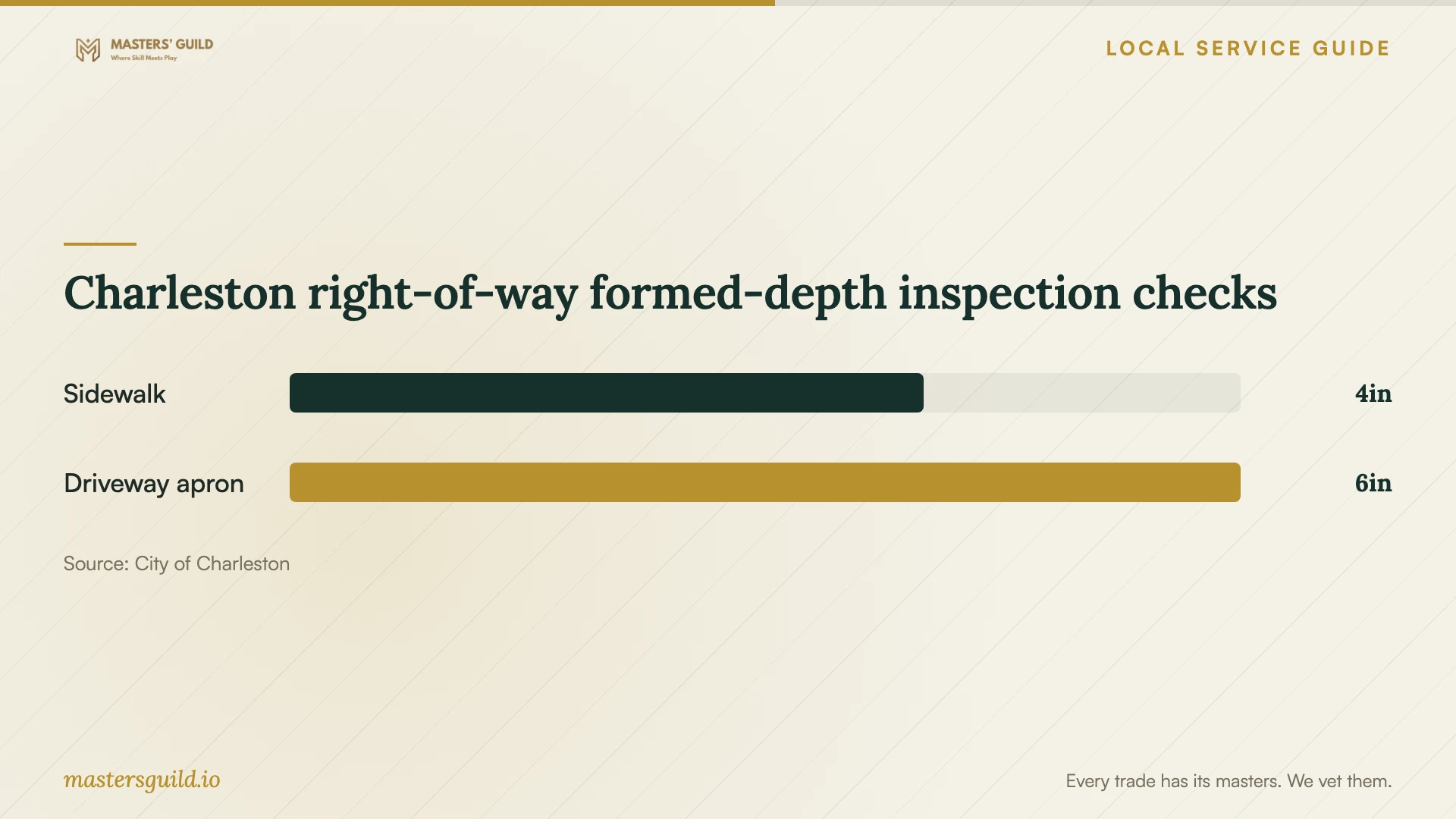
For city right-of-way work, arrange inspection before concrete placement where required. Charleston lists formed driveway aprons, sidewalks and curbs among its pre-pour inspection examples. Its inspectors check formed depths of 4 inches for sidewalks and 6 inches for driveway aprons. These checks apply to the city's right-of-way inspection context. [1]
Agree on who decides to postpone for weather, who contacts the concrete supplier and how the contractor handles rescheduling. Arrange alternate parking and a route to your entrance. Have the contractor provide written instructions for curing, protection, walking and vehicle use that fit the proposed concrete and site conditions.
Before final payment, review the completed scope with the contractor. Record unfinished cleanup, restoration or other agreed work. Keep the contract, approved changes and return-to-use instructions together so you can refer to the same terms if a concern develops.
Charleston right-of-way formed-depth inspection checks
Local details that affect your job
Approval comes before a different right-of-way material
Charleston requires standard broom-finished concrete for driveway and sidewalk portions in the right of way. For another material, the applicant must obtain an issued encroachment agreement before the city can issue the Engineering Permit. Resolve that choice before paying for a decorative design extending to the street. [1]
Truck and dumpster staging involve separate paperwork
The city's applications page assigns sidewalk blocking and driveway aprons to Engineering, while it assigns street blocking, parking meter bags and dumpsters in the street to Traffic and Transportation. Have the contractor map delivery and demolition staging, then identify the approvals and fees for that plan. [2]
Excavation needs an erosion-control paperwork check
Charleston lists erosion protection and sediment control certification as required for all projects with proposed ground disturbance. Include this certification in the application discussion when your scope includes excavation or base replacement, and name the person responsible for submitting it. [2]
Choose the next step for your project
| Project situation | Next planning step | Contract detail |
|---|---|---|
| Private patio or driveway | Arrange a site assessment and confirm applicable approvals. | Preparation, drainage, dimensions and intended use. |
| City right-of-way apron or sidewalk | Confirm Engineering approval and pre-pour inspection arrangements. | Broom finish and approved construction details. |
| Another right-of-way material | Resolve the encroachment agreement before Engineering Permit issuance. | Approval responsibility and an alternative material proposal. |
| Street staging for deliveries or demolition | Check Traffic and Transportation permit needs. | Staging location, fees and access arrangements. |
| Foundation work within a residential addition | Verify credential scope and appropriately licensed supervision. | Design responsibility and oversight of the full undertaking. |
Your hiring checklist
- Give bidders the same sketch, photographs, dimensions and intended use.
- Identify private-property and right-of-way portions on the proposed plan.
- Compare written preparation, drainage, reinforcement, joint and finish specifications.
- Verify credential scope and obtain insurance documentation.
- Assign approvals, fees and inspection scheduling to a named party.
- Agree on staging, alternate access, weather postponement and return-to-use instructions.
- Record exclusions, change approval, payment milestones and cleanup obligations.
Frequently Asked Questions
Does sidewalk replacement require a permit?
Charleston states that all sidewalks require a permit for work or blocking, regardless of who maintains the street. Confirm the application and inspection arrangements with Engineering before scheduling demolition. [1]
Do the city's thickness checks apply to my entire driveway?
The cited city guidance describes right-of-way inspections: inspectors check formed sidewalk depths of 4 inches and driveway apron depths of 6 inches. Have your contractor specify the design for the private driveway and other areas according to your project. [1]
Can a registered residential mason handle an entire addition?
A residential specialty contractor cannot construct a residential addition without supervision by a residential builder or another appropriately licensed person or entity. LLR also restricts specialty contractors to their registration scope. Identify the person responsible for the addition before hiring for its concrete work. [3]
How can I compare quotes with different totals?
Compare the specified work line by line. Resolve differences in demolition, base preparation, drainage, thickness, reinforcement, finish and access. Have bidders price the same agreed scope and explain exclusions before you choose.
Sources and scope
This guide combines the sources below with practical planning guidance. Figures apply to the stated geography and period; request a written quote for your property.