
Local service guide
Lighting installation in Cedar Rapids, IA
For Lighting installation in Cedar Rapids, hire an Iowa electrical contractor with credentials appropriate to your project and request a written quote for the full scope. Before scheduling, have the contractor confirm replacement-permit requirements for your address and assign responsibility for inspections. Iowa requires inspections for all new electrical installations, including owner-performed work that qualifies for its licensing exemption. [2]
Define the installation before choosing a contractor
Give each contractor the same room-by-room scope so you can compare their offers. Separate fixture replacements from new light locations and switch changes. Include photos taken from floor level, fixture model numbers, ceiling heights, and your preferred pendant height. Ask the contractor to assess the existing box, wiring, and mounting support before you commit to a fixture.
For recessed lights or sconces, mark where you want illumination and describe the task: preparing food, reading, or working at a desk. Point out glare and shadows you want to address. For a chandelier, send its weight and mounting instructions. Ask each contractor to describe any support work, wiring route, and openings that they propose.
Check Iowa credentials and confirm permit responsibilities
Iowa requires electrical contractors to register with DIAL. Its Electrical Contractor credential requires an affiliated person who holds a Master A or B license or employs a Master A or B electrician. Its Residential Electrical Contractor credential has its own master-license qualifications. Ask which contractor credential covers the business accepting your job, confirm that it fits the proposed work, and request insurance documentation. [2]
Confirm Cedar Rapids replacement-permit requirements before scheduling a fixture swap. Ask the contractor to identify the permitting authority for your address and record who will obtain any required permit and arrange inspections. For new electrical installations, Iowa’s DIAL guidance requires inspections regardless of whether the person doing the work needs a license. [2]
DIAL reports that HF2800 changed Iowa’s statewide installation requirements on June 2, 2026. The law removed the previous state electrical amendments and returned the state to the 2023 NEC framework, subject to HF2800’s exclusions and amendments. Ask the installer to confirm the requirements for your wiring and controls before approving a plan based on older rules. [1]
Compare scope-specific prices, tax, and timing
Obtain written quotes for your actual project to set the budget and work window. Ask each contractor to identify fixture supply, labor, wiring or switch changes, support work, access equipment, permit handling, and surface repairs. Confirm who removes the old lights and who patches and paints openings. Agree on how you will approve and pay for additional work if the contractor finds a wiring problem.
Iowa’s Department of Revenue lists installing new light fixtures among taxable repair and installation examples. For work connected with qualifying new construction, reconstruction, alteration, expansion, or remodeling, the contractor pays tax on building materials and supplies and does not charge the customer tax on that construction work. Ask the contractor to explain the classification and provide the total you will pay. [3]
For a mixed project, Iowa requires the contractor to itemize taxable repairs or installations alongside qualifying construction work and charge tax on the repair portion. If you combine lighting with a remodel, ask the contractor to identify which work belongs to each category. Also request an estimated power-interruption window and agree on the sequence of installation, surface repairs, and inspection. [3]
Choose brightness, bulbs, and controls together
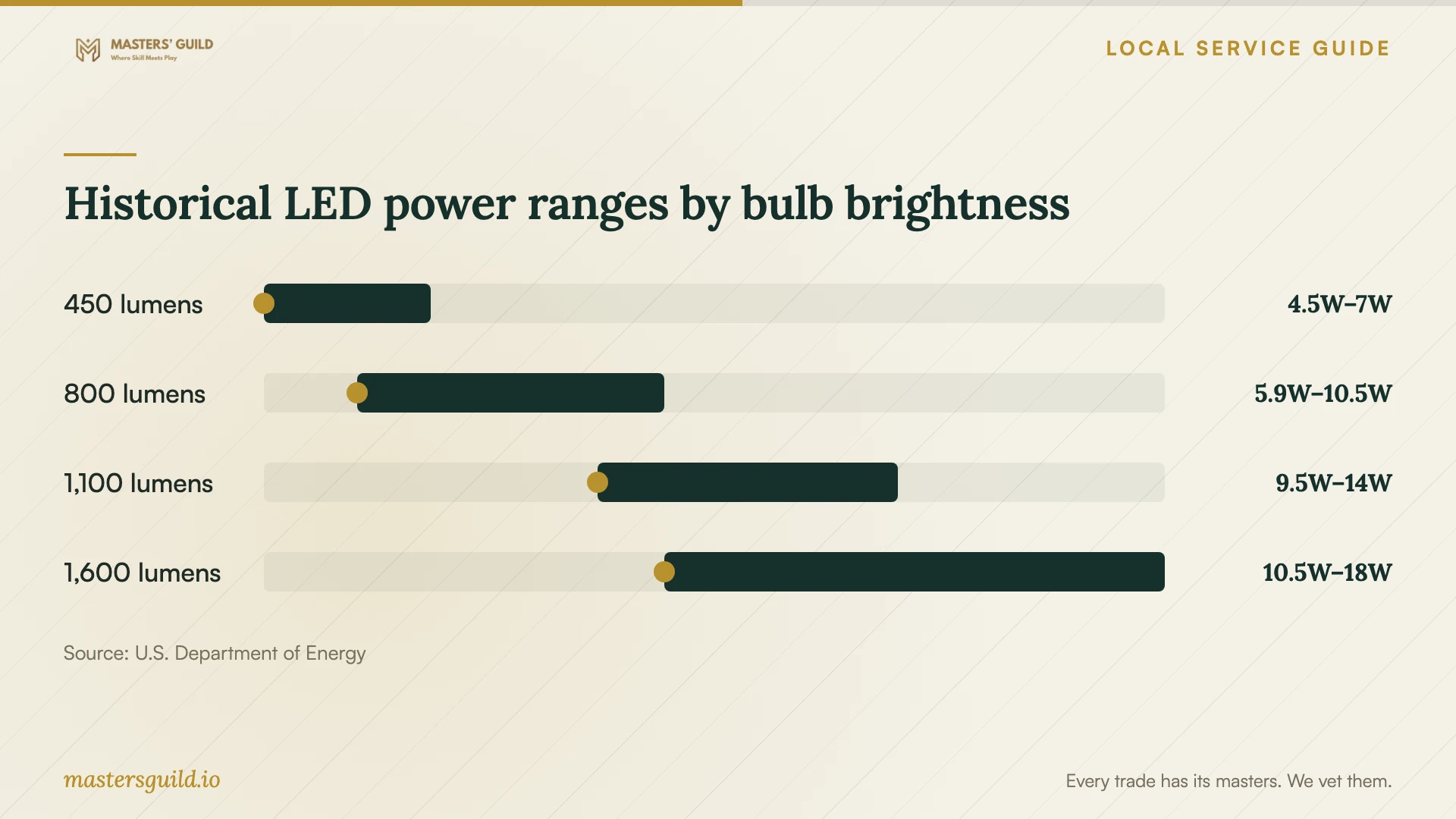
DOE advises buyers to compare light output in lumens and power input in watts. Its June 2023 national reference table pairs 800 lumens with a 60-watt incandescent bulb and LED inputs of 5.9 to 10.5 watts. Use that historical comparison to describe the bulb brightness you want, then ask the installer to review placement and coverage for the room. [4]
DOE describes 2,700 K light as warm and 3,000 K light as soft. Try a sample in the room before ordering matching bulbs. DOE also advises buyers to confirm that an LED supports dimming and works with the chosen dimming system. Give the installer both model numbers and include an operation check in the scope. [4]
For a fully enclosed fixture, DOE advises checking the bulb’s packaging or technical specifications for suitability. The agency explains that enclosed fixtures trap heat, which can affect some LEDs’ performance and life expectancy. Ask the installer to check the exact bulb and fixture combination before purchasing. [4]
Prepare the space and check the completed work
Before the appointment, clear furniture from the work area and agree on access to the electrical panel and any attic space. Keep fixture instructions and packaging available. If you supply the lights, ask the contractor to check the delivered models against the agreed scope and explain who handles a defective or incompatible product.
At handover, operate each light and control with the installer. Check pendant heights, dimming through the intended range, and exterior-light aiming and sensor settings. Request the invoice, warranty terms, product instructions, and applicable permit and inspection records. Record any unfinished repairs and agree on who will complete them.
Historical LED power ranges by bulb brightness
Local details that affect your job
Iowa limits the homeowner licensing exemption
For owner-performed work in Cedar Rapids, Iowa’s exemption applies to an existing principal residence that qualifies for the homestead tax exemption and is no larger than a single-family dwelling. DIAL requires a licensed Electrical Contractor or Residential Electrical Contractor for a new house and inspections for all new electrical installations. Before choosing DIY work, confirm your property’s eligibility and the permit requirements for your scope. [2]
Iowa tax classification changes the quoted total
A standalone lighting installation and lighting connected with a qualifying remodel can receive different Iowa tax treatment. Revenue lists installing new light fixtures as a taxable installation example, while qualifying construction or remodeling receives the construction treatment described above. For a Cedar Rapids project, ask the contractor to identify the classification in the quote and separate any taxable repair work within a larger remodel. [3]
Check exterior equipment against local cold conditions
NOAA’s 1991–2020 normals for Cedar Rapids Municipal Airport report a January average temperature of 19.6°F and 7.7 January days with minimum temperatures at or below 0°F. For porch, garage, or yard lighting, ask the installer to check manufacturer operating-temperature limits for the fixtures and sensors. Use these airport normals as planning context, not as a design minimum or an appointment forecast. [5]
Questions to resolve for your lighting project
| Project | Resolve before hiring | Record in the scope |
|---|---|---|
| Existing fixture replacement | Ask the installer to assess the box, wiring, and support and confirm replacement-permit requirements. | Fixture model, mounting work, disposal, and tax-inclusive total |
| New recessed lights or sconces | Assign responsibility for the inspections Iowa requires for new electrical installations. | Layout, wiring route, controls, inspection arrangements, and surface repairs |
| LED lights with dimming | Have the installer check that the LEDs support dimming and suit the dimming system. | Bulb or fixture model, dimmer model, and operation check |
| Lighting within a remodel | Ask how the contractor will classify the work under Iowa tax guidance. | Construction work and separate itemization of taxable repairs or installations |
| Exterior lighting | Ask the installer to check product operating-temperature limits against the intended conditions. | Fixture and sensor specifications, aiming, and settings |
Your hiring checklist
- Separate replacement fixtures, new light locations, and control changes in your job description.
- Share fixture model numbers, weights, ceiling heights, and photos taken from floor level.
- Request the business’s Iowa contractor credential, registration details, and insurance documentation.
- Confirm replacement-permit requirements before scheduling and assign permit and inspection responsibilities.
- Compare written totals that include applicable tax, access equipment, disposal, and surface repairs.
- Confirm brightness, color appearance, enclosed-fixture suitability, and dimmer compatibility before ordering.
- Agree on access and power interruptions, then test the completed lighting with the installer.
Frequently Asked Questions
Do I need a permit to replace a ceiling light?
Confirm Cedar Rapids replacement-permit requirements for your address and scope before scheduling. Ask the contractor to record the answer and identify who handles any required permit. Iowa’s statewide guidance requires inspections for all new electrical installations; resolve the requirements for your particular replacement with the permitting authority. [2]
Can I install lighting in my own home?
Iowa exempts owner-performed work from licensing in an existing principal residence that qualifies for the homestead tax exemption and is no larger than a single-family dwelling. DIAL requires licensed contractors for new-house electrical work and inspections for all new installations. Confirm eligibility and local permit requirements before choosing DIY work. [2]
Should my lighting quote include sales tax?
Iowa lists installing new light fixtures as a taxable installation example. The state applies different treatment to work connected with qualifying construction or remodeling. Ask the contractor to explain the classification, itemize taxable work within a mixed project, and quote the total you will pay. [3]
Can I keep my existing dimmer when switching to LEDs?
Have the installer check the specific models before you buy. DOE advises buyers to confirm that LEDs support dimming and are compatible with the dimming system. Provide the existing dimmer model and proposed bulb or fixture model, then test the agreed dimming range at handover. [4]
Sources and scope
This guide combines the sources below with practical planning guidance. Figures apply to the stated geography and period; request a written quote for your property.