
Local service guide
Hiring help for gardening in Cedar Rapids
Hire a gardener for the beds and tasks you can describe, with a written agreement on the finished result, price, and care between visits. For gardening in Cedar Rapids, decide whether you want to collect materials yourself or include delivery. Linn County residents can collect compost and wood chips without charge under the Solid Waste Agency's material and vehicle rules. [1]
Define the work and the finished result
Give each gardener the same description. Identify which beds need weeding, which plants need attention, and whether you want planting, shrub pruning, or a seasonal cleanup. Mark plants to keep. Ask the gardener to identify unfamiliar growth before removing it, especially where weeds and wanted plants grow together.
Describe gate widths, steps, parking, water access, and a place to unload materials. For a cleanup, agree on what the gardener will remove and what they will leave. For recurring care, specify the tasks for each visit and who approves additional work. Ask for proof of liability insurance and examples of similar garden work.
Ask for a price tied to your beds and tasks
Ask gardeners to quote labor for your specific beds and tasks. Request itemized amounts for plants, soil amendments, mulch, transport, and disposal. If you choose hourly work, clarify whether the rate covers one worker or a crew, whether travel counts, and when the gardener must seek approval to continue. For a fixed price, record the quantities and exclusions.
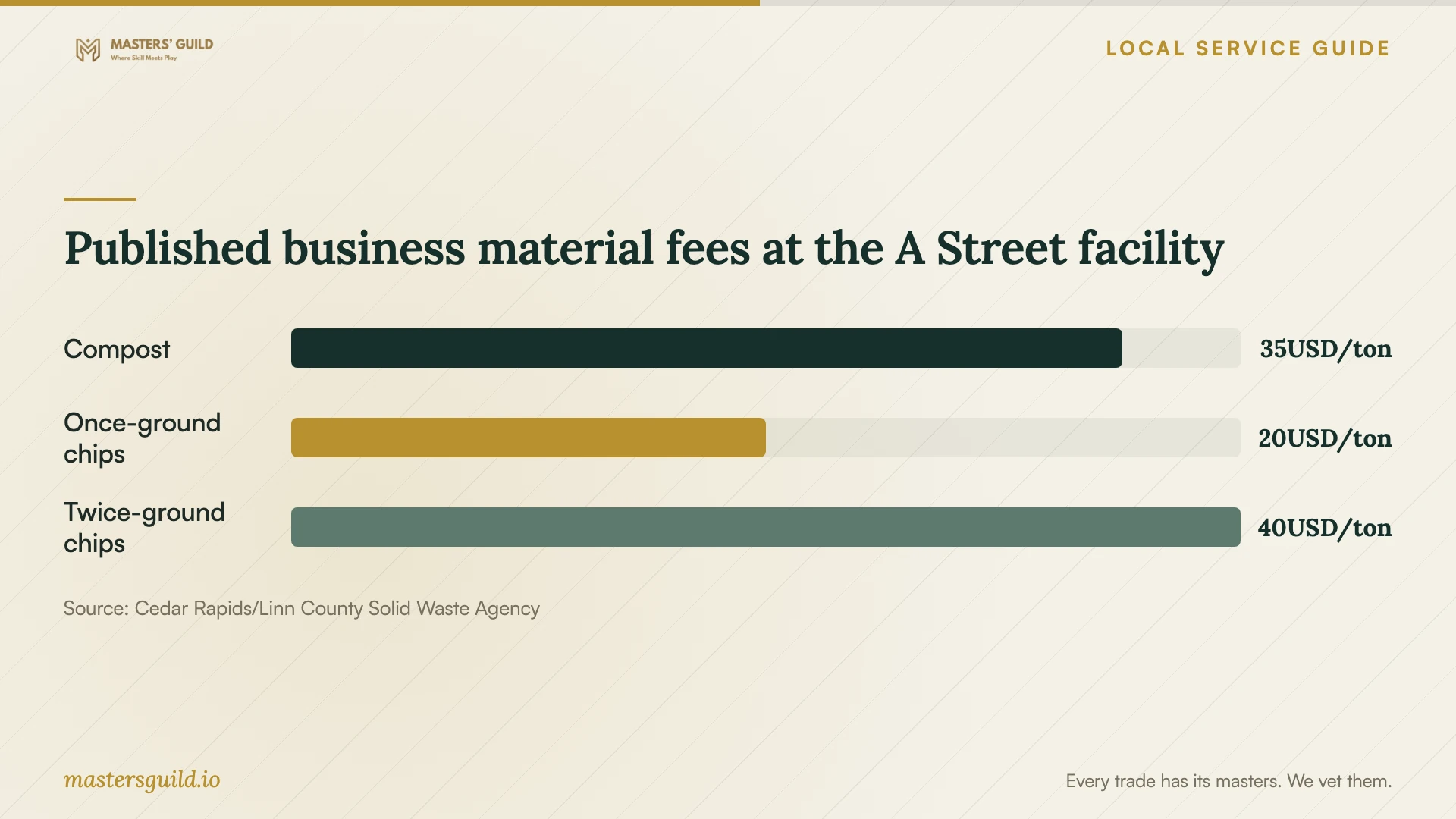
Use the chart's Agency material fees to discuss a proposed material allowance. The Agency publishes business prices of $35 per ton for compost, $20 per ton for once-ground wood chips, and $40 per ton for twice-ground wood chips. Those purchase fees do not cover the gardener's labor or transport. Ask which material source the gardener intends to use. [1]
Before supplying materials yourself, agree on the type, quantity, and delivery date with the gardener. The Agency describes its wood chips as uncolored material from Linn County trees and stumps. Discuss whether that appearance suits your beds before arranging collection. [1]
Plan material handling and application
Choose a collection arrangement you can manage from pickup through spreading. At A Street, stop at the scale house and tell the attendant which material and quantity you want. Agency staff load pickups and trailers; residents can bring buckets and a shovel for smaller amounts from the self-loading area. [2]
Show the gardener where to stage the load and which beds should receive each material. The Agency's application guidance directs users to keep compost away from stems and tree trunks. Agree on placement before spreading, and ask the gardener to explain the amount they recommend for each area. [1]
Review pesticide proposals before treatment
Ask the gardener to identify the problem and the plants they propose to treat. Discuss whether hand removal or another approach could meet your goal. Iowa's Pesticide Bureau distinguishes the certified individual applicator from the licensed pesticide company and provides applicator and company resources. Use those resources to review both credentials. [3]
Request the product name and instructions for access after treatment. Tell the gardener about edible plants and areas used by children or pets. Record which areas you authorize for treatment so a general maintenance agreement does not substitute for your decision about a particular application.
Agree on weather delays and care between visits
Keep planting dates flexible around the selected plants and current forecast. National Weather Service 1991–2020 normals for Cedar Rapids Municipal Airport record an average of 8.1 April days and 7.3 October days with minimum temperatures at or below 32°F. These historical averages do not establish a safe planting date for your property. Ask the gardener how they will handle protection or rescheduling. [4]
Before the gardener finishes planting, get watering instructions and name the person responsible between visits. Discuss how you will report plant problems and whether the agreement includes follow-up care or replacements. For ongoing maintenance, agree on how the gardener will communicate rain delays and unfinished tasks.
Published business material fees at the A Street facility
Local details that affect your job
Resident pickup eligibility affects who should collect materials
The Solid Waste Agency offers no-charge compost to Linn County residents in personal vehicles under its pickup-truck and single-axle-trailer rules. For wood chips, qualifying residential loads include pickups, single-axle trailers, and self-loaded buckets. Dump trucks and double-axle trailers incur the listed business charges. Confirm eligibility with the Agency before assuming that a gardener collecting on your behalf qualifies for the resident benefit. [1]
Garden debris goes to A Street, with unloading arranged
Take accepted yard waste and tree debris to 2250 A Street SW. The Agency's County Home Road facility in Marion refuses these materials, including small grass-and-leaf loads. At A Street, customers weigh in, unload their own vehicles, and weigh out; the Agency charges by the weight difference. The facility excludes large land-clearing loads of trees, debris, stumps, and root balls brought by large equipment. Describe the debris before hiring a hauler so they can arrange an appropriate destination. [2]
Choose the scope that fits your garden
| Your goal | Arrangement to consider | Question to resolve |
|---|---|---|
| Restore neglected beds | One-time cleanup with a defined endpoint | Which plants stay, and what should the beds look like afterward? |
| Keep beds maintained | Recurring visits with a task list | Which tasks belong in each visit, and who approves extras? |
| Add new plants | Planting with a written care handoff | Who chooses plants and handles watering between visits? |
| Refresh soil or mulch | Supply materials yourself or include collection in the job | Can you manage transport, staging, and the agreed quantity? |
Your hiring checklist
- Photograph each work area and provide approximate bed dimensions.
- Mark plants to preserve and identify growth that needs assessment.
- Set a completion standard and a spending limit for extra work.
- Clear access and designate a material staging area.
- Tell the gardener about edible plants and household use of treatment areas.
- Write down watering duties and the plan for weather delays.
Frequently Asked Questions
How much should I budget for a gardener?
Request a quote for your task list and bed sizes. Choose a fixed total or an hourly arrangement with a spending limit. Ask what happens if the gardener discovers more work during the visit, and approve changes before they proceed.
When can I collect compost or wood chips?
The Agency lists material pickup at 2250 A Street SW from 8 a.m. to 4 p.m. Monday through Friday and 8 a.m. to noon Saturday. Check hours before your trip and coordinate collection with the planned gardening visit. [1]
How should I prepare a load of garden debris?
Tie down and secure the load before leaving. The Agency lists fines of $25 for unsecured residential loads and $100 for unsecured business loads. Arrange enough help to unload at the facility because staff cannot unload customer vehicles or trailers. [2]
Sources and scope
This guide combines the sources below with practical planning guidance. Figures apply to the stated geography and period; request a written quote for your property.