
Local service guide
Tax preparation and accounting in Calgary
Tax preparation for a Calgary small business starts with a written scope: identify your business structure, the tax years involved, and whether you need bookkeeping, filing or advice. Give prospective providers the same requirements to price. For an incorporated business, confirm coverage of any required Alberta AT1 return and provincial account support. Alberta requires corporations with a permanent establishment in the province to file an AT1 unless exempt. [4]
Choose the work before choosing the provider
Describe the result you need: organized monthly records, completed returns, advice about a transaction, or help responding to a notice. Have the provider identify their tasks and the records you must supply. For ongoing bookkeeping and year-end work, request separate descriptions and fees so you can compare offers.
Tell prospective providers about employees, rental income, investment transactions, ownership changes and activity outside Alberta. Ask about their experience with your situation and who will review the work. For a corporate engagement, request a list of federal and provincial filings rather than relying on the phrase business taxes.
Verify the person and the practice
CPA Alberta says anyone in Alberta can call themselves an accountant without registering with the organization. Verify a claimed CPA designation through its member search. The regulator also offers separate searches for firms and CPA professional corporations. If a member search returns no result, CPA Alberta suggests trying again without the city. [1]
CPA Alberta requires CPAs offering public-practice accounting services or tax advice to use a registered Professional Accounting Firm. It requires members providing accounting services or tax advice on behalf of a corporation whose primary business is not accounting, such as a bank or wealth management firm, to register a Professional Service Provider. Ask which registration applies to the provider’s setting and proposed work. [2]
For a CPA practice operating as a Professional Corporation, that registration does not replace Professional Accounting Firm registration. Match the legal practice name on your engagement letter to the relevant regulator record. [2]
Confirm who will handle your file and answer questions after submission. Agree on a secure document-transfer method and account access before sharing financial information. Include arrangements for returning records if you end the engagement.
Compare quotes against the same deliverables
Request a written quote based on your records and required work. Separate bookkeeping cleanup, return preparation, planning meetings and responses to notices. For recurring work, specify the reporting frequency, accounts to reconcile and responsibility for missing receipts.
Confirm whether the provider charges a fixed fee, an hourly rate or a capped amount. Identify what triggers extra charges and require approval before the provider exceeds the agreed scope. Check whether the quote includes applicable taxes, software charges, amendments and a meeting to explain the completed work.
Agree on records handover and delivery dates. Have the preparer confirm receipt, identify missing information and supply filing confirmations with your final copies. Share unresolved notices at the start and request a response plan.
Plan Alberta corporate filing and payment together
Alberta requires corporations subject to AT1 filing to submit the return within six months after their tax year end. Its general payment rules require monthly instalments and a remaining balance by the end of the second month after year end, with exemptions and different timing for qualifying corporations. Request a payment calendar alongside the filing calendar. [4]
For taxation years beginning after December 31, 2024, Alberta requires corporations to net file AT1 returns except insurance corporations, non-resident corporations, corporations reporting in functional currency and corporations exempt under section 35 of the Alberta Corporate Tax Act. Have the preparer confirm your filing method and supply the submission receipt. [4]
The Canada Revenue Agency collects Alberta personal income tax alongside federal income tax. For owner-level planning, ask your adviser to explain the personal and corporate treatment of a proposed owner payment before you approve it. [5]
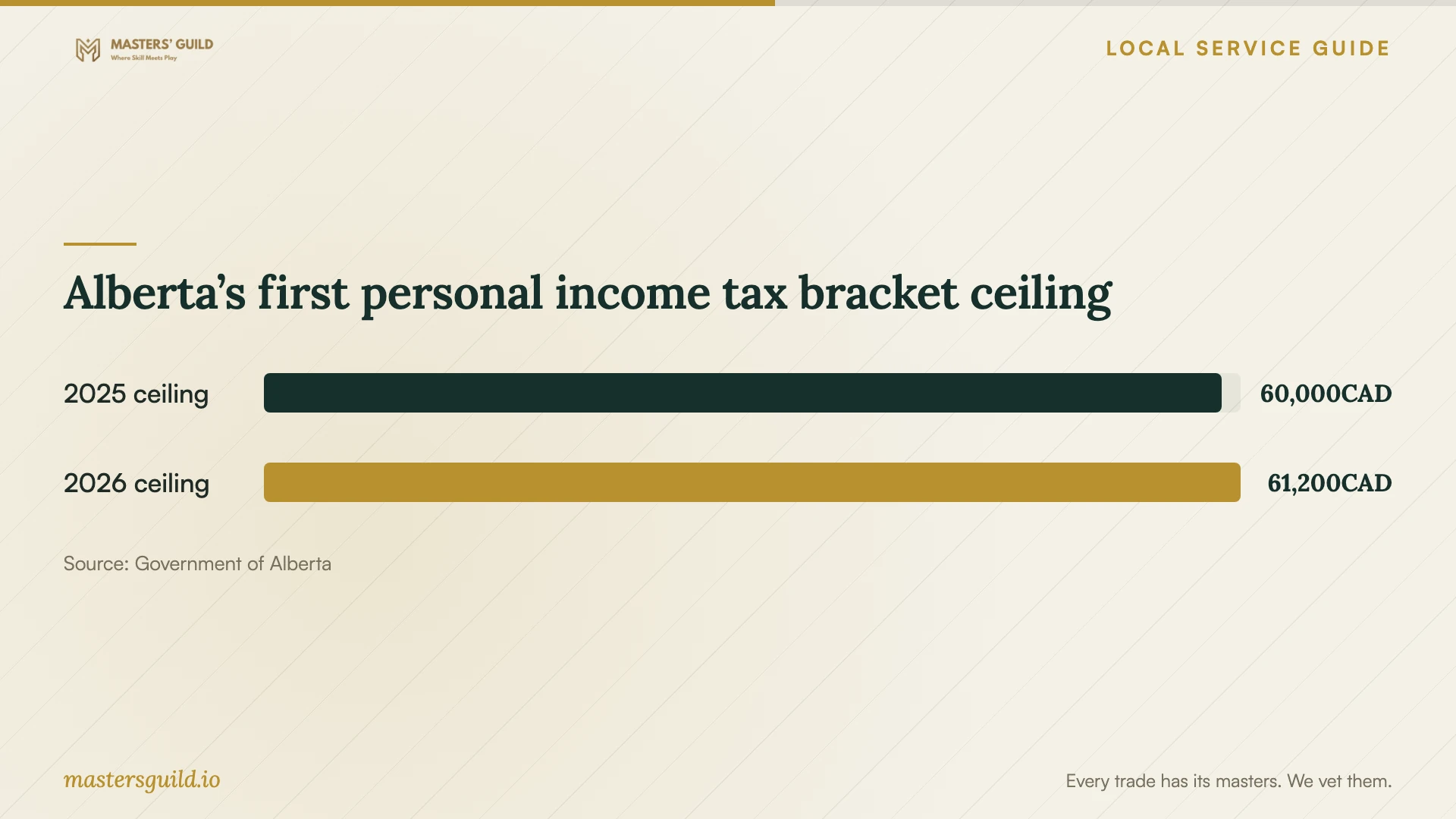
Alberta’s first personal income tax bracket ceiling
Local details that affect your job
Distinguish Calgary registration from professional credentials
The City requires businesses operating in Calgary to register and requires location approval for Calgary business locations. It says provincially or federally regulated businesses, including accountants, typically do not need a municipal business licence. Use CPA Alberta to check a claimed CPA credential; consult the City about municipal requirements for the provider’s particular operation. [3] [1]
Assign responsibility for Alberta online notices
Since April 1, 2026, Alberta has used TRACS online mail as the default for new corporations incorporated through Alberta Corporate Registry, existing corporations with TRACS accounts, and corporations that have authorized a third-party organization to manage their corporate income tax account. Agree who will check notices and forward them, including during a change of accountants. [4]
Prepare for the November 2026 access change
Alberta has announced TRACS corporate account access changes effective November 14, 2026. Account owners will need to be listed directors. Alberta residents will need a verified Alberta.ca account; directors without Alberta government-issued identification will need to complete Interac’s Document Verification Service. Confirm your director information and exact name match before arranging representative access. [4]
Match the engagement to your immediate need
| Your situation | Work to request | Question before accepting |
|---|---|---|
| Records need organizing | Bookkeeping cleanup with a defined handover | Which accounts and periods will you reconcile? |
| You need advice on a planned transaction | A written tax-advice scope | If you are a CPA, which practice registration applies to your service and setting: PAF or PSP? |
| Your corporation has an Alberta permanent establishment | Assessment of AT1 obligations and any exemption | Does the quote cover the required provincial return and payment calendar? |
| You are changing accountants | Records transfer and account-access review | Who will monitor TRACS correspondence during the handover? |
Your hiring checklist
- Describe your business structure, activities and tax years covered.
- Gather prior returns, assessment notices and unresolved correspondence.
- Prepare bank statements, credit card statements, sales records and expense receipts.
- Identify payroll records, asset purchases and owner transactions for review.
- Request separate prices for cleanup, filing and ongoing advice.
- Verify any claimed CPA designation and registration applicable to the practice setting.
- Agree who authorizes filings, makes payments and monitors notices.
- Request completed returns, filing receipts and a list of outstanding tasks.
Frequently Asked Questions
Does an accountant in Alberta have to be a CPA?
CPA Alberta says anyone in the province can use the accountant title without registering with the organization. Verify a claimed CPA designation and ask about the provider’s experience with your work. [1]
Does a corporate tax quote include the Alberta return?
Have the provider confirm this in writing. Alberta requires an AT1 from a corporation with a permanent establishment in the province unless exempt. Ask the provider to identify any exemption and list the filings included. [4]
Can I wait until the AT1 filing deadline to pay?
Request your corporation’s specific payment dates. Alberta allows six months after year end to file, but its general payment rules require an earlier balance payment and may require instalments. Exemptions depend on the corporation’s circumstances. [4]
What should I receive when the work is complete?
Request completed returns, filing confirmations, a fee breakdown and unresolved items. Have the provider explain payment instructions and confirm who will handle later notices or amendments.
Sources and scope
This guide combines the sources below with practical planning guidance. Figures apply to the stated geography and period; request a written quote for your property.