
Local service guide
Bricklaying and Masonry in Calgary
To arrange Bricklaying and Masonry in Calgary, have contractors inspect the structure and quote the same repair or construction scope. Check their municipal business licence and relevant experience. Confirm any retaining-wall approvals and heritage coordination before agreeing to materials or a start date. Calgary lists specialty trade contractors among businesses requiring a licence; Alberta identifies bricklayer certification as optional. [1] [2] [3] [4]
Define the work before comparing quotes
Alberta’s bricklayer profile covers constructing and repairing walls, partitions, patios, arches, fireplaces and chimneys with brick and other masonry units. Ask each contractor for examples involving your type of structure and identify who will supervise the work. [2]
Send an overview photo and close-ups of the affected joints or units. Explain what you want to preserve. Have the contractor distinguish joint repair, unit replacement and rebuilding in the proposal. For new construction, provide the intended dimensions, finish and access route.
If you see leaning masonry, loose pieces above a walkway or a changing crack, keep people away from the affected area and request an assessment. Before agreeing to cosmetic repairs, ask whether you need structural advice and who will coordinate it.
Check the contractor and crew
Calgary requires business licences for general contractors, specialty trade contractors and landscapers constructing retaining walls. Request a copy under the business name on your contract. Direct questions about the applicable licence category to the Planning Services Centre. [1]
Alberta makes bricklayer certification optional but regulates restricted activities within the trade. Its profile authorizes registered apprentices or workers operating at journeyperson level in their employer’s opinion to perform those activities. Ask about the crew’s training, relevant qualifications and apprentice supervision. [2]
Before paying a deposit, check whether provincial prepaid contracting licensing applies. Calgary describes prepaid contractors as businesses that solicit, negotiate or conclude prepaid contracts in person away from the seller’s premises and accept payment before completing the work or services. Ask for the applicable licence if those conditions describe your arrangement. [1]
Compare the scope, materials and total price
Request descriptions of preparation, repair and finishing. For joint work, ask how the crew will remove existing mortar and choose the replacement mix, colour and joint profile. Agree on replacement brick or stone and whether you will approve a sample before installation.
Have each bidder identify access equipment, surface protection, debris removal, cleanup, permits and taxes in the quote. Request insurance documentation and written exclusions. Agree on how the contractor will record concealed damage and obtain your approval for extra work.
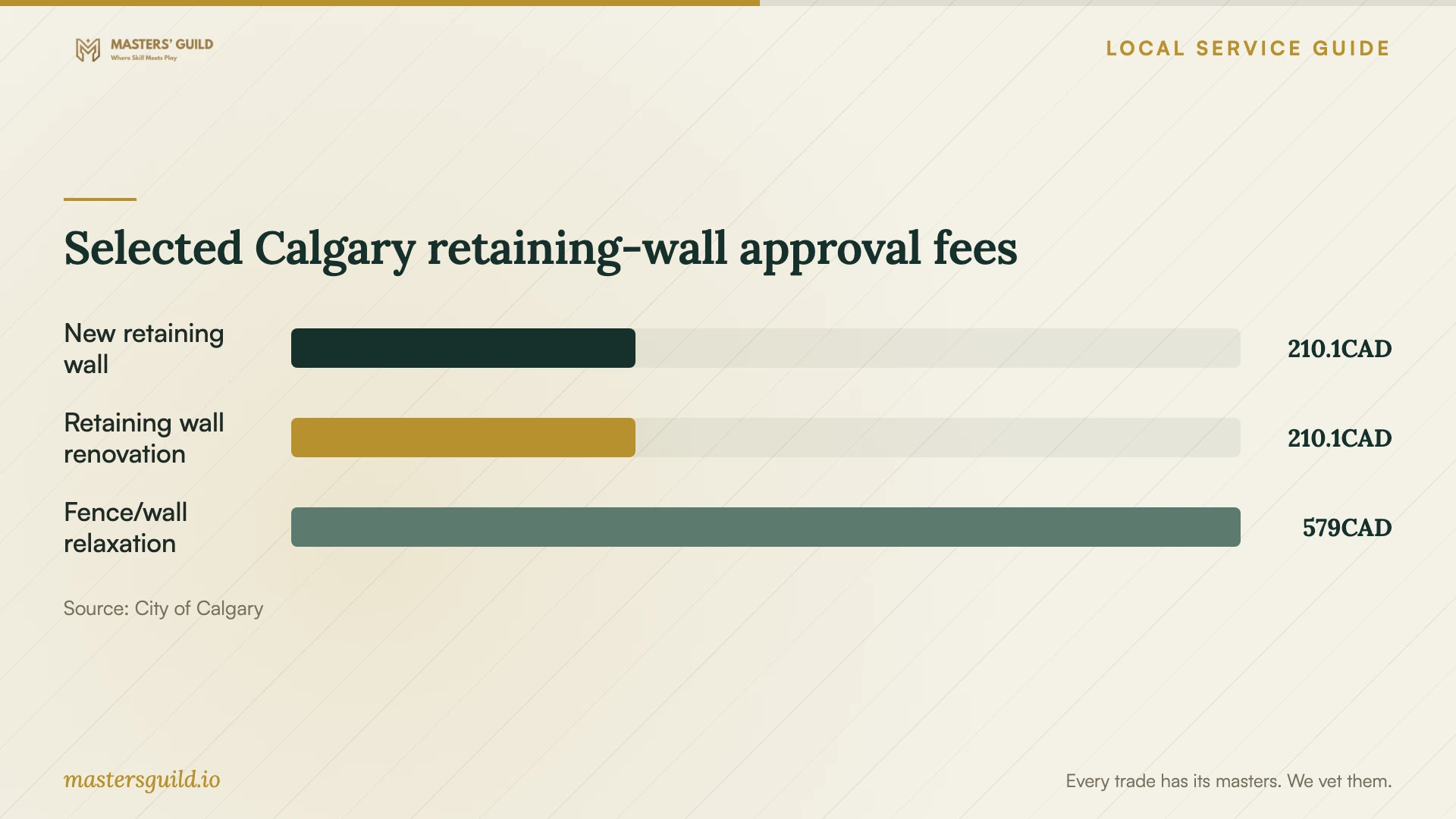
Set your construction budget from a site-specific quote. The City publishes selected retaining-wall approval fees, shown in the chart. Keep those fees separate from the contractor’s labour, materials and other project charges. [3]
Set weather and completion terms
Ask the contractor to specify the chosen material’s installation and curing requirements, overnight protection and postponement conditions. At Calgary Airport, the 1991–2020 normals give an October daily average of 4.9°C and an average daily minimum of −1.3°C. These historical averages do not predict your construction-day weather or establish suitable installation conditions. [5]
Agree on a start window and who will notify you about delays. Record the expected time on site, how long protection must remain and when you can use nearby paths or patios. Include a completion walkthrough, care instructions and written warranty terms.
Selected Calgary retaining-wall approval fees
Local details that affect your job
Confirm retaining-wall approvals with your measurements
Calgary lists permit-trigger conditions involving retention of 1.2 m or more of soil and combined heights of 1.2 m or more for retaining walls or garden boxes within 1 m of each other. For projects that meet its permit conditions, the City generally describes building safety approval as the required approval, with planning approval for designs or locations outside land-use specifications. Its design section separately says retaining walls at least 1.2 m high require a development permit. Confirm the requirements for your property with the Planning Services Centre at 403-268-5311. Bring retained-soil measurements, wall spacing and a layout; settle who will submit drawings and book inspections before choosing a construction date. The City also directs owners to contact Utility Safety Partners before digging. [3]
Check heritage status before choosing alterations
Calgary’s Heritage Planning team reviews applications concerning properties on the Inventory of Evaluated Historic Resources regardless of legal designation status. Municipal Historic Resource designation can add requirements because the designation bylaw identifies protected elements. Check both statuses before settling on replacement materials or alterations. The City advises applicants to discuss proposals with Heritage Planning at [email protected] before submitting permit applications. Prepare photos of the existing masonry and a description of the proposed work for that discussion. [4]
Choose your next step
| Project situation | Next step | Question to settle |
|---|---|---|
| Joint repair or damaged units | Request an inspection and written repair scope. | Which joints or units will the crew repair, and with which materials? |
| Retaining wall near the 1.2 m threshold | Confirm applicable approvals with the City. | How much soil does it retain, and are other walls or garden boxes within 1 m? |
| Property on the Heritage Inventory | Discuss the proposal with Heritage Planning before permit applications. | Which heritage features could the work affect? |
| Deposit before completion | Check whether provincial prepaid contracting licensing applies. | Where will you negotiate the contract, and when will you pay? |
| Exterior work in October | Request a material-specific weather protection plan. | How will the crew handle overnight cold and postponements? |
Your hiring checklist
- Photograph the structure and affected joints or units; note access constraints.
- Have contractors inspect and quote the same defined scope.
- Request the municipal business licence, insurance documentation and comparable work examples.
- Identify crew qualifications and the person supervising the project.
- Confirm applicable retaining-wall approvals and heritage coordination.
- Agree on materials, samples, equipment, cleanup and exclusions.
- Record deposit terms, extra-work approvals, weather delays and completion requirements.
Frequently Asked Questions
Must a bricklayer hold an Alberta journeyperson certificate?
Alberta identifies bricklayer certification as optional. It also regulates restricted activities and who may perform them. Ask about the crew’s qualifications, supervision and experience with work similar to yours. [2]
Does my retaining wall need a permit?
Confirm the requirements with Calgary using your retained-soil height, wall spacing and location. The City lists a 1.2 m threshold and combined nearby heights, but gives differing descriptions of development approval on its page. Obtain a property-specific answer before construction. [3]
Does Heritage Inventory listing give a property legal protection?
Inventory listing alone does not provide legal protection. Heritage Planning still reviews applications relating to Inventory properties. Municipal designation adds protection through a designation bylaw, so clarify both statuses before agreeing to alterations. [4]
Sources and scope
This guide combines the sources below with practical planning guidance. Figures apply to the stated geography and period; request a written quote for your property.