
Local service guide
Tree cutting and arborist services in Burnaby
Before arranging tree work in Burnaby, confirm ownership, protected-tree status and nearby power lines. Have an arborist assess retention options, then compare written scopes covering cutting, cleanup, stump work and replacement planting. Burnaby requires a permit to remove protected trees. BC Hydro recommends a certified utility arborist if you cannot prune near electrical lines safely or are unsure how to proceed. [1] [3]
Check protection before requesting removal
Burnaby defines protected trees through development status, tree type, diameter and other protections. Without a development application, the size thresholds are 30 cm or greater for conifers and 45 cm or greater for deciduous trees. On properties subject to a development application, the threshold is 20 cm or greater for any tree. Covenanted, replacement and retained trees also qualify, along with trees covered by specified landscaping approvals, streamside protections or cemetery zoning. [1]
Give the City's private-property tree team your address, photos, tree type if known and details of any development application. Request instructions for measuring diameter and confirmation of other protections. Burnaby requires a tree cutting permit for protected-tree removal and allows one application to cover multiple trees. [1]
Choose assessment, pruning or removal
Describe the problem you want to solve: a damaged limb, concern about stability, roots affecting a structure or a proposed construction area. Request retention options and an explanation of the evidence supporting removal. Burnaby lists poor health, structural defects and certain utility or structural conflicts among circumstances where it would normally issue a permit. For structural damage, the City considers whether other measures could address the problem. [2]
The City says it would not normally issue a removal permit for shade, falling leaves or needles, obstructed views, alternative landscaping or wildlife attraction. For these concerns, discuss tree management before commissioning a removal plan. For pruning, have the contractor identify the branches and purpose of the proposed cuts so you can compare matching scopes. [2]
Resolve electrical hazards before booking
Tell the contractor about overhead wires, the service wire to your home and nearby transformer boxes. BC Hydro recommends a certified utility arborist for people who cannot do their own pruning or are unsure how to do it safely. It describes this qualification as covering tree and vegetation work near energized conductors or electrical equipment. Request the relevant qualification from the person who will direct that work. [3]
BC Hydro specifies at least one metre of vegetation clearance around a service wire. Do not use that maintenance clearance as your safe working distance: BC Hydro's working limits depend on line voltage. If you cannot verify voltage or stay outside those limits, call 1 800 224 9376 for an assessment and request a vegetation coordinator. Before digging or excavation, arrange underground utility locating through BC 1 Call. [3]
Compare the whole project cost
Compare site-specific written quotes with matching scopes. Request separate amounts for assessment or reporting, pruning or removal, debris hauling, stump grinding and site restoration. Confirm whether the crew will leave logs or chips, the grinding depth and who will remove grindings. Describe gate width, proposed access through neighbouring property and surfaces you want protected.
Request evidence of liability insurance and workers' compensation coverage, plus the name and qualifications of the person directing the work. Have the contractor identify subcontractors, exclusions and any work you must arrange yourself. Agree on how you will approve changes to the scope and price.
Include replacement planting in the budget discussion. Burnaby bases replacement numbers on the removed tree's size. For single-family and two-family properties without development, the City may require replacements depending on property characteristics and constraints. If the City requires replacements, you must provide security before it issues the permit. The City may require a cash contribution if the property cannot accommodate the required planting. [2]
Confirm current permit and security amounts with the City. Keep those amounts separate from the contractor's cutting charge, and identify who will arrange replacement planting and inspections. Burnaby adjusts its stated replacement-security fees each year, so confirm the amount for your application rather than relying on an old quote. [2]
Plan the work date and replacement care
Burnaby identifies March 15 to August 15 as bird nesting season. During that period, its guidance requires you to check for active nests before pruning or removing trees or vegetation and wait until the birds leave if you find one. Agree on who will check before work begins and how the contractor will handle a postponement. [2]
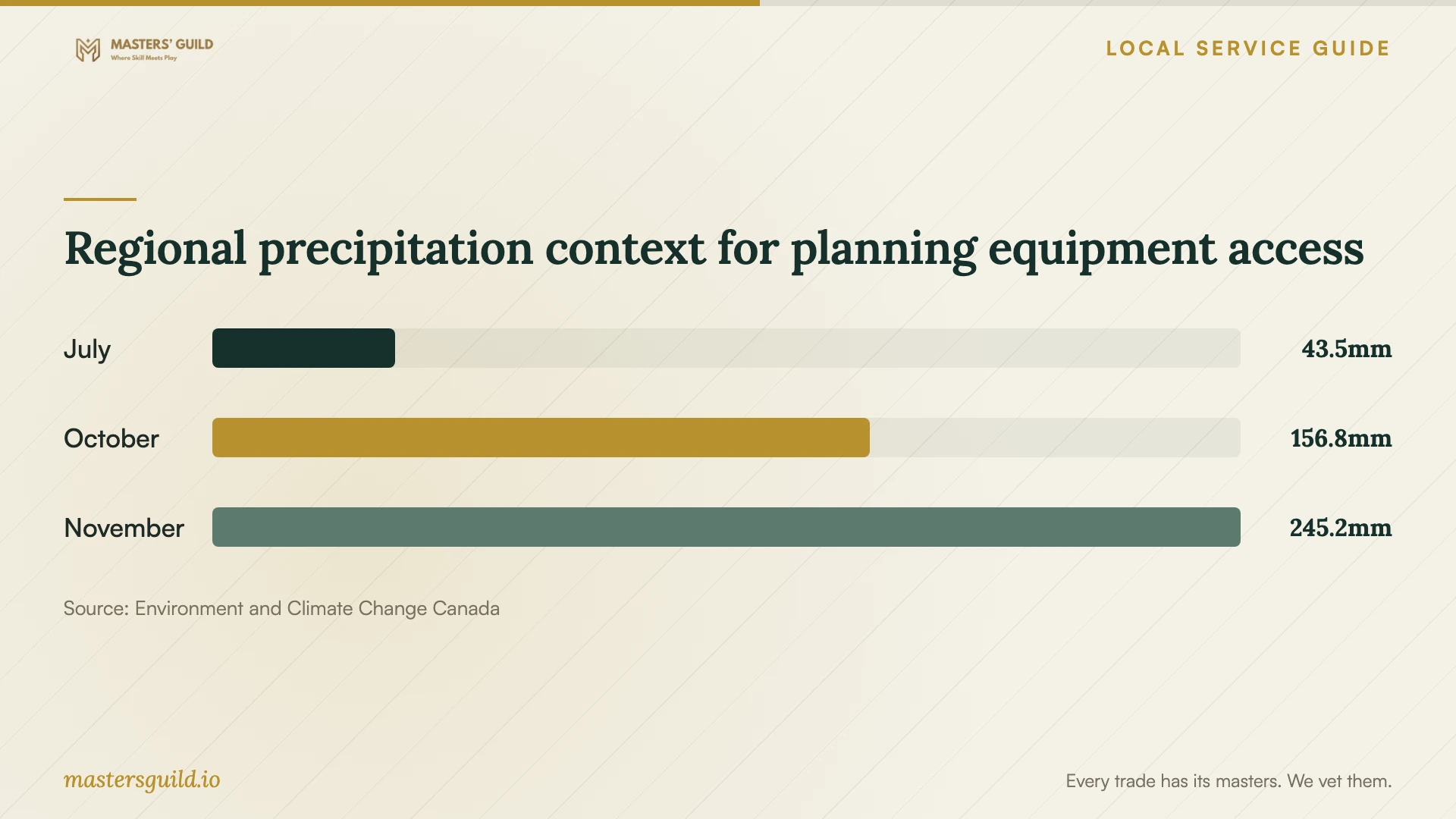
Discuss wet-ground access and rescheduling with the crew. Nearby Vancouver Harbour's 1991 to 2020 normals show more total precipitation in October and November than July. These regional averages do not predict conditions on your work date. Have the contractor explain how the crew will protect lawns and paving and where equipment can operate. [4]
For replacement planting, Burnaby specifies conifers at least 2 metres high and deciduous trees with a minimum trunk diameter of 5 cm. Plant replacements on private property with at least 3 metres between trunks, allowing room for mature growth. Contact the City's arborist after planting for the first inspection. That inspection starts the one-year waiting period before reinspection and the tree-bond refund. [2]
Regional precipitation context for planning equipment access
Local details that affect your job
Route boulevard concerns to the City
Burnaby's Forestry Division manages City-owned trees, including boulevard trees. Contact the City tree service line at 604-297-4500 before commissioning work on a boulevard tree. For private-property tree questions and permit requests, use 604-294-7130. Confirm ownership if the tree stands near the road or property boundary. [1] [2]
Coordinate tree work with development
For development sites, Burnaby asks applicants to discuss affected trees before the Engineering pre-application. Show retained and replacement trees on the site plan. Keep driveways, paving, construction and utility connections outside designated tree protection areas. The City generates the tree permit through the development application process, so applicants do not submit a separate tree-permit application. [2]
Specify acceptable replacement stock
Confirm who will buy suitable nursery stock, plant it and maintain it through the inspection period. Burnaby rejects hedging, shrubs and invasive species as replacement trees. Check the proposed species and size before accepting a planting allowance; an offer to plant a hedge does not satisfy the City's replacement-tree requirements. [2]
Choose the next step before hiring
| Situation | Next step | Question to resolve |
|---|---|---|
| Tree on a boulevard | Contact the City's tree service line | Does the City own and maintain it? |
| Private tree that may be protected | Confirm status with the City and request an assessment | Do size, development status or other protections require a removal permit? |
| Healthy tree causing shade or leaf litter | Discuss management or pruning options | Can you address the concern while retaining the tree? |
| Tree near energized lines | Consult a certified utility arborist or BC Hydro | Can the crew meet the applicable electrical safety limits? |
| Removal associated with development | Coordinate tree planning with the development application | Does the site plan show retained trees, replacements and protection areas? |
Your hiring checklist
- Confirm tree ownership and identify each tree in photos.
- Confirm protected-tree status and the permit route with the City.
- Request retention options and the reasons for any proposed removal.
- Flag overhead wires and underground services before planning equipment access.
- Request evidence of insurance, workers' compensation coverage and relevant qualifications.
- Compare cutting, hauling, stump work and restoration as separate quote items.
- Assign responsibility for permit conditions, replacement planting and inspections.
- Agree on access, surface protection, nest checks and rescheduling.
Frequently Asked Questions
Does a small tree ever need a removal permit?
Yes. Size is one part of Burnaby's protected-tree definition. A replacement tree, covenanted tree or tree covered by other specified protections can qualify regardless of the general size thresholds. Confirm its status before cutting. [1]
Must I replace a tree after removal?
Burnaby requires replacement trees as a condition of tree cutting permits, with an exception for single-family and two-family properties without development. For those properties, the City may require replacements based on site circumstances. Confirm your obligation before agreeing to the work scope. [2]
Can one contractor handle cutting, stump work and planting?
Have the contractor confirm each task in writing, including subcontractors and exclusions. Assign responsibility for underground utility locating before excavation, acceptable replacement stock and the City's planting inspections. [2] [3]
Can I prune near the wire supplying my house?
BC Hydro says you can perform your own pruning if you can verify the line voltage and keep yourself, tools and all tree parts outside the appropriate safe distance limit. If you cannot verify or stay outside those limits, contact BC Hydro for an assessment. It recommends a certified utility arborist if you cannot do the pruning or are unsure how to do it safely. Confirm protected-tree requirements with the City as well. [1] [3]
Sources and scope
This guide combines the sources below with practical planning guidance. Figures apply to the stated geography and period; request a written quote for your property.