
Local service guide
Tax preparation in Burlington, VT: Hiring Guide
Tax preparation in Burlington should start with a written scope: ask who will prepare your federal and Vermont returns, handle homeowner filings, and answer follow-up questions. Choose someone who can explain your property situation and verify any claimed professional license. As of October 12, 2026, homeowners who missed the Vermont Homestead Declaration deadline should address the October 15 final acceptance date before arranging routine work. [1] [3]
Choose the scope before choosing the preparer
Describe the work in plain terms before requesting a quote. List employment income, investments, rental activity, self-employment, property purchases or sales, and tax notices that you want the preparer to review. Ask which returns and schedules the proposed fee covers and who will handle questions after filing.
For accounting work, explain the result you need: reconciled bank accounts, organized rental records, business bookkeeping, or records ready for a tax return. Ask the provider to separate cleanup work from ongoing work and tax filing. Agree on the records you must supply and the point at which the provider will quote any added work.
If a provider claims a Vermont professional license, request the name and license number used in the official record. The Office of Professional Regulation search provides license type, status, issue and expiration dates, and available disciplinary information. Use that record to check the credential, then ask about experience with the specific filings you need. [3]
Address the homeowner deadline first
Vermont requires an annual Homestead Declaration from owners whose homes meet its homestead definition. For 2026, the state identifies Vermont residents who own and occupy the property as their domicile on April 1, 2026. The state lists April 15, 2026 as the due date and October 15, 2026 as the final date accepted. [1]
An income-tax filing extension does not extend the Homestead Declaration deadline. Eligible owners must file the declaration even if they do not have to file a Vermont income-tax return. If you have not filed, ask the preparer to address the declaration before other work and confirm submission. [1]
Tell the preparer about rental use and any change in ownership or occupancy. Vermont treats property leased for more than 182 days in the calendar year as nonhomestead. The state allows an April 1 tenant-occupied property to qualify under the stated exception if the owner meets the other requirements and leases it for no more than 182 days during 2026. Ask the preparer to review your dates before choosing the filing treatment. [1]
Review housing credits as a separate task
Vermont uses Form HS-122 for the Homestead Declaration and Property Tax Credit Claim. Ask the preparer to identify which parts apply to you and what supporting information they need. Bring your property tax bill: the state says the school district code appears in the middle three digits of the SPAN. [1]
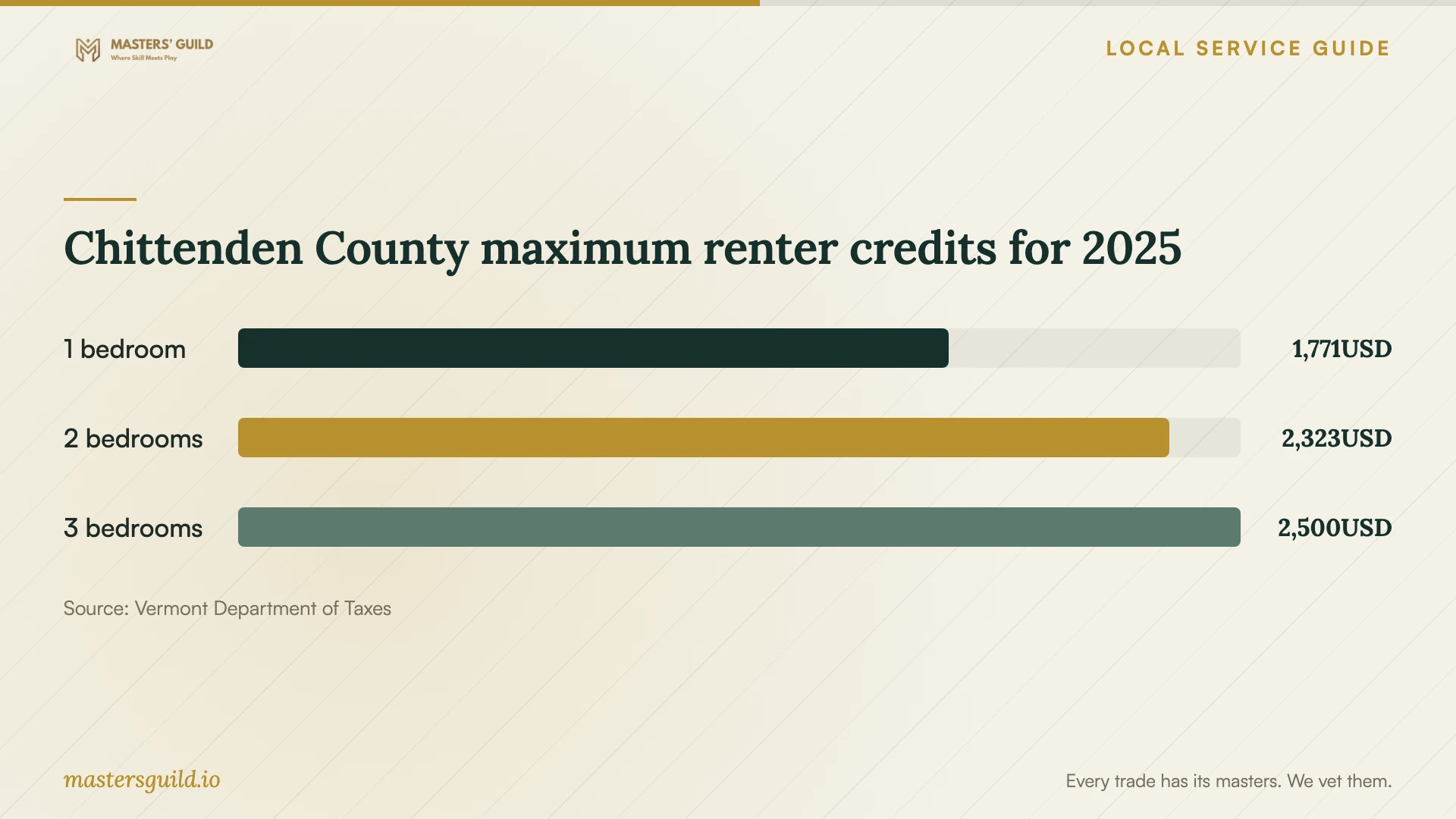
If you rented during 2025, ask whether you should pursue a renter-credit claim filed in 2026. Vermont's calculator considers family size, income, months rented, and other factors. Its Chittenden County table lists maximum amounts of $1,771 for the one-bedroom category, $2,323 for two bedrooms, and $2,500 for three through eight bedrooms. Ask the preparer to determine the applicable category and eligibility before estimating your credit. [2]
Add local business reporting when it applies
If you also run a business, ask whether the engagement covers transaction-tax reporting. Burlington has a 1% local-option sales tax, bringing the total to 7% on sales subject to it. Vermont bases local-option tax on where the buyer takes possession or receives delivery. Ask an accountant to review your delivery locations and sales records rather than applying a rate solely from your business address. [4]
For a business involving meals, entertainment, lodging, or alcoholic beverages, ask who will handle Burlington's local reporting. The Vermont Department of Taxes states that Burlington administers and collects its own local taxes in those categories and directs businesses to the city for remittance information. Include that responsibility in the quote if it applies to your work. [4]
Compare fees and agree on the handoff
Request a written fee or pricing method for the same scope from each provider. Ask whether the quote includes Vermont housing forms, record cleanup, additional state returns, amendments, and responses to notices. For hourly work, request an estimate and an approval point before the provider exceeds it. Do not compare totals until you know what each provider will deliver.
Agree on a secure method for transferring documents, a date for supplying missing records, and a date for reviewing the completed work. Ask who will contact you with questions and what confirmation you will receive after submission. Keep copies of the engagement, completed filings, and submission confirmations together.
Chittenden County maximum renter credits for 2025
Local details that affect your job
A separate Vermont homeowner filing deadline
For 2026, Vermont lists October 15 as the final acceptance date for a Homestead Declaration. Owners who fail to file by that deadline face nonhomestead classification and must pay the higher of the two rates, a penalty, and additional property tax and interest due. Ask a preparer to check your declaration status before spending an appointment on next year's planning. [1]
Chittenden County renter-credit review
For 2025 claims filed in 2026, Vermont publishes Chittenden County maximum renter credits by bedroom category. The maximum reaches $2,500 in the three-through-eight-bedroom categories. If your housing history includes renting, request an eligibility review and supply family size, income, and months rented rather than treating the published maximum as your expected payment. [2]
Burlington business taxes need a defined owner
Vermont lists Burlington for local-option sales tax but says the city administers its own local meals, entertainment, lodging, or alcoholic-beverage taxes. If you operate a relevant business, ask the accountant to specify who handles state filings and city remittances. [4]
Match the engagement to your situation
| Your situation | Work to request | Question to resolve |
|---|---|---|
| Income-tax returns with no property questions | A defined federal and Vermont preparation scope | Which returns and follow-up work does the fee include? |
| Eligible homeowner with an unfiled 2026 declaration | Homestead Declaration status check and filing | Can you address the October 15, 2026 final acceptance date? |
| Homeowner with rental use | Review of ownership, occupancy, and lease dates | Does the more-than-182-day rental rule affect my treatment? |
| 2025 renter seeking a credit review | Eligibility and applicable credit-category review | How do family size, income, and months rented affect my estimate? |
| Owner also operating a Burlington business | A separate scope for applicable state and city tax reporting | Who handles local sales tax and any city-administered taxes? |
Your hiring checklist
- Describe the returns, housing forms, and accounting work you want covered.
- Ask for the provider's claimed credential and the details needed to verify it.
- Gather prior returns, current income documents, and notices you want reviewed.
- Bring your property tax bill and a dated summary of ownership, occupancy, and rental changes.
- Request a written fee, exclusions, and approval process for added work.
- Agree on document transfer, review dates, and responsibility for missing information.
- Request copies of completed filings and submission confirmations.
Frequently Asked Questions
Does an income-tax extension cover my Homestead Declaration?
No. Vermont requires the Homestead Declaration by the April filing deadline even when you extend your income-tax filing time. For 2026, the state lists April 15 as the due date and October 15 as the final date accepted. [1]
Can I submit the Homestead Declaration myself?
Vermont allows you to file through myVTax or use paper forms. Ask a preparer for help if you need a review of ownership, occupancy, rental use, or a Property Tax Credit Claim. The state uses Form HS-122 for the declaration and credit claim. [1]
How do I check a claimed Vermont professional license?
Use the Office of Professional Regulation's Find a Professional search. Check the person's name, license type, status, and expiration date, plus disciplinary information where available. Ask the provider to explain any discrepancy before signing an engagement. [3]
Does the chart show what I will receive as a renter credit?
It shows published maximum amounts for Chittenden County categories for the 2025 tax year. Vermont says an estimate depends on family size, income, months rented, and other factors. Ask the preparer to review your eligibility and applicable category. [2]
Sources and scope
This guide combines the sources below with practical planning guidance. Figures apply to the stated geography and period; request a written quote for your property.