
Local service guide
Data Recovery and Backup in Burlington, VT
Arrange Data Recovery and Backup in Burlington, VT by separating the immediate recovery attempt from ongoing backup service. Choose a provider who will document diagnostic charges, your approval limit, device handling, and how you will check recovered files. For suspected ransomware, involve incident-response help before restoring systems: CISA recommends isolating affected devices and restoring data onto clean systems. [4]
Choose help that fits the failure
Describe the symptoms at intake: missing files, an unreadable device, physical damage, an inaccessible account, or a ransom message. Include the device identifier and any recovery attempts you have made. Name the records you need first and the business tasks they support. Hold off on authorizing a reset, reinstallation, wipe, or disposal while you still want information from the original storage.
For an existing backup, arrange a supervised restore to a separate destination and inspect the results before replacing working copies. For an unreadable device, approve diagnosis first, then review the proposed recovery attempt. Have the provider explain whether its method will alter the original storage and whether another laboratory will handle it.
For suspected ransomware, CISA advises isolating affected systems from the network. It reserves shutdown for situations where you cannot disconnect them, because powering down loses potential evidence held in memory. An incident-response specialist should coordinate containment, evidence preservation, and restoration rather than treating the incident as a file-retrieval job alone. [4]
Set the quote and handoff terms
Compare quotes using the same device and priority-file list. Separate diagnosis, recovery work, outside laboratory work, transport, replacement storage, and expedited handling. Agree on an approval ceiling and the amount owed if recovery fails. Define completion through files you can open or an application you can operate, rather than a list of filenames.
Before delivering equipment, settle who will receive it and where the work will happen. Keep a handoff receipt recording the device identifier, condition, accessories, and recipient. Include written terms for access to contents, subcontractor transfers, delivery of recovered data, and deletion of the provider's working copies.
Set a diagnostic-update deadline separately from the delivery target. During acceptance, open representative documents, check date coverage, and test the business application you identified at intake. Record missing priority files before approving completion. Keep the original storage until you have verified the recovered copy and a separate backup.
Specify a backup service you can test
CISA recommends offline, encrypted backups of critical data and regular tests of their availability and integrity in a disaster recovery scenario. It warns that ransomware can delete or encrypt accessible backups. Have the provider identify which copy remains offline and explain how you will obtain the encryption credentials during a recovery. [4]
Decide how much recent work you can afford to lose and how long you can operate without each application. Use those limits to set the backup schedule and restoration priorities. Include business cloud accounts in the inventory. Make a demonstrated restore part of acceptance, including retrieval of an older file version if you need that capability.
Name the person responsible for checking backup failures, contacting you, and performing restores in the service agreement. CISA recommends contract language that formalizes security requirements when a managed service provider maintains backups. Keep recovery instructions and necessary account access under your business's control. [4]
Protect sensitive records during recovery
The Vermont Attorney General states that businesses must keep personal information such as Social Security numbers, payment card numbers, and bank account information confidential and secure. Identify sensitive records at intake and settle access, transfer, retention, and destruction terms before handing over equipment. [2]
The Attorney General describes a security breach as unauthorized acquisition, or a reasonable belief of unauthorized acquisition, of electronic data that compromises personal information. If you suspect that kind of access, involve your legal adviser alongside the technical team. Have them assess notification requirements while the provider investigates and recovers data. [2]
Finish recovery before equipment disposal
Authorize sanitization or destruction after verifying the files you intend to keep. Obtain a record identifying the storage device and the completed method. Vermont DEC warns that electronics recycling does not guarantee data security and directs users to remove data before recycling. For storage you cannot access, discuss a documented sanitization or destruction service with the provider. [3]
Use CSWD's electronics-specific acceptance list to plan the trip. It names Essex, Hinesburg, Milton, South Burlington, and Williston. Burlington appears in the general facility directory but not that acceptance list, so confirm a listed electronics destination before transporting equipment. [1]
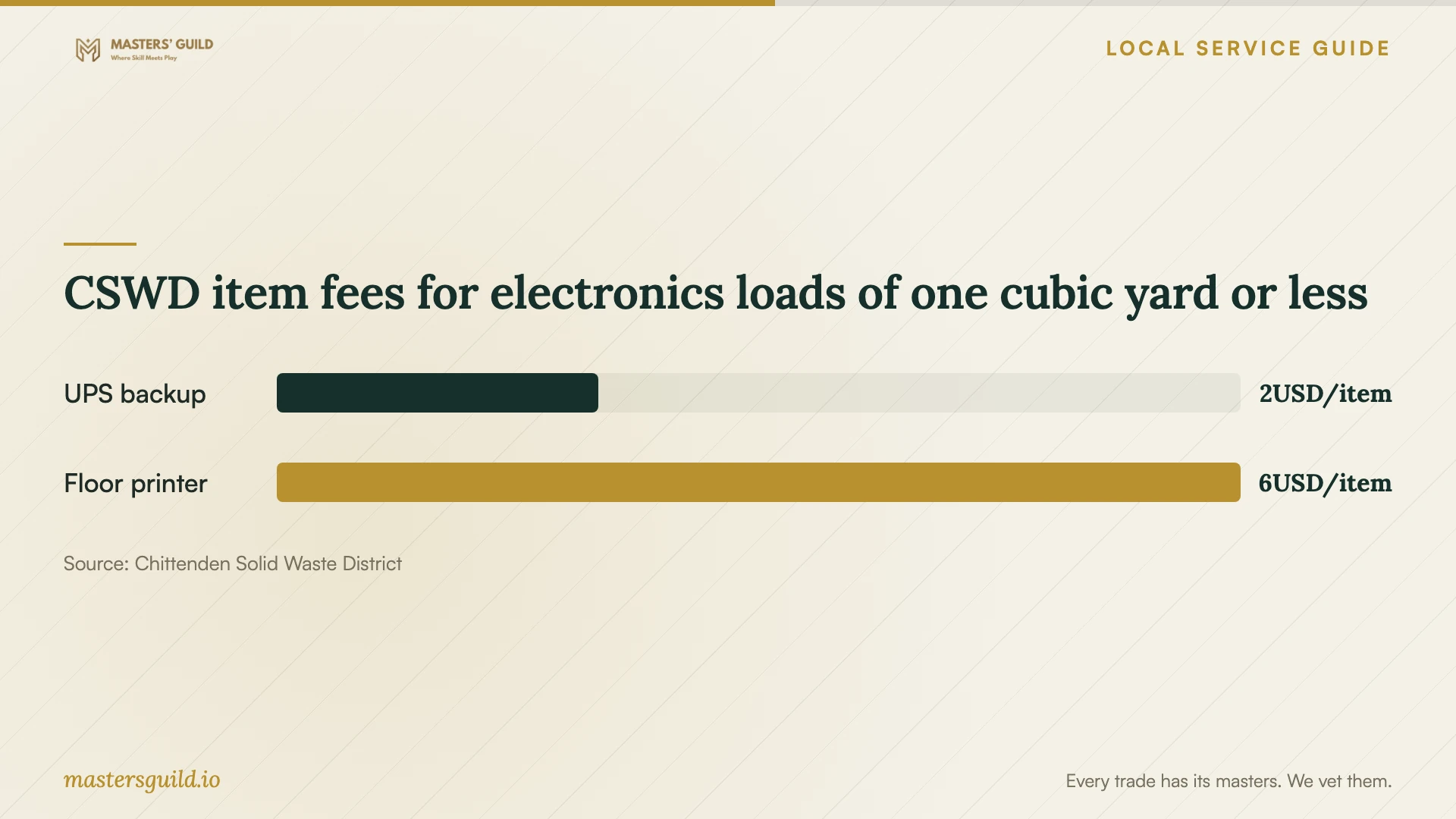
CSWD item fees for electronics loads of one cubic yard or less
Local details that affect your job
Vermont breach notice needs an early legal assessment
The Attorney General gives businesses a general preliminary-notice deadline of 14 days after discovering or receiving notice of a breach, and links an affirmation procedure to waive that preliminary notice. Consumer notification must occur as soon as possible without unreasonable delay, no later than 45 days after discovery or notice of the breach. Have your legal adviser assess applicability and the waiver procedure at intake rather than waiting for recovery to finish. [2]
Plan the destination and volume before a clear-out
CSWD lists its South Burlington electronics destination at 87 Landfill Road. It requires an appointment for loads over one cubic yard; call 802-872-8100 to arrange one. A center at capacity may direct you to return another day or visit another location. Confirm acceptance, capacity, and charges before arranging transport. [1]
Employee count and load size affect disposal charges
CSWD accepts covered E-Cycles items without charge from businesses with 10 or fewer employees. For ordinary loads of one cubic yard or less, larger businesses may bring up to seven covered items free and pay per-item fees for additional covered items. For loads over one cubic yard, CSWD lists $0.30 per pound for non-covered items or loads from entities outside E-Cycles coverage. Larger businesses planning a clear-out should confirm how CSWD will apply that weight-based rule rather than budgeting from the seven-item allowance. [1]
Match the situation to the service
| Situation | Service to arrange | Completion check |
|---|---|---|
| You have an existing backup | Supervised restoration to a separate destination | Open priority files and check their dates. |
| A device is unreadable or damaged | Diagnosis with approval before recovery work | Review usable files against your priority list. |
| You suspect ransomware | Incident response, isolation, and restoration onto clean systems | Have the technical lead assess the recovery environment. |
| You need ongoing backups | Offline encrypted copies and regular restore testing | Witness a restore and confirm credential access. |
| You are retiring equipment | Documented sanitization followed by an accepted recycling route | Verify retained copies and the sanitization record. |
Your hiring checklist
- Record symptoms, device identifiers, and previous recovery attempts.
- List priority files, applications, and acceptable downtime.
- Compare diagnostic fees, approval limits, and unsuccessful-recovery terms.
- Document device handoffs and transfers to outside laboratories.
- Set sensitive-data access, delivery, retention, and deletion terms.
- Inspect recovered files and witness a backup restore before acceptance.
- Verify separate copies before authorizing sanitization and arranging disposal.
Frequently Asked Questions
Can a provider quote recovery before seeing the device?
Treat an initial quote as a proposed scope. Clarify what diagnosis includes, which findings could change the price, and when you must approve further work. Compare the total authorized charges and unsuccessful-recovery terms before handing over equipment.
Does recovering files resolve a ransomware incident?
CISA warns that ransomware may follow an earlier unresolved compromise. Coordinate investigation and containment with restoration onto clean systems. If someone may have acquired personal information, have your legal adviser assess Vermont notification duties. [2] [4]
Can I send a failed computer straight to recycling?
Complete any wanted recovery first and verify your retained copies. Vermont DEC warns that recycling does not guarantee data security. Arrange documented sanitization or destruction before disposal, including a method appropriate for storage you cannot access. [3]
Sources and scope
This guide combines the sources below with practical planning guidance. Figures apply to the stated geography and period; request a written quote for your property.