
Local service guide
Bricklaying and Masonry in Burlington, VT
For Bricklaying and Masonry in Burlington, hire a contractor who can describe the repair, specify the materials, and assign responsibility for approvals before agreeing to a start date. The city requires a building permit for this work except qualifying in-kind repairs costing $1,000 or less. Check zoning separately when you change exterior appearance, add a patio or walkway, or build a retaining wall. Ask contractors to price the same written scope so you can compare their offers. [1] [2]
Define the repair before comparing quotes
Prepare a short description of the problem and the result you want. Photograph the whole wall, chimney, steps, or foundation, then take closer pictures from a safe position. Note where you see missing mortar, damaged bricks, cracks, or water entry. Ask the contractor to explain whether the proposed work addresses joints, replaces masonry units, or involves rebuilding part of the structure.
Request a marked photograph or sketch showing the areas included in the price. For repointing, ask how the contractor will choose the mortar and match the joint appearance. For replacement bricks or stone, request a sample before approving the material. If the contractor proposes a different exterior material or appearance, check the zoning implications before accepting that change. [2]
For a leaning wall, loose overhead masonry, or a chimney with visible movement, ask for an assessment before authorizing cosmetic repairs. Keep people away from the affected area and avoid climbing to collect photographs. Ask whether the contractor needs an engineer’s input and who will arrange it.
Check both Burlington permit routes
Burlington’s Building and Trades Division requires a building permit for non-mechanical, electrical, or plumbing work, with listed exceptions that include only in-kind repairs costing $1,000 or less. Give the division the proposed masonry scope and cost before assuming your repair qualifies. The city also requires a building permit for demolition. [1]
The zoning division exempts maintenance, repair, or in-kind replacement of an exterior architectural feature when the work preserves its location, design, material, and outward appearance. The city lists retaining walls, patios, new or expanded walkways, and exterior appearance changes among work requiring zoning review, subject to applicable exemptions. Describe the finished result, not just the label “masonry repair.” [2]
Ask the contractor to put permit responsibility in the quote: who submits applications, pays fees, schedules inspections, and supplies completion documents. If you are unsure whether zoning applies, ask the zoning office about a written determination of non-applicability. The city requires photographs documenting the existing condition for that determination. [2]
Screen the contractor for your project
Vermont requires residential-contractor registration for covered residential construction with an estimated value of $10,000 or more, including labor and materials. The state’s definition covers residential dwelling units and buildings or premises with four or fewer residential units. Verify the registration under the name that will appear on your contract. [3]
Ask about exemptions rather than assuming the threshold covers every masonry job. The state lists exemptions for work on structures unattached to a residential building and for subcontractors hired by another contractor rather than the homeowner, among others. Business registration with the Secretary of State differs from OPR residential-contractor registration. [3]
Ask for a current insurance certificate and examples of comparable masonry work. Registered residential contractors must document liability coverage of at least $1 million per occurrence and $2 million aggregate. Use project examples to discuss mortar selection, access, and finish quality; registration alone does not answer those questions. [3]
Make the price and schedule reviewable
Compare quotes by included work rather than the total alone. Ask each contractor to separate repair quantities, replacement materials, scaffolding or other access, protection of nearby surfaces, debris removal, and permit handling. Request an explanation of any allowance or excluded work. These sources do not establish a Burlington masonry price range; use quotes based on your property and scope.
For contracts governed by Vermont’s residential-contractor requirements, the state specifies price terms, estimated start and completion dates, descriptions of services and materials, and a change-order provision. The parties must document contract amendments in a signed writing. Ask how the contractor will price hidden damage before you approve additional work. [3]
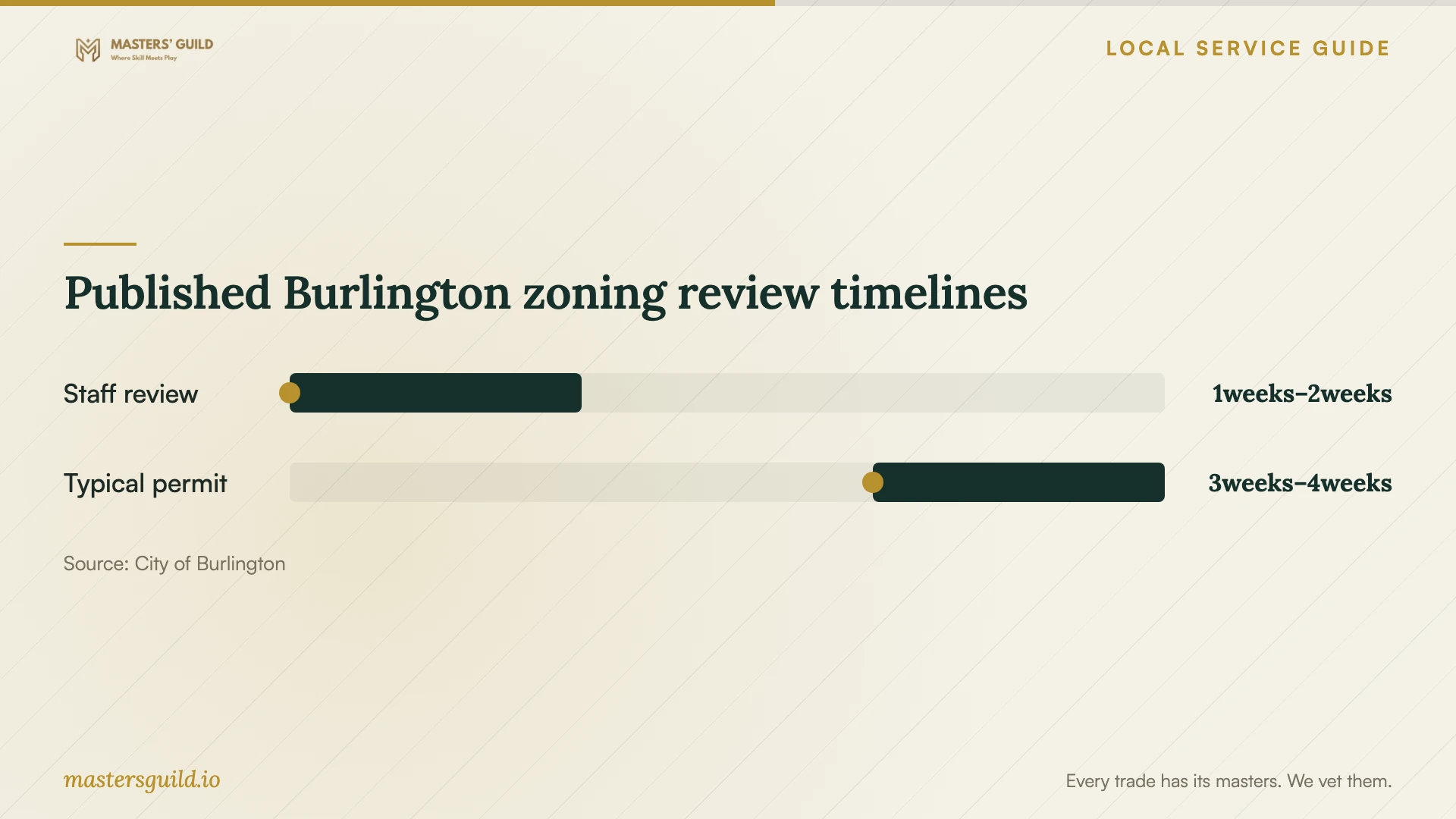
Separate approval time from the contractor’s working time. Burlington publishes a typical zoning-permit timeline of 3 to 4 weeks, including staff review and a 15-day appeal period; board-reviewed permits take longer. Ask for a proposed start window tied to approval and a written plan for weather delays, protection of unfinished work, and site access. [4]
Published Burlington zoning review timelines
Local details that affect your job
An unchanged repair still needs a building-permit check
Burlington’s zoning exemption focuses on preserving location, design, material, and outward appearance. Its building-permit exception also limits in-kind repairs to $1,000 or less. If your unchanged masonry repair exceeds that amount, do not use the zoning exemption to skip the building application. [1] [2]
Downtown and waterfront proposals may need an earlier meeting
The city requires a pre-application Administrative Conference with zoning staff for proposals in the downtown and waterfront area subject to the form based code. Ask staff whether your property and proposed masonry changes fall within that requirement before setting an application or construction date. [4]
Rental inspections require tenant coordination
For permit inspections at rental properties, Burlington requires tenants to receive 48 hours of advance notice and the owner or local property manager to meet the inspector. If you own a rental home, assign notice and inspection attendance before scheduling the work. [1]
Choose the next step for your masonry project
| Proposed work | Approval issue | Next step |
|---|---|---|
| In-kind repair costing $1,000 or less | May fit the building exception; zoning has separate conditions | Confirm the scope qualifies under both routes |
| In-kind repair costing more than $1,000 | Falls outside the stated in-kind building exception | Arrange the building application and check zoning separately |
| Changed exterior masonry appearance | City lists exterior appearance alterations for zoning review | Discuss materials and finish with zoning staff before approval |
| New patio, retaining wall, or expanded walkway | City lists these project types for zoning review, subject to exemptions | Provide the proposed layout and confirm applicable approvals |
| Covered residential contract of $10,000 or more | OPR registration applies unless an exemption covers the contractor or work | Verify registration under the contracting name |
Your hiring checklist
- Photograph the affected area from a safe position and describe the result you want.
- Ask for a sketch or marked photograph defining the repair boundaries.
- Confirm building and zoning requirements with the proposed scope and cost.
- Verify applicable contractor registration and request a current insurance certificate.
- Approve mortar, brick, or stone samples before material purchases.
- Compare access, surface protection, debris removal, and permit handling in each quote.
- Record payment terms, the start window, and signed approval procedures for extra work.
Frequently Asked Questions
Does repointing need a permit?
Check both permit routes. Burlington exempts only in-kind repairs costing $1,000 or less from its stated building requirement. Zoning exempts exterior repairs that preserve location, design, material, and outward appearance. Give staff the repair scope, cost, and proposed finish to confirm your next step. [1] [2]
Must every mason hold Vermont residential-contractor registration?
The requirement applies to covered residential construction valued at $10,000 or more, including labor and materials, with exemptions. The state exempts work on structures unattached to residential buildings and subcontractors hired by another contractor, among other cases. Ask which rule applies to your contract. [3]
How much time should I allow for zoning approval?
The city publishes a typical timeline of 3 to 4 weeks, including staff review and the appeal period. Board-reviewed permits take longer. Confirm the review route before treating the contractor’s proposed start date as firm. [4]
What should I ask about unexpected damage?
Ask the contractor to document the affected area, explain the additional repair, and provide a price before proceeding. For contracts governed by Vermont’s residential-contractor requirements, the parties must document amendments in a signed writing. [3]
Sources and scope
This guide combines the sources below with practical planning guidance. Figures apply to the stated geography and period; request a written quote for your property.