
Local service guide
Tree cutting in Buffalo, NY: Hiring and Planning
Arrange Tree cutting in Buffalo by defining your goal, requesting an assessment if you hope to keep the tree, and obtaining a written, site-specific quote. Identify overhead wires before choosing the crew: National Grid recommends an electric-qualified tree contractor for pruning or removal near service lines. Agree on the work and finished condition before signing. [1]
Choose an assessment, pruning, or removal
Describe the problem before requesting a price. Tell the contractor whether you see a broken limb, want roof clearance, or worry about the tree's health. If you want to preserve it, request an assessment and an explanation of the proposed work. Ask why the assessor recommends removal and whether pruning or monitoring could meet your goal.
Identify the tree on a photo so both parties agree which one the crew will work on. For pruning, ask the contractor to describe the branches they intend to cut and the purpose of those cuts. For removal, request a plan for handling the trunk and limbs around your house, fences, and neighboring property.
Address electrical hazards before hiring
National Grid states that New York law requires people performing tree work near overhead electric lines to have training to recognize energized-equipment hazards. Ask about the training of the employees assigned to your job. For work near service lines, the utility recommends an electric-qualified tree contractor whose workers have training to work within 10 feet of electrical hazards. [1]
After a storm, keep everyone away from downed wires and report them to National Grid at 1-800-867-5222 or call 911. The utility advises treating downed telephone, cable, and fiber wires as energized because they may contact electrical wires outside your view. Photograph the situation only from a safe location. [1]
Check the business and compare written quotes
Request the contractor's legal business name, current liability insurance documentation, and workers' compensation documentation where applicable. Ask who will assess the tree, who will supervise the crew, and whether subcontractors will perform any work. Verify any claimed arborist credential with its issuing organization.
Buffalo's Chapter 144 includes an article for Landscape and Snow Removal Contractors, with provisions on licensing, insurance, and active-license reporting. Ask the city whether your proposed tree work falls under that article and which requirements apply. The chapter index does not establish the requirements for a particular tree job. [2]
Obtain a written, site-specific quote. Give each bidder the same description and ask them to identify equipment needs, access arrangements, exclusions, and any charges that depend on conditions discovered during work. Agree on how you will approve changes and how the contractor will document additional costs.
Plan access and address suspected oak disease
Walk through the proposed equipment route with the contractor. Discuss gate width, parked vehicles, fences, and the space available for equipment. Decide where the crew can place logs or chips, how they will protect surfaces, and who will move obstacles before arrival.
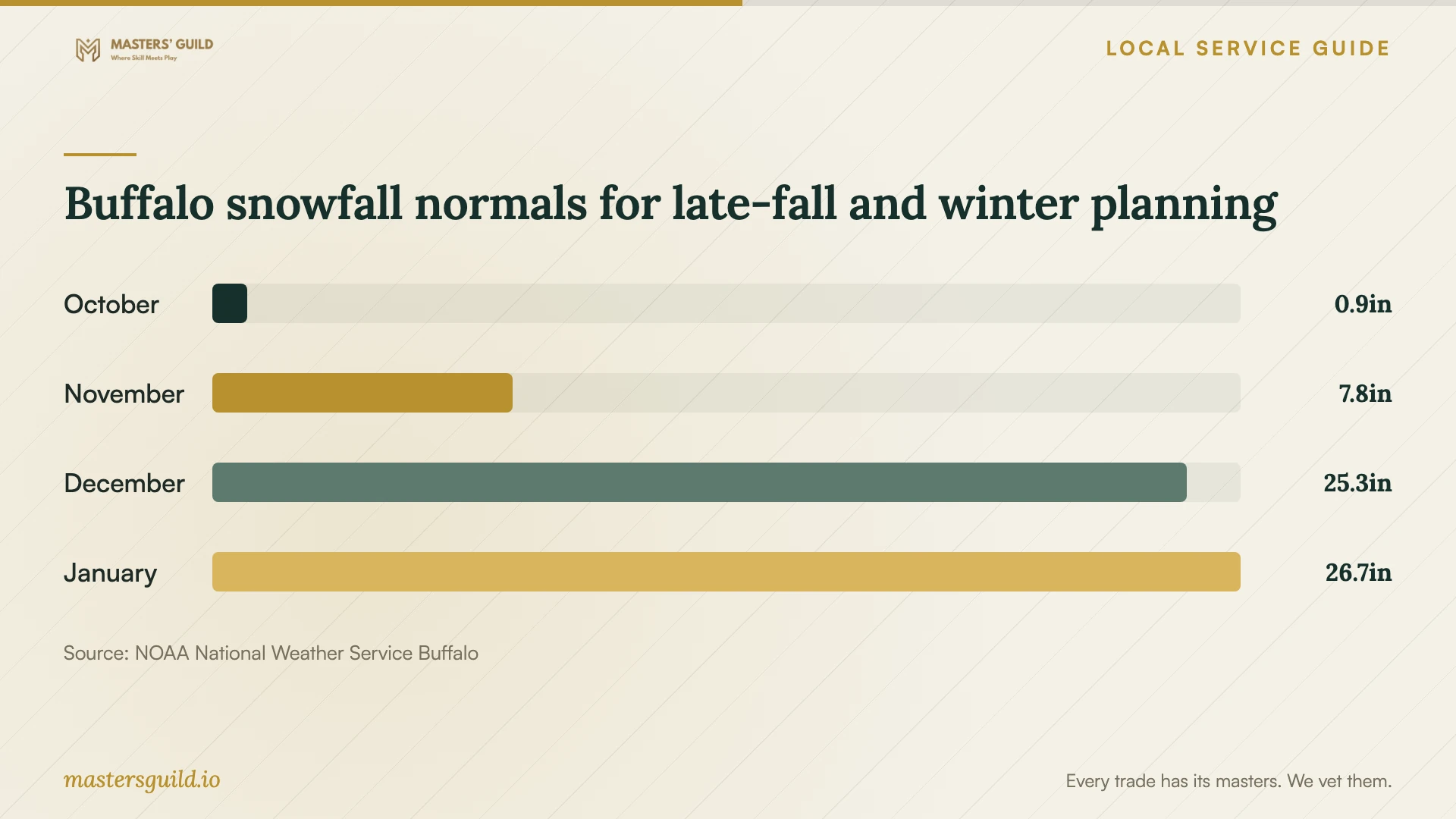
Use Buffalo's snowfall normals as context for discussing winter access and postponement arrangements. NWS publishes the Buffalo station's 1991–2020 monthly normals; those historical averages do not forecast conditions on your work date. Ask the contractor which site or weather conditions would trigger a delay and how they will arrange a new date. [4]
DEC lists summer leaf drop, leaf discoloration, and branch dieback among oak wilt symptoms. If you suspect the disease, photograph fallen leaves, the tree base, and the whole tree. Submit the photos through DEC's Forest Health Reporting Form or call 1-866-640-0652. Ask for an assessment rather than treating a symptom as a diagnosis. [3]
Specify storm cleanup and the finished ground
National Grid assigns removal of storm-damaged trees and limbs to homeowners, including material its crews cut from utility facilities during restoration. Neither the utility nor its contractors remove damaged trees from buildings; owners must select their own qualified contractor. Include these tasks when describing a storm job. [1]
Separate hazard removal, hauling, stump work, and ground restoration in the quote. If you want to retain wood, specify its size and placement. Agree on responsibility for damage to a driveway or fence. At completion, review the promised finish from a safe location and record any unfinished work.
Buffalo snowfall normals for late-fall and winter planning
Local details that affect your job
National Grid service-wire scheduling
For a property served by National Grid, you may request temporary disconnection of the service entrance wire for planned tree work. Contact Customer Service at 1-800-642-4272 at least five days before the work. The utility says a forestry representative will visit to assess safety hazards or outage risks. Coordinate that assessment before committing to the cutting date. [1]
New York oak-pruning calendar
DEC's statewide guidance advises avoiding oak pruning or wounding from March through September. For routine work here, ask the arborist to identify the species and propose a dormant-season date. Apply this as a New York disease-prevention precaution, without assuming that your tree or neighborhood has an oak wilt infection. [3]
Match the situation to the first step
| Situation | First step | Decision to resolve |
|---|---|---|
| You hope to preserve the tree | Request an assessment | Can the proposed work meet your goal? |
| A downed wire is present | Keep away and report it to National Grid or 911 | Address the electrical hazard before arranging cutting |
| Planned work may require service-wire disconnection | Contact National Grid before booking | Coordinate the utility assessment and crew date |
| An oak shows summer leaf drop | Document symptoms and contact DEC | Obtain an assessment before deciding on treatment or removal |
Your hiring checklist
- Photograph the tree from a safe location and state your goal.
- Mark the intended tree and proposed work on the estimate.
- Record the assessor's recommendation and reasons.
- Confirm the equipment route and move agreed obstacles.
- Review exclusions and the process for approving additional costs.
- Agree on postponement arrangements and completion review.
Frequently Asked Questions
Does a removal quote include stump grinding?
Ask the contractor to state the inclusion or exclusion in writing. Specify grinding depth, removal of grindings, fill, and surface restoration. Compare prices using the same finish requirements.
How should I handle an oak wound in spring or summer?
DEC advises sealing spring or summer oak wounds immediately with water-based spray paint or wound dressing to deter beetles that can spread oak wilt. This is oak-specific guidance. For a damaged limb, ask a tree care professional to assess the hazard and explain how they will manage the wound. [3]
What should I send when requesting a quote?
Send safe-distance photos of the whole tree, its base, nearby structures, and the equipment access route. Describe your goal and mention overhead wires. Ask the contractor to confirm the scope and price after assessing the property.
Sources and scope
This guide combines the sources below with practical planning guidance. Figures apply to the stated geography and period; request a written quote for your property.