
Local service guide
Tile setting in Buffalo, NY: Hiring and Permit Guide
For tile setting in Buffalo, hire an installer who will inspect the existing surface, describe preparation and any shower waterproofing, and give you a written scope before you buy materials. Ask the installer to distinguish finish-only work from structural or building-system changes. Buffalo exempts specified tile flooring and wall finishes from building permits under conditions concerning support, code compliance and, for walls, fire separations. Confirm the complete scope before relying on that exemption. [3]
Define the job before requesting quotes
Tell the installer whether you want a floor, backsplash, shower surround or isolated repair. Supply room dimensions, photographs, your tile choice if you have one, and a description of existing damage. For a repair, ask the installer to assess the surrounding area before you agree to replace individual tiles.
Request a site inspection before accepting a fixed scope. Ask the installer to describe the surface underneath the tile, proposed preparation and finished height at adjoining rooms. Have them explain how they will handle doors, thresholds, baseboards and appliances. For wall work, agree on the tile boundaries and exposed-edge treatment.
Separate tile finishes from a larger renovation
Buffalo names ceramic, quarry, porcelain and stone tile among exempt flooring materials in existing one- and two-family dwellings. The exemption requires adequate structural capacity for the flooring and related installation materials, plus compliance with applicable building, fire and life safety codes. Ask the installer to explain how they will assess support before adding tile or installing over an existing finish. [3]
For wall finishes, the city adds a condition that the installation or renovation must not affect fire separations. The general interior-renovation exemption also excludes work affecting structural parts, cutting away walls, or enlarging, altering, completely replacing or relocating a building system. If your shower project includes those changes, ask Permit and Inspection Services to review the full description. [3]
Ask the contractor to record the permit decision and who will handle applications, inspections and closeout. Buffalo places primary responsibility for permit matters on the property owner even when the owner employs a contractor. Keep the agreed scope and any city correspondence with your project records. [3]
Check credentials and compare complete quotes
Ask for the contractor's exact business name, Buffalo license category and evidence of current insurance. Buffalo's code lists several city contractor categories and defines a city license as separate from a license held in another municipality or state. A credential from elsewhere does not establish the contractor's Buffalo licensing status. [3]
Buffalo addresses home-improvement licensing in Chapter 144, including a section on the license requirement and exceptions. Ask the city which category applies to the proposed work rather than assuming that a tile installer needs no local credential. [1]
Have bidders separate tile supply, removal, disposal, preparation and installation. Specify the tile size, pattern, grout selection, edge trim and transitions. For a shower, request the proposed waterproofing system and how the installer will treat corners, penetrations and the drain connection. Ask for photographs of comparable completed work and permission to contact references.
Agree on changes, access and return to use
Before work begins, agree on a written change-order process for damage discovered after removal. Ask the installer to stop and document additional work before you approve its price. Separate the allowance for hidden repairs from the agreed installation scope so you can compare bids without guessing what each contractor included.
Ask for dates covering removal, preparation, installation, grouting and return to use. Request product-specific instructions for foot traffic, water exposure and cleaning. Arrange an alternative bathroom if the contractor expects to take your only shower out of service. Discuss material storage, cutting space, dust control and daily cleanup.
The supplied city sources establish permit rules and published fees, but they do not establish local installation prices or contractor availability. Use written site-specific quotes for your budget and agree on your schedule with the installer. [1] [2] [3]
Published residential building-permit fee components
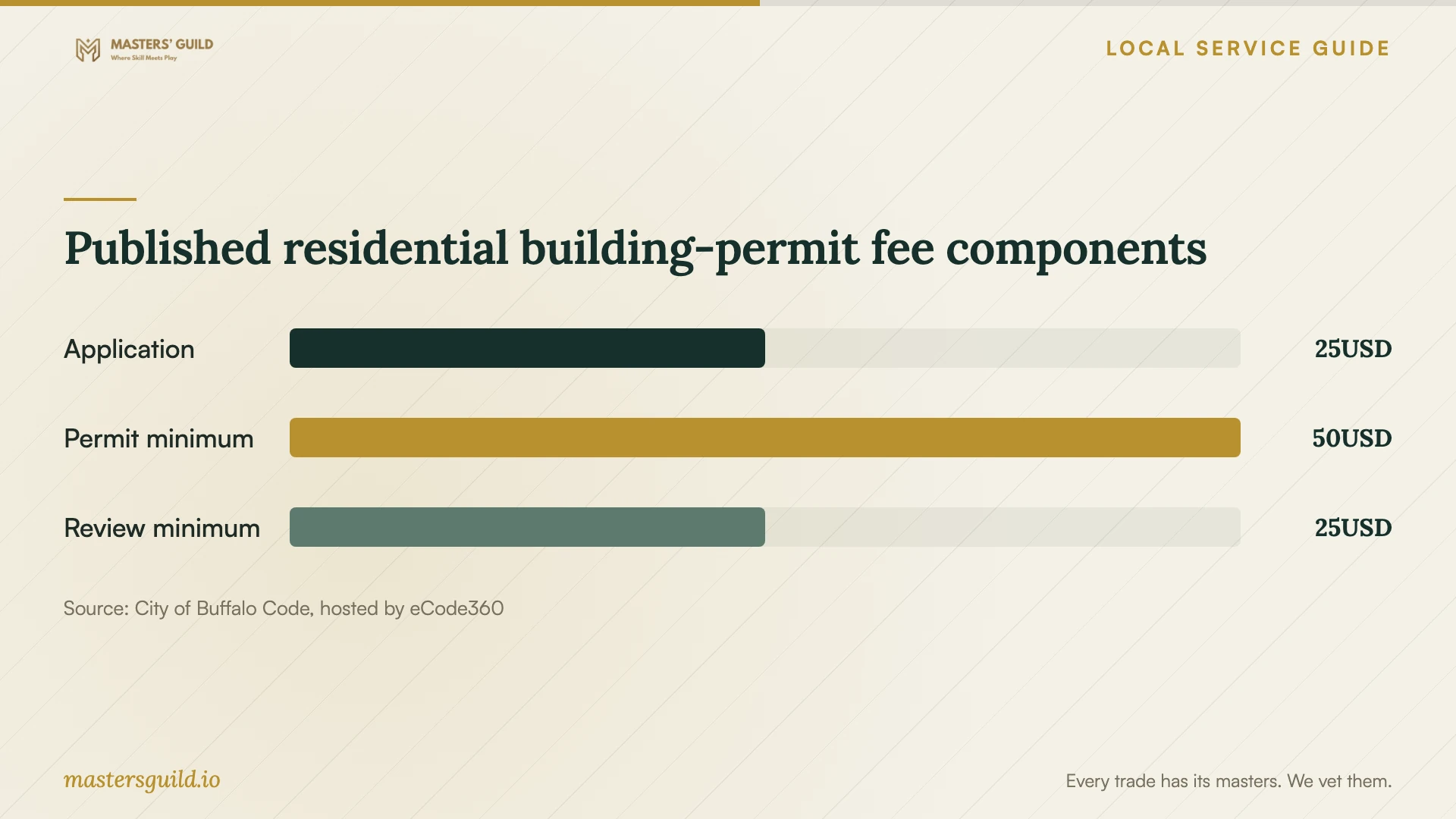
Local details that affect your job
Finish-only exemptions have specific limits
For an existing one- or two-family dwelling, Buffalo exempts named tile flooring and wall finishes under Section 103-2.3. Floor work must meet structural-load and code conditions; wall work must also avoid affecting fire separations. Describe any joist repairs, wall removal or building-system changes when asking the city whether your complete project qualifies. [3]
Asbestos work changes the permit decision
Buffalo requires an asbestos abatement permit for removal or containment of asbestos-containing materials. If an assessment identifies those materials beneath the proposed tile area, ask the contractor to separate that work from ordinary finish removal and confirm the permit arrangements before disturbance. The city lists a separate application charge and removal fees by affected area. [2] [3]
Match the project to the next step
| Proposed work | Local rule or planning issue | Next step |
|---|---|---|
| Tile floor finish | Named tile materials can qualify for an exemption with structural-load and code conditions. | Ask the installer to assess support and describe the installation layers. |
| Backsplash or wall tile | The wall-finish exemption also requires that work avoid affecting fire separations. | Confirm the wall scope and any work behind the finish. |
| Tile with structural or building-system changes | The finish exemption does not establish an exemption for the added work. | Send the full project description to Permit and Inspection Services. |
| Removal of identified asbestos-containing materials | The city requires an asbestos abatement permit. | Confirm abatement arrangements before anyone disturbs the material. |
Your hiring checklist
- Photograph the room, existing damage, thresholds and adjoining finishes.
- Give each bidder the same tile size, layout and installation boundaries.
- Request an inspection and a written description of surface preparation.
- Verify the contractor's Buffalo license category and insurance.
- Confirm the full scope's permit status before removal begins.
- Agree on written approval and pricing for hidden repairs.
- Record access arrangements, cleanup duties and return-to-use instructions.
Frequently Asked Questions
Do I need a permit to replace a tile floor?
Buffalo exempts specified tile flooring in existing one- and two-family dwellings when the structure supports the added load and the installation complies with applicable codes. Confirm any additional structural or building-system work as part of the complete scope. [3]
Can I treat a shower renovation as exempt wall tile?
Review the whole project. Buffalo's wall-finish exemption has structural-support, fire-separation and code conditions. Ask the city to assess the scope if you plan wall removal, structural work or building-system changes. [3]
What should I ask about a low quote?
Ask the bidder to identify preparation, removal, waterproofing where applicable, trim, disposal and cleanup. Request exclusions and the process for approving hidden repairs. Compare the same tasks and material choices across bids.
Does a permit exemption remove my other responsibilities?
No. Buffalo requires code compliance and applicable approvals even when a building permit or building-permit fee exemption applies. The city also identifies the owner as the primary responsible party for permit matters. [3]
Sources and scope
This guide combines the sources below with practical planning guidance. Figures apply to the stated geography and period; request a written quote for your property.