
Local service guide
Special Item Transport in Buffalo, NY
For Special Item Transport in Buffalo, choose a mover after reviewing the item, access at both addresses, written charges, and damage coverage. For a household move within New York, verify the carrier with NYSDOT using its exact name or NYDOT number. If your standalone transport job has an uncertain classification, ask NYSDOT which requirements apply before booking. [1]
Choose someone who can explain the handling plan
Describe the item before discussing a booking date. Send its make or model, dimensions, photographs, and any manufacturer documentation you have. Distinguish a documented weight from your estimate. Ask the mover to explain the equipment, crew, protective materials, and handling method they propose for your item.
Identify who will perform each part of the work. For a piano, discuss preparation and final placement. For a pool table, specify dismantling, transport, reassembly, and leveling. For a safe, discuss contents removal and any anchoring work. For artwork or antiques, ask about packing or crating. Include the tasks you need in the written scope.
For household moves within New York, NYSDOT tells customers to verify the mover’s license and obtain a Summary of Information booklet explaining shipper rights. Alongside that check, ask the mover for examples of comparable work and an explanation of how the crew will protect your item and property. [1]
Review access at pickup and delivery
Photograph the full path from the item to the truck and from the truck to its final position. Include exterior steps, door openings, stair turns, landings, and any elevator. Measure the narrowest clear opening and explain where the truck can stand. Have the mover review both routes before accepting the job.
Arrange a site assessment if the mover cannot confirm access from your measurements and photographs. Discuss floor and wall protection, door removal, and any proposed lifting through an opening. If the plan involves altering the building or using outside lifting equipment, identify who will assess and arrange that work before you authorize it.
Compare written scope and charges
Obtain item-specific written estimates using the same pickup, delivery, access, and setup details. NYSDOT recommends at least three estimates, preferably following a physical inspection, and cautions that a phone or written estimate may differ from the actual cost. Ask each mover to explain which charges can change. [1]
Have each mover identify charges for transport, packing, dismantling, setup, stairs, carrying distance, storage, and any return visit. Confirm whether the price is fixed or depends on time or other variables. Record how you will approve changes, along with cancellation, weather delay, and waiting charges.
Before loading, review cost and delivery terms with the company representative. New York’s Department of State advises customers to avoid blank or incomplete estimates and to question large upfront or full advance payments. For a household move within New York, NYSDOT says to obtain an Order for Service stating the amount payable at delivery. [1] [2]
Agree on coverage and inspect the delivery
Ask the mover to explain its liability and options for additional coverage, as NYSDOT recommends. Discuss the item’s value, existing damage, and who packs it. Request applicable limits and exclusions in writing so you can assess whether the proposed protection meets your needs. [1]
Make a photo record and written inventory before pickup, following Department of State guidance. Photograph surfaces, corners, and visible defects. At delivery, compare the item with your record and inspect the agreed placement and setup before signing a completion acknowledgment. Record any damage you find. [2]
For loss or damage on a New York intrastate move, notify the mover in writing as soon as possible. NYSDOT says movers must respond within 30 days and resolve the claim in writing within 120 days; a resolution may include a denial. NYSDOT cannot adjudicate loss or damage claims. Keep your paperwork if you need to pursue a court remedy. [1]
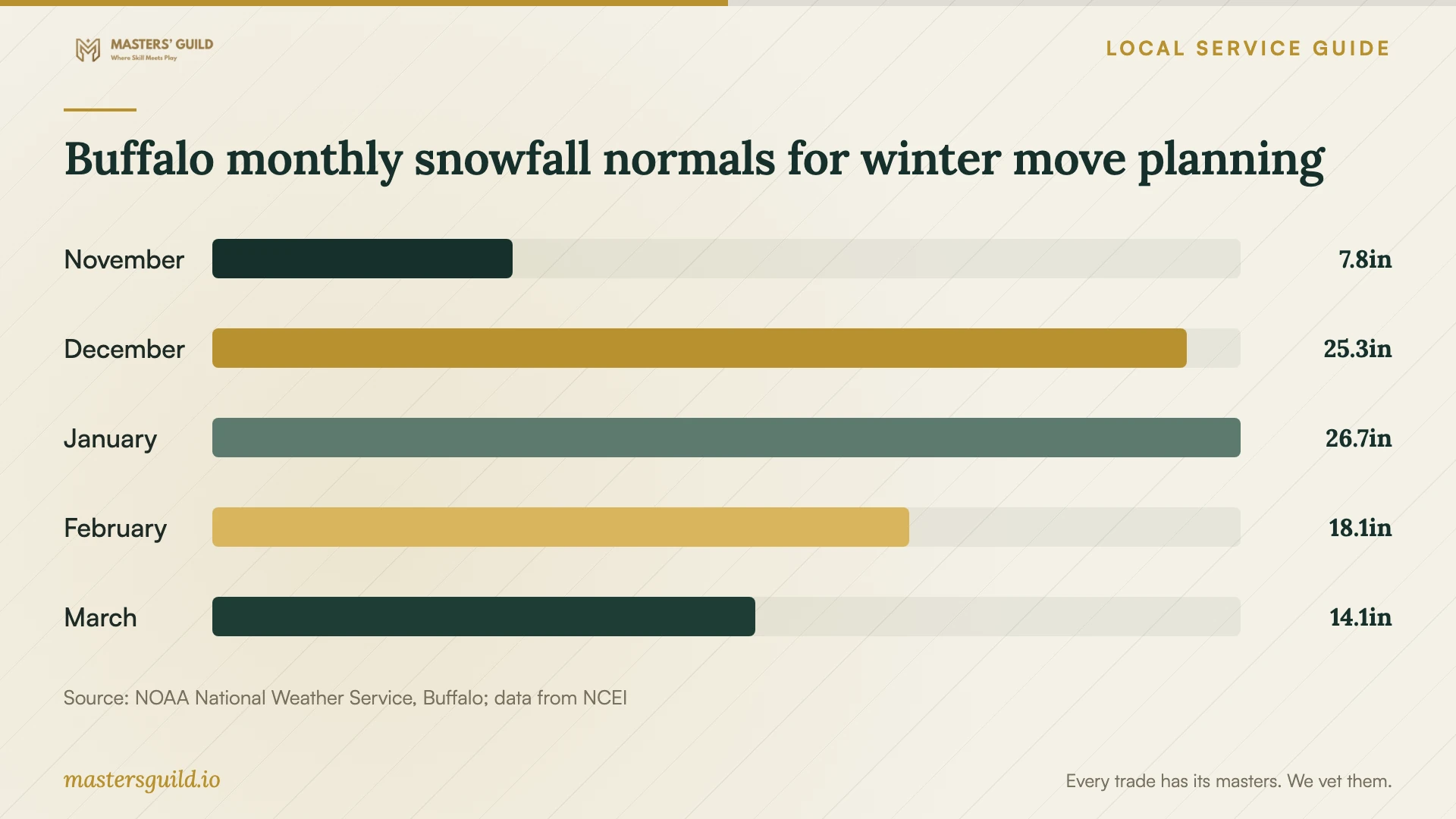
Buffalo monthly snowfall normals for winter move planning
Local details that affect your job
Verify authority for your actual route and job
For a household move that starts and finishes in New York, call NYSDOT at 518-457-6512 or email [email protected] with the company’s exact name and, if available, NYDOT number. For a household move between New York and another state, check federal registration through FMCSA. If you are arranging standalone special-item transport and are unsure how NYSDOT classifies the work, describe the item, route, and proposed service to NYSDOT before deciding which authority check applies. [1] [2]
Check winter access at each property
NWS Buffalo explains that lake-effect snow is localized and that areas south of Buffalo receive more lake-effect snow than locations to the north. For a winter move, ask someone at each property to confirm driveway, step, and unloading-area conditions that morning. Agree with the mover who clears snow and ice and when unsafe access would trigger rescheduling. For a route extending south of the city, make a separate destination check rather than relying on conditions at pickup. [4]
Match the booking to the work
| Your situation | Next step | Confirm before booking |
|---|---|---|
| Household move within New York | Verify the carrier with NYSDOT | Exact company name, NYDOT number if available, and Order for Service |
| Household move between New York and another state | Check federal mover registration | Identity of the company transporting the item and applicable paperwork |
| Standalone transport with uncertain classification | Describe the proposed job to NYSDOT | Which requirements apply to the service and route |
| Piano, safe, or slate table with difficult access | Request a handling plan and access assessment | Equipment, packing, workable routes, and setup responsibilities |
| Winter pickup and delivery | Check conditions at both properties | Snow clearance responsibility and rescheduling terms |
Your hiring checklist
- Send item photographs, dimensions, model information, and documented weight if available.
- Measure openings and photograph stairs, turns, and the truck-to-door route at both addresses.
- Resolve any uncertainty about job classification with NYSDOT and verify the applicable carrier authority.
- Record who handles packing, dismantling, reassembly, leveling, and final placement.
- Confirm coverage terms, payment arrangements, and how you will approve extra work.
- Arrange clear loading access and agree on weather delay terms.
- Keep a condition record and inspect the item and agreed setup at delivery.
Frequently Asked Questions
How much should I budget for a special-item move?
Obtain at least three item-specific written estimates with the same access and setup details. NYSDOT recommends estimates following physical inspections and warns that an estimate may differ from the actual charge. Ask each mover which charges can change, what triggers a change, and how you will approve additional work. [1]
Does transport include reassembly or installation?
Have the mover list those tasks in the agreement. NYSDOT cautions customers against expecting services such as disconnection and reinstallation without charge. Specify final placement, reassembly, leveling, or anchoring for your item, and identify who will perform each task. [1]
Can I use the snowfall chart to choose a moving date?
Use it to plan seasonal precautions. The chart contains Buffalo primary climate-station normals for 1991–2020, rather than a forecast for your address or booking date. NWS describes lake-effect snow as localized. Check current conditions at both properties and discuss scheduling flexibility with your mover. [3] [4]
Sources and scope
This guide combines the sources below with practical planning guidance. Figures apply to the stated geography and period; request a written quote for your property.