
Local service guide
Plumbing services in Buffalo, NY: Hiring and Permits
Arrange Plumbing services in Buffalo by defining the repair, checking the contractor’s City of Buffalo master-plumber license, and requesting a written estimate with probable permit fees. Ask the contractor to identify any permit exemption that applies. For a suspected buried water-service leak or lead service line, contact Buffalo Water before approving excavation or paying for replacement. [1] [2] [4] [7]
Describe the problem before booking
Give the plumber your address, building type, affected fixtures and a description of the problem. Explain whether you need drain clearing, a visible pipe repair, a replacement fixture, water-heater work or investigation of a buried line. Send photographs of accessible piping and equipment labels. Ask for the diagnostic charge, arrival window and charges for work outside the initial visit.
For an active supply leak, close the household shutoff if you can reach and operate it safely. Buffalo Water says the whole-house valve usually sits near the incoming service in the front of the basement or crawl space. If that valve fails to hold or needs replacement, call customer service at 716-847-1065 to arrange a utility shutoff. Coordinate that appointment with your plumber. [4]
If you hear running water while nobody uses a fixture, check for a leaking toilet and meter movement. Buffalo Water advises calling 716-847-1065, option 2, for investigation if you suspect a buried leak after checking for internal leaks. Its crew can help determine whether the sound comes from the private service line or a city main. [4]
Check the license and permit responsibility
Ask for the responsible master plumber’s name and City of Buffalo license details, then verify current status with the city before hiring. Request proof of insurance as a separate hiring check. Buffalo prohibits an unlicensed person from conducting the business of master plumbing, and its code requires master plumbers to ensure that employed journeymen hold current licenses. [2]
Buffalo requires a permit before plumbing work begins unless the work qualifies for an exemption. The city issues plumbing permits to City of Buffalo Licensed Master Plumbers, with a separate provision for resident owners who prove their qualifications to the Commissioner. Ask the contractor to identify the applicable permit or exemption and name the person who will arrange inspections. [1]
For existing one- and two-family homes, exemptions include drain clearing without cutting beyond the fixture trap, specified faucet and toilet-component work, and repairs or replacements in-kind of existing fixtures other than hot water tanks. The city also exempts qualifying water-distribution leak repairs involving no more than 20 lineal feet of piping aboveground or above the basement or cellar floor. Exempt work must meet code. Ask the city to confirm your scope if you plan to relocate or add fixtures. [1]
Compare complete quotes
Ask each plumber to quote the same scope: diagnosis, labor, named parts or equipment, removal, access work and cleanup. Identify who repairs opened walls or floors. For a recurring drain problem, ask what findings would justify further investigation or pipe replacement. Require your approval before the contractor expands the work.
Buffalo requires master plumbers to include probable permit fees in estimates or contracts. It also requires a warning about reasonably anticipated additional work and an approximate cost, especially for buried or hidden piping. Request that explanation in writing. Agree on how the contractor will document discoveries and obtain approval for additional charges. [2]
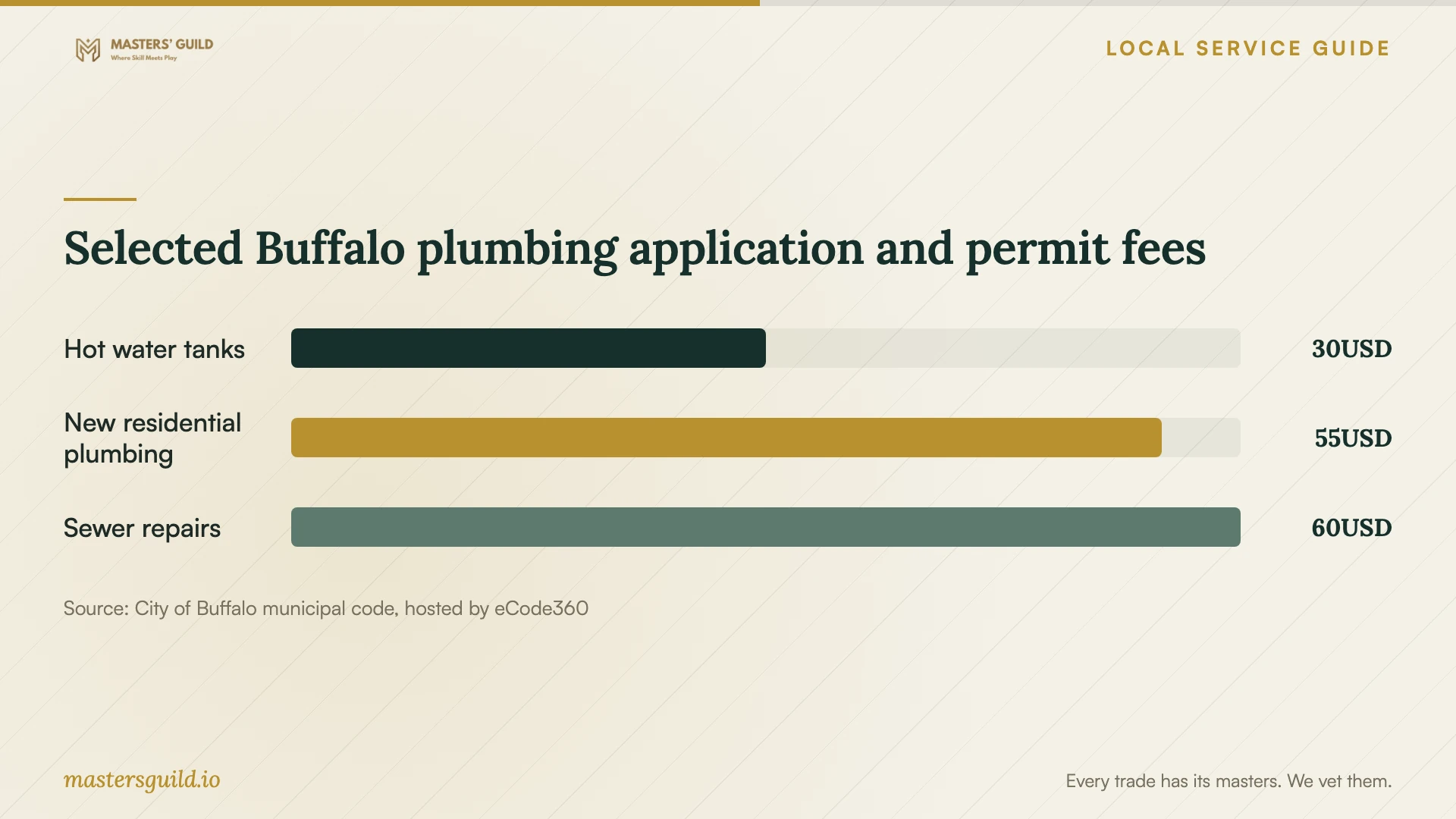
The fee chart combines the city’s application and permit charges for three categories eligible for its plumbing flat-fee schedule. Use those amounts to check the permit allowance in a quote. They do not include the plumber’s labor, equipment or restoration work. The city uses a different schedule for work requiring plans, so ask which schedule applies to your project. [3]
Plan service-line work before excavation
Buffalo Water assigns property owners responsibility for the private water service line from the main to the house, plus the service box and shutoff valve. For underground repairs, ask the plumber to specify the repair limits, utility coordination, excavation method and restoration of any affected roadway, sidewalk or landscaping. [4] [5]
Review your property’s service-line classification through the Buffalo Water Lead Program inventory. The program distinguishes lead, non-lead, galvanized requiring replacement and unknown material. An unknown classification means the program lacks documented evidence to classify the material. Ask Buffalo Water how to confirm it before accepting a replacement proposal based on a particular pipe material. [6]
Homeowners and tenants can request free in-home lead tap sampling through 311. The utility’s FAQ describes no-cost replacement when a home has a lead service line and samples show high lead levels even after flushing. It also describes replacement of lead lines discovered during water-main replacement projects. Confirm your property’s eligibility and schedule with Buffalo Water before authorizing a private replacement. The inventory label alone does not establish eligibility under those stated conditions. [7]
Prepare access and agree on completion
Clear access to the affected fixture, incoming water service and equipment. Tell the plumber about shared shutoffs or occupied units, and agree on the water-off window before the appointment. Keep the quote, equipment information and photographs together. At completion, ask the plumber to demonstrate operation, explain the repair and provide permit and inspection records where applicable.
For a property that will sit vacant for an extended period or through winter without heat, Buffalo Water recommends shutting water off at the curb and draining the house piping to prevent freezing and flooding. Arrange a winterization scope that names who will confirm the shutoff and drain the plumbing. [4]
Selected Buffalo plumbing application and permit fees
Local details that affect your job
Repair length changes the permit question
In existing one- and two-family homes, Buffalo’s water-distribution leak-repair exemption covers no more than 20 lineal feet of piping and requires aboveground piping or piping above the basement or cellar floor. Tell the plumber the location and anticipated length so they can assess the exemption before starting. [1]
Check the utility’s lead program before paying
Call 311 for free lead tap sampling and ask Buffalo Water about the replacement conditions described in its FAQ. Check your line material and sampling results before choosing a privately funded replacement. [6] [7]
Include the street portion in your quote
Buffalo property owners bear responsibility for their service line all the way to the water main, including replacement under the street and street repair when required. Ask for explicit restoration terms. If you have a service contract, check coverage limits, waiting periods and restoration exclusions with its administrator. [5]
Match the job to the next step
| Your situation | Next step | Local scope check |
|---|---|---|
| Single blocked drain | Describe the affected fixture and request a clearing scope. | The exemption for existing one- and two-family homes covers clearing without cutting beyond the fixture trap. |
| Visible supply-pipe leak | Share the pipe location and proposed repair length. | The qualifying residential exemption limits repairs to 20 lineal feet aboveground or above the basement or cellar floor. |
| Water-heater replacement | Request permit responsibility and equipment details in the quote. | Hot water tanks fall outside the listed residential fixture-replacement exemption. |
| Suspected buried service leak | Check internal leaks, then contact Buffalo Water for investigation. | The owner maintains the private line from the main to the house. |
| Lead or unknown service-line material | Check the inventory and discuss sampling or material confirmation with the utility. | Homeowners and tenants can request free lead tap sampling through 311. |
Your hiring checklist
- Record affected fixtures, symptoms, photographs and equipment labels.
- Ask for the responsible master plumber’s city license details and proof of insurance.
- Request a written scope with diagnostic charges, parts, labor and exclusions.
- Ask the contractor to identify the permit requirement or specific exemption.
- Agree on water-shutoff timing and access to shared or occupied spaces.
- For service-line work, ask Buffalo Water about material verification and applicable assistance before approving excavation.
- Require approval for added work and specify who handles surface restoration.
- Keep the invoice, warranty terms and applicable permit and inspection records.
Frequently Asked Questions
Can I replace a toilet without a plumbing permit?
Buffalo lists replacement in-kind of an existing plumbing fixture, excluding hot water tanks, among exemptions for existing one- and two-family dwellings. Confirm that your toilet work fits that scope. Moving the fixture or changing its piping requires a separate assessment, and exempt work must meet code. [1]
Who pays for a leaking water line under the street?
Buffalo Water says the property owner maintains the private service line from the water main to the house, including the portion under the street and required street restoration. Ask the utility to help distinguish a service-line leak from a main leak, and review any existing service-contract coverage. [4] [5]
Does a lead service line qualify for free replacement?
Confirm eligibility with Buffalo Water. Its FAQ describes no-cost replacement for a lead service line when tap samples show high lead levels even after flushing, and for lead lines discovered during water-main replacement projects. Request free sampling through 311 before committing to private replacement. [7]
Can Buffalo Water shut off the supply for an indoor repair?
If the household shutoff fails to hold or needs replacement, Buffalo Water directs customers to call 716-847-1065 to schedule an onsite service shutoff. The utility notes a trip charge. Coordinate the utility appointment and plumber’s visit, and confirm the charge when booking. [4]
Sources and scope
This guide combines the sources below with practical planning guidance. Figures apply to the stated geography and period; request a written quote for your property.