
Local service guide
Mold Removal in Buffalo, NY: Hiring and Planning
For Mold Removal in Buffalo, start with an independent New York licensed mold assessor before requesting remediation quotes for a covered project. The assessor defines the work; a separate licensed remediator prepares a work plan and quote. Arrange moisture repairs and a post-remediation assessment as part of your project planning. New York defines covered mold projects as areas greater than 10 square feet, with exceptions described in its guidance. [1] [2]
Choose assessment or small-area cleanup
New York advises considering professional assessment and remediation when the total affected area exceeds 10 square feet or you have sensitivity to mold. For an area below that threshold, its guidance allows homeowner cleanup when the homeowner has no mold sensitivity. The state also exempts residential owners working on their own property from mold licensing requirements. [2]
For a small patch on a hard, nonporous surface, Erie County recommends detergent and water followed by complete drying. Moldy porous materials, including carpet and ceiling tiles, may need disposal. Use the county’s protective-equipment guidance, and avoid involving children in disaster cleanup. [3]
Describe the total affected area when arranging an assessment, including separate patches. Send photos, identify rooms and explain whether the growth returned after earlier cleaning. If you cannot see the full extent, ask the assessor how they will investigate it before you authorize removal.
Verify licenses and keep assessment independent
New York requires the appropriate mold license for covered assessment, remediation and abatement work. The Department of Labor links to a contractor search for businesses and an individual-license search for assessors and workers. Check the exact names and expiration dates against the people and company you intend to hire; expired license holders cannot perform covered mold work. [1] [2]
A licensee cannot perform both assessment and remediation on the same project. The remediator must obtain the assessor’s remediation plan, prepare a work plan that meets its requirements and give you that work plan before abatement begins. You cannot waive the required assessment. [2]
Ask who will assess the property, who will supervise removal and who will complete the post-remediation assessment. Request current insurance documentation and keep copies with the plans and contract. Resolve unclear company names or roles before signing.
Build a budget from the assessed scope
New York’s guidance says remediation cost estimates should not precede the independent assessment. The assessor’s remediation plan includes an abatement cost estimate; you then give that plan to a remediator to develop a work plan and project quote. Use this sequence instead of treating an early room-based price as your final budget. [2]
Request separate prices for assessment, remediation, moisture repairs, reconstruction and the post-remediation assessment. Ask each bidder to identify exclusions, disposal arrangements and the process for pricing additional work if they uncover more damage. Compare quotes against the same plan rather than comparing totals alone.
Ask for a schedule that identifies assessment, source repair, removal, drying, reassessment and rebuilding. Have the contractor explain access restrictions and when you can use the affected rooms. Require written approval for changes to the scope or price.
Repair moisture and prepare the work area
Erie County recommends drying water-damaged areas and items within 24 to 48 hours to help prevent mold growth. It identifies moisture control as essential and warns that cleaning without fixing the water problem can allow mold to return. Treat active water intrusion as a repair task alongside the mold project. [3]
If floodwater entered your heating or cooling system, Erie County advises having a professional experienced in mold cleanup check and clean it before you turn it on. Running a flooded system can spread mold through the home. [3]
Before crews arrive, agree on the route for removing debris, which belongings you should move and how workers will protect adjacent rooms. Ask who handles the underlying leak. New York allows assessors or remediators to perform moisture-source repairs outside the remediation plan, but clarify those repairs in your contract. [2]
New York’s minimum work standards include a post-remediation assessment. Plan that step before rebuilding, and ask what documentation you will receive. Keep the assessment, work plan, repair records and completion documents together for any follow-up. [1]
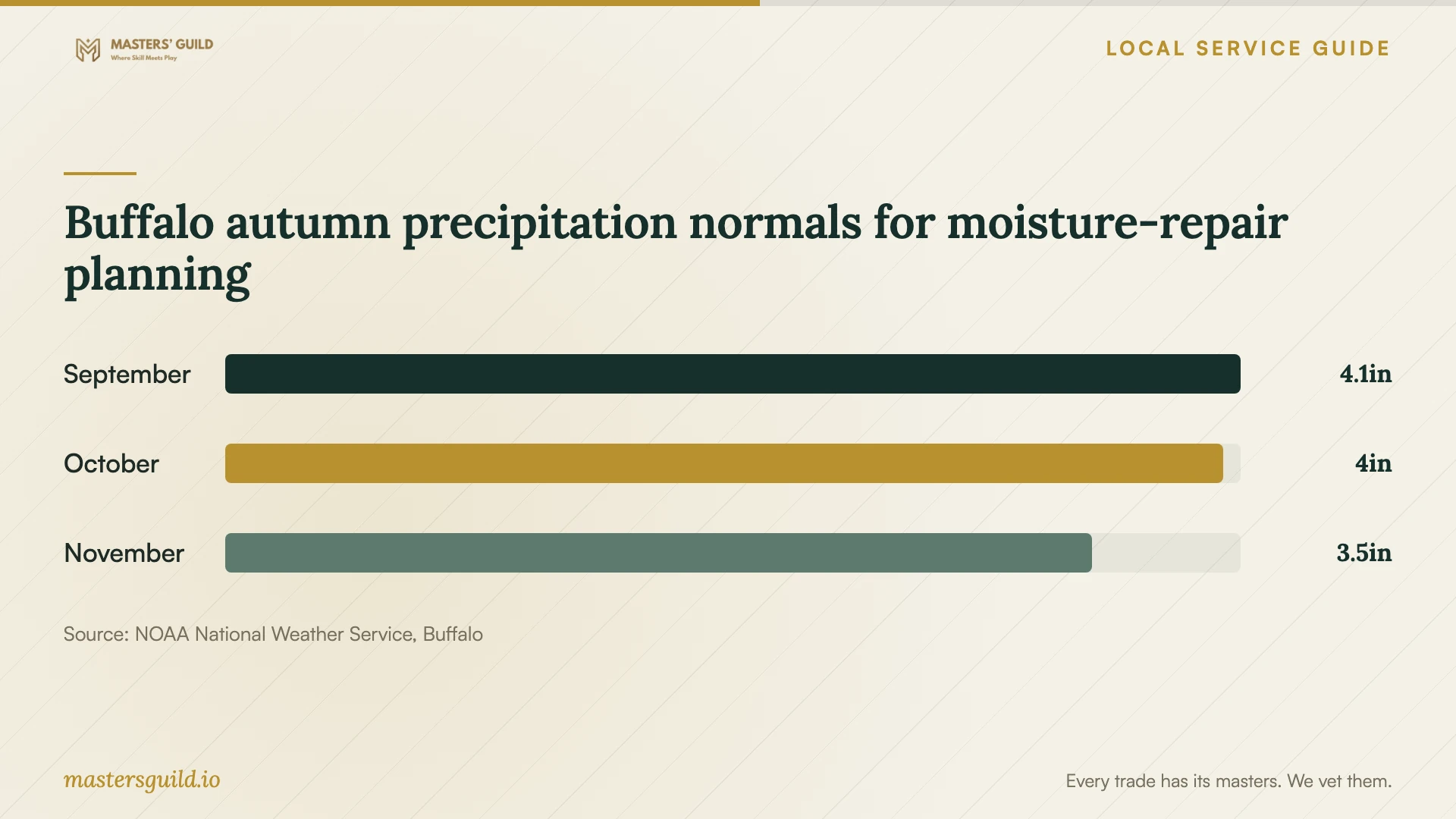
Buffalo autumn precipitation normals for moisture-repair planning
Local details that affect your job
Use Erie County for moisture-condition guidance
Erie County Environmental Health cannot perform home mold testing or assessment. It may have limited authority to require owners to eliminate certain moisture-causing conditions, such as leaking pipes; structural roof or gutter issues belong with the local building inspector. Call Environmental Health at 716-961-6800 to clarify its role before expecting a county inspection to replace a licensed assessment. [3]
Direct licensing concerns to the Buffalo district
The New York State Department of Labor’s Buffalo district serves Erie County and lists its office at 295 Main St, Suite 905, with telephone 716-847-7126. The department enforces mold licensing and work standards and provides a mold complaint form. Use that route for concerns about unlicensed covered work or violations of the assessment and remediation requirements. [1]
Choose your next step
| Situation | Next step | Reason |
|---|---|---|
| Less than 10 square feet and no mold sensitivity | Consider homeowner cleanup using official precautions. | New York allows this option; porous materials may still need disposal. |
| More than 10 square feet or mold sensitivity | Consider a licensed assessor before arranging remediation. | State guidance recommends professional help in these circumstances. |
| A remediator offers to assess and remove mold on the same project | Arrange independent assessment and verify licenses. | New York prohibits a licensee from performing both roles. |
| Floodwater entered HVAC equipment | Arrange an experienced professional’s check and cleaning before operation. | Erie County warns that operating a flooded system can spread mold. |
| A leaking roof or gutter needs official intervention | Contact the local building inspector. | Erie County identifies structural issues as the inspector’s responsibility. |
Your hiring checklist
- Record affected rooms, approximate total area, photos and the history of leaks or repeat growth.
- Verify the assessment business, individual assessor and remediation business in the state license searches.
- Obtain the independent assessor’s plan before requesting remediation quotes.
- Give each bidder the same plan and request written inclusions, exclusions and change pricing.
- Assign responsibility for the moisture repair and any rebuilding.
- Agree on room access, belongings, debris removal and the work schedule.
- Arrange the post-remediation assessment and retain the project documents.
Frequently Asked Questions
Do I need air testing before hiring someone?
New York says air sampling and mold testing are unnecessary in most cases and notes that no EPA or federal mold standards exist for interpreting results. An assessment still serves a separate purpose: defining the remediation scope. Ask the assessor what a proposed test would change in the plan. [2]
Can I hire a remediator without an assessor if I sign a waiver?
No. For a covered project, New York requires a licensed assessor’s assessment before the licensed remediator begins work. The state says an owner’s waiver does not remove that requirement. [2]
Should the contractor paint over the affected surface?
New York advises against painting or caulking over moldy surfaces. Ask the contractor to explain cleanup, removal and drying before you approve finish work. [2]
Will Erie County test my home for mold?
No. Erie County Environmental Health says it cannot perform mold testing or assessment. It may address some moisture-causing conditions within its authority, while structural problems go to the local building inspector. [3]
Sources and scope
This guide combines the sources below with practical planning guidance. Figures apply to the stated geography and period; request a written quote for your property.