
Local service guide
Kitchen Remodeling in Buffalo, NY: Plan and Hire
For Kitchen Remodeling in Buffalo, choose a contractor after you agree on the layout, compare written scopes and verify the required city license and insurance. Confirm permits with the local building and codes office before starting. For a pre-1978 home, include Erie County's required lead-safe practices and worker certification in your demolition plan before accepting a bid. [1] [2]
Define the kitchen you want before requesting bids
Start with the problems you want to solve: limited storage, awkward appliance placement, damaged finishes or insufficient space to cook. Decide which cabinets, appliances and surfaces you want to keep. Give each bidder the same photographs, measurements and proposed layout.
Request separate descriptions of cabinet work, countertops, flooring, lighting, plumbing, appliance installation and wall changes. For products you have not selected, ask for an allowance and its inclusions. Discuss delivery, installation and disposal so you can compare complete scopes.
Before approving cabinet drawings, review door swings, drawer access and room to use the dishwasher and oven. Ask who will measure the kitchen and confirm appliance dimensions. Assign responsibility for correcting a mismatch between the approved design and ordered products.
Verify the contractor and agree on contract terms
Erie County Consumer Protection says home-improvement contractors must hold a license in the City of Buffalo. Its guidance recommends checking references and requesting proof of insurance. Verify the business named in your contract, and ask who will perform plumbing and electrical work. [2]
For work exceeding $500, New York requires a written home-improvement contract. Erie County lists contractor contact information, approximate dates, a work description, identifying material details and the agreed price among the required terms. Its guidance also describes cancellation and advance-payment protections. Read those provisions before paying a deposit. [2]
Ask a reference about a completed kitchen with a similar scope. Discuss how the contractor handled changes, protected occupied rooms and resolved unfinished items. Name the person who coordinates subcontractors. Require written approval of changes, including their price and effect on the schedule.
Confirm permits and itemize the fee allowance
Erie County recommends verifying permit requirements with your local building and codes office before work begins. Describe wall changes, sink relocation, new electrical work and ventilation changes. Ask the contractor who will submit applications, pay fees and arrange inspections. [2]
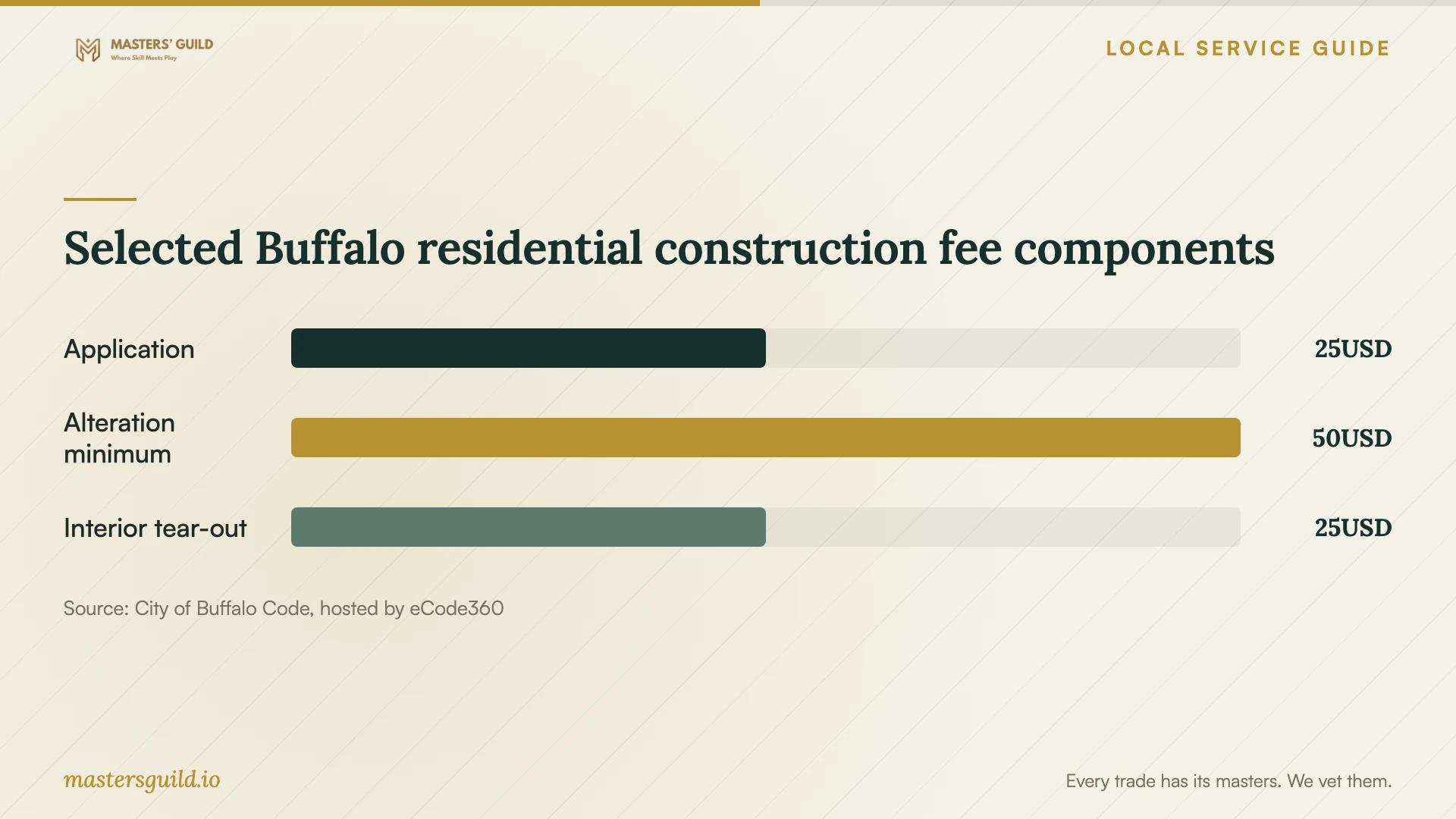
Buffalo's residential construction fee category covers detached one- and two-family dwellings. For alterations and repairs in that category, the city lists a $25 application fee and a permit fee of $5 per $1,000 of construction cost, with a $50 minimum. When work requires plans, the plan-review fee is 20% of the permit fee, with a $25 minimum. [3]
Use those figures to review a permit allowance. Buffalo publishes separate plumbing and electrical fee schedules, so the residential building fees alone do not establish the full permit bill. Request a calculation matching your building type and proposed work, then keep permits and inspection records with your contract. [3]
Plan lead-safe work before disturbing painted surfaces
For housing built before January 1, 1978, Erie County presumes paint contains lead and requires lead-safe practices during maintenance, painting and renovation. The county states that this work requires an EPA-certified individual or someone with other lead-safe certification approved by the county health commissioner. [1]
Ask the contractor to explain containment before removing painted trim or disturbing painted walls. Erie County's guidance includes covering objects and floors, closing and covering forced-air ducts in the work area, confining dust and debris, and using HEPA vacuuming and wet cleaning. Include the protection and cleanup plan in the scope. [1]
A missing testing record does not establish that your kitchen has no lead. Erie County says you can request its testing records through a Freedom of Information request, but it has no information about testing performed by others. Ask for available reports before planning demolition. [1]
Agree on kitchen downtime and completion
Request a schedule covering design approval, ordering, demolition, trade work, cabinet installation, countertop measurement and final hookups. Confirm the status of essential materials before agreeing to remove the existing kitchen. Ask which decisions you must make before each stage.
Plan where you will store food, wash dishes and prepare meals. Agree on access hours, delivery routes, debris storage and protection for adjoining rooms. At the final walkthrough, check cabinet adjustments, appliance operation, leaks and finish repairs. Record remaining work and collect the agreed documents.
Selected Buffalo residential construction fee components
Local details that affect your job
Check the Buffalo license before signing
Erie County names the City of Buffalo among jurisdictions requiring home-improvement contractor licenses. Ask for city license information before accepting an offer. For a property outside city limits, verify requirements with that municipality instead of assuming the Buffalo rule applies. [2]
County lead rules affect demolition and DIY plans
Erie County requires lead-safe practices in pre-1978 housing and specifies certified individuals for renovation work. Before arranging painted-surface demolition, confirm worker certification and containment. The county offers free homeowner lead-safe classes; contact its Lead Program at 716-961-6800 for information. [1]
Your building type changes the fee category
Buffalo limits its residential construction fee category to detached one- and two-family dwellings. It places other buildings under the commercial construction fee category, including buildings containing homes. Give the permit office your building type before using residential fees to assess an allowance. [3]
Choose the next step for your kitchen project
| Your situation | Next step | Include in the scope |
|---|---|---|
| Keep the layout and update finishes | Identify each surface and product you will replace | Preparation, installation, protection and disposal |
| Move the sink or change electrical work | Confirm permit requirements with the building and codes office | Trade workers, applications, fees and inspections |
| Renovate a pre-1978 home | Confirm county-required lead-safe practices and certification | Containment, occupant protection and cleanup |
| Remodel in a building other than a detached one- or two-family dwelling | Ask the city to calculate fees under the applicable building category | A fee allowance matching the building type |
Your hiring checklist
- Give bidders the same layout, appliance list and material specifications.
- Request contractor license information, proof of insurance and references.
- Confirm your exact permit scope with the building and codes office.
- Ask for worker certification and a lead-safe plan for a pre-1978 home.
- Record allowances, exclusions and responsibility for owner-supplied products.
- Agree on written change approvals and payment milestones.
- Confirm material readiness, household access and kitchen downtime.
- Collect permits, inspection records, warranties and the remaining-work list.
Frequently Asked Questions
How much should I budget for the complete remodel?
Request itemized bids using your actual layout and material selections. Buffalo's published fees describe permit components, not contractor labor, cabinets or a complete remodel price. Compare allowances and exclusions, and ask each bidder how you will approve unexpected work. [3]
Does keeping the layout mean I can skip permits?
Confirm your exact scope with the building and codes office before starting. Erie County recommends this check. Buffalo's fee schedule says permits apply to work outside the City Code's listed exemptions; keeping the layout alone does not establish an exemption. [2] [3]
Can I use a home lead test kit before removing trim?
Erie County says the state health department and EPA do not recommend home kits for detecting lead in paint, dust or soil. The county requires a presumption of lead and lead-safe practices in pre-1978 housing. Discuss appropriate assessment and certified work before disturbing painted trim. [1]
Should I pay the entire price before construction?
Erie County advises against paying the full price upfront. Agree on a payment schedule in the signed contract and review advance-payment protections. Ask the contractor how the deposit will be held or protected before you pay. [2]
Sources and scope
This guide combines the sources below with practical planning guidance. Figures apply to the stated geography and period; request a written quote for your property.