
Local service guide
Commercial Building Cleaning in Buffalo, NY
Arrange Commercial Building Cleaning in Buffalo, NY by giving bidders the same task list, visit schedule and access rules. Request a walkthrough, compare totals including applicable sales tax, check employer coverage information and assign chemical-disposal responsibilities before signing. Agree on who handles entrance cleanup between visits and how the contractor will correct missed work. [3] [4]
Give bidders a scope they can price
Prepare a task list for entrances, work areas, restrooms, break rooms and stairs. Identify floor materials, surfaces you want cleaned and rooms the crew must leave untouched. Walk each bidder through the same spaces and agree on the area included in its quote.
Specify the work you want at each visit. Request separate prices for carpet extraction, interior glass and floor stripping. Name who supplies and replenishes paper products, liners and soap. Ask whether the contractor includes equipment and cleaning products in its recurring charge.
For a medical practice, food business or premises with specialized procedures, provide your required protocol and ask the contractor to explain how its crew will follow it. Define the surfaces, tasks and products behind any proposed sanitation service. Ask the bidder to list exclusions in writing.
Compare the full contract cost
Request the recurring total, included visit count, supply charges and prices for occasional work. Ask how the contractor charges for extra visits or changes in occupied space. Use matching walkthrough quotes to set your budget; the cited sources do not provide a Buffalo commercial-cleaning price range.
New York’s tax department identifies dusting furniture and cleaning or waxing building walls and floors as taxable maintenance services. Ask each bidder to show applicable sales tax alongside its service charge so you can compare the amount you would pay. [3]
The department’s October 2024 advisory opinion describes an untaxed management fee under a specific arrangement: the customer’s own employees performed the cleaning, while the petitioner supervised them and managed payroll as the customer’s agent. The opinion limits its conclusions to the stated facts. Ask for an explanation if a cleaning contractor proposes an untaxed arrangement. [3]
Set entrance-care and floor-work arrangements
Show the contractor each public entrance and discuss wet mats, tracked-in grit and floor drying. Assign a staff member to check entrances between scheduled cleaning visits. State who can authorize additional cleanup, how you will approve its price and how the crew can enter if your business closes.
For carpet extraction or floor treatments, agree on a work window and ask the contractor for its drying or return-to-use instructions. Plan a route for staff and customers while the crew works. Ask the bidder to confirm that its methods suit the floor material and to identify any furniture you must move beforehand.
Check coverage and control access
The New York Workers’ Compensation Board provides an employer coverage search using insurer-submitted information. Insurers update proof-of-coverage information daily and can submit future cancellation notices. Search using the beginning of the employer’s name, then examine the coverage type and dates. [4]
Ask for the contractor’s legal business name and current liability insurance documentation. Request the names of any subcontracting businesses. If you cannot match the employer’s name or understand a coverage result, ask the bidder to resolve it before handing over access. Recheck dates when reviewing a renewal.
Agree on key custody, alarm instructions and the person authorized to approve personnel changes. Name a supervisor you can contact about incomplete work. Put the correction deadline, cancellation notice and renewal terms in writing, then review the first visit against your task list.
Separate chemical disposal from routine cleaning
Erie County offers a small-generator hazardous-waste program for qualifying Western New York businesses and other organizations. The county directs participants to review product labels and safety data sheets for hazardous ingredients. Inventory unwanted cleaning chemicals and contact the county about eligibility before asking a cleaner to remove them. [2]
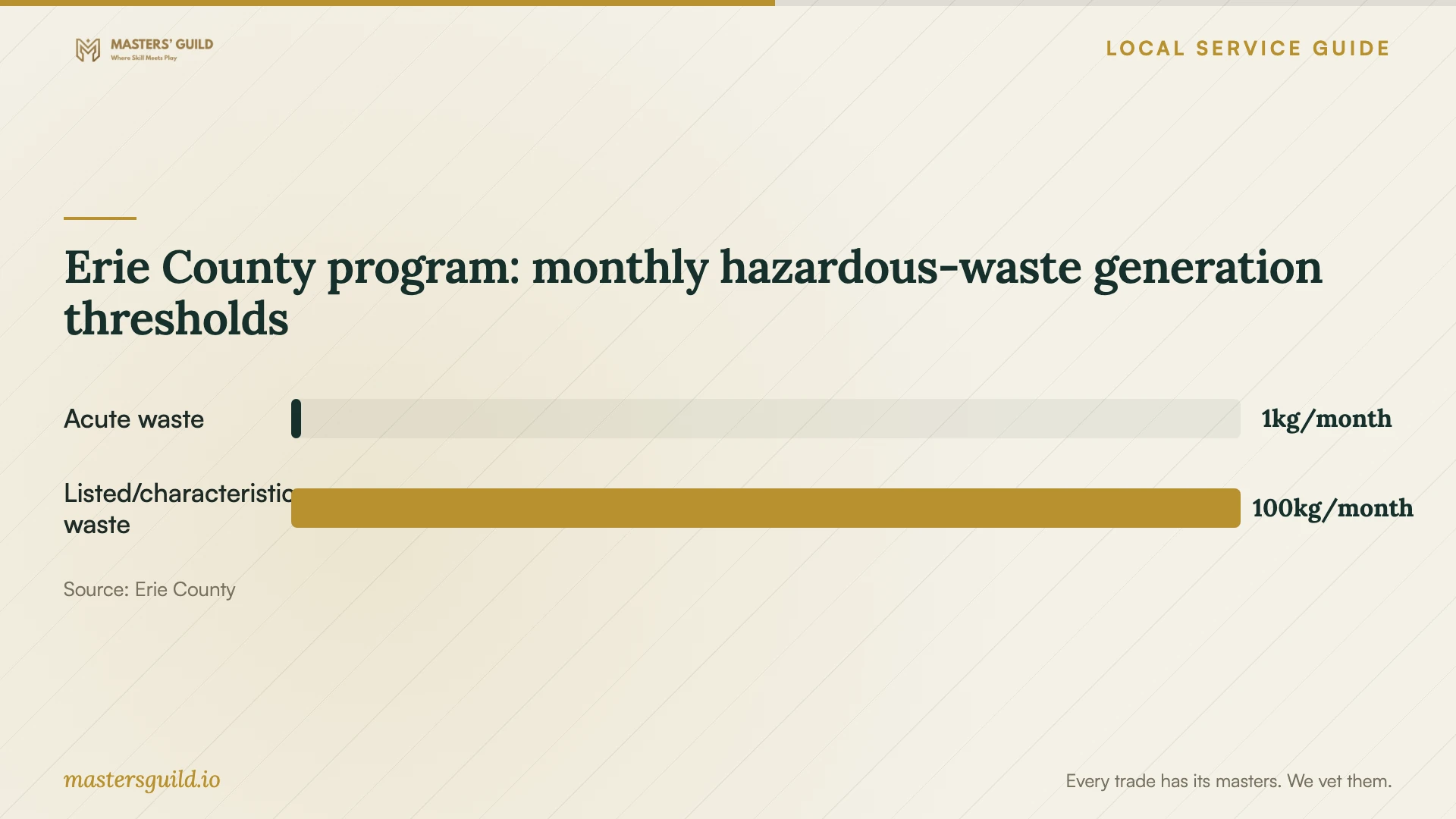
The county describes monthly generation thresholds of less than 1 kg of acute hazardous waste or less than 100 kg of listed or characteristic hazardous waste, plus a storage condition of never more than 1,000 kg at a time. Ask county staff how the requirements apply to your waste inventory. These are program eligibility conditions, not cleaning-product use limits. [2]
Participants complete a certification form listing waste types and amounts. The county calculates disposal charges and assigns an appointment after the participant accepts the cost. Participants transport their own waste and pay at drop-off. Agree on disposal responsibilities and charges as a separate item before promising a clearout date. [2]
Erie County program: monthly hazardous-waste generation thresholds
Local details that affect your job
Erie County appointments require advance preparation
Contact Erie County at 716-858-4805 to discuss its business small-generator program and obtain the certification form. The county describes collections as usually occurring in spring or fall, with appointments after cost acceptance. Confirm eligibility, availability and transportation arrangements before scheduling a chemical clearout with your cleaner. [2]
New York tax treatment affects quote comparison
Ask Buffalo bidders to separate the cleaning charge and applicable sales tax. State guidance identifies dusting and building wall or floor cleaning and waxing as taxable maintenance. The cited opinion’s untaxed management arrangement involved the customer’s own employees; it does not establish an exemption for your cleaning contract. [3]
Match the contract to the work
| Your situation | Request | Confirm before signing |
|---|---|---|
| Recurring office or shop cleaning | Room-by-room tasks and a visit schedule | Supplies, exclusions and missed-task correction |
| Wet or gritty entrances | Mat checks, cleanup and drying arrangements | Staff duties between visits and approval for extra work |
| Carpet extraction or floor treatment | A separate scope and price | Method compatibility, drying instructions and access routes |
| Unwanted cleaning chemicals | An inventory and assigned disposal responsibility | Erie County eligibility, calculated charges and participant transport |
| After-hours crew access | Named contacts and an access procedure | Employer coverage dates, key custody and alarm instructions |
Your hiring checklist
- Mark cleaning areas, floor materials and restricted rooms on a simple plan.
- Give each bidder the same task list, visit schedule and walkthrough.
- Request separate prices for periodic floor care and extra entrance cleanup.
- Ask for a total covering applicable tax, supplies and agreed add-ons.
- Check employer coverage dates and request current liability insurance documentation.
- Agree on keys, alarm instructions, supervisor contacts and correction deadlines.
- Inventory unwanted chemicals and assign disposal responsibilities before work starts.
Frequently Asked Questions
How much should I budget for commercial cleaning?
Get walkthrough quotes for the same scope. Compare visit counts, supplies, periodic work and applicable tax alongside the recurring total. Ask for the charge and approval process for extra visits before choosing a contract.
Should the cleaning quote include sales tax?
Ask the bidder to show applicable tax. New York guidance identifies dusting furniture and cleaning or waxing building walls and floors as taxable maintenance. The cited employee-management exception depends on its specific facts. [3]
How can I check workers’ compensation coverage?
Use the New York Workers’ Compensation Board employer coverage search. Enter the beginning of the employer’s name and examine coverage and cancellation dates. Ask the contractor to clarify a name mismatch or unclear result. [4]
Can Erie County accept unwanted business cleaning chemicals?
Ask county staff whether your business and waste qualify for its small-generator program. Participants submit a certification form, accept calculated charges and receive an appointment. Participants transport their waste and pay at drop-off. [2]
Sources and scope
This guide combines the sources below with practical planning guidance. Figures apply to the stated geography and period; request a written quote for your property.