
Local service guide
Website Design in Bridgeport, CT: Plan Your Project
Arrange Website Design in Bridgeport by giving designers the same written brief, comparing itemized proposals, and agreeing on account ownership before paying a deposit. Define what customers need to do: request a quote, book an appointment, or buy a product. Ask each designer to price that work, explain recurring charges, and demonstrate how you will update the finished site.
Write a brief around customer tasks
Start with the action you want a visitor to complete. For a quote request, specify the fields, who receives submissions, and how staff should respond. For booking, identify your scheduling system and cancellation process. For sales, describe your products, payment provider, delivery choices, and refund workflow.
List the pages you need and name the person responsible for each piece of content. Include business hours, contact details, service descriptions, photos, and any languages your customers need. Ask the designer to distinguish your responsibilities from paid copywriting, photography, translation, and content entry.
For a redesign, give bidders your existing page list and identify content you want to retain. Ask them to include a plan for preserving existing addresses or redirecting changed pages, transferring content, and testing forms. Choose a target launch date, then request a schedule showing your review deadlines and the designer’s dependencies.
Compare the full proposal and tax treatment
Request separate prices for design, development, content, migration, integrations, and post-launch support. Ask for renewal charges for hosting, software, domain registration, and maintenance. Compare the same scope across proposals; request an explanation when one bidder includes a task that another excludes.
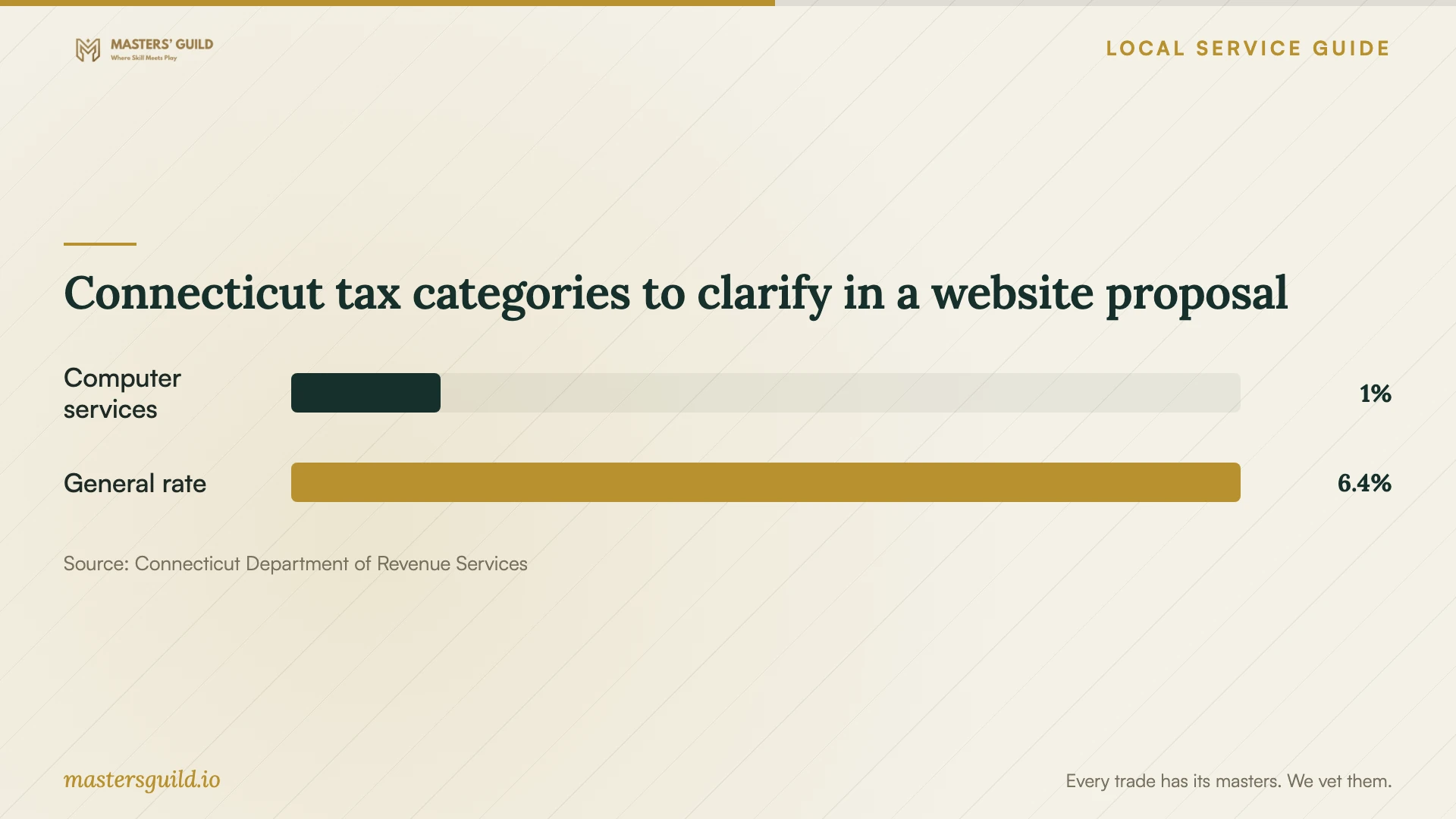
Connecticut DRS lists a general sales and use tax rate of 6.35% for most goods and taxable services, a 1% rate for computer and data processing services, and no additional local sales taxes. It also lists 1% for canned software that a business purchases for business use and accesses or receives electronically without tangible personal property. These categories do not establish one rate for an entire website project. [3]
Ask the vendor to identify the tax category for each charge and explain any bundled treatment. Have your accountant review unclear classifications before you approve the proposal. DRS states that businesses purchasing taxable goods or services for use in Connecticut without paying Connecticut sales tax must pay use tax; include purchases from outside the state in that review. [3]
Scope privacy work before choosing integrations
Inventory the information you intend to collect and the vendors that will receive it. Include contact forms, booking tools, analytics, advertising tags, and mailing lists. Ask your designer to document where submissions go, who can access them, and who will implement your approved privacy choices.
The Connecticut Attorney General’s guidance lists coverage triggers including processing personal data of at least 35,000 consumers, processing sensitive data, or offering personal data for sale, with specified exclusions and exemptions. The guidance excludes data processed solely to complete payment transactions from the first two triggers. It also describes coverage for consumer health data controllers conducting business in Connecticut or targeting its residents regardless of size or processing thresholds. Do not assume a small customer list settles applicability. [2]
For covered businesses, the Attorney General describes privacy notices, data minimization, sensitive-data consent, and consumer-rights obligations. Covered controllers must honor qualifying opt-out preference signals from Connecticut residents as of January 1, 2025. Ask a qualified adviser to determine your obligations, then assign implementation and testing to named people in the project scope. [2]
Agree on ownership and launch acceptance
Require the agreement to name the owner of the domain, hosting account, site content, and design files. Ask who holds each software license, what you can export, and what happens if you change providers. Keep account recovery details under your business’s control and give the designer the access needed for the work.
Before approving launch, test the site on a phone and with a keyboard. Submit each form, complete a test booking or purchase where relevant, and confirm that staff receive the right messages. Request written acceptance criteria for navigation, readable content, broken links, and customer transactions.
Ask for a handover session in which you edit hours, replace a photo, and update a service description. Define who handles backups, software updates, failed forms, and recovery after launch. Put the support period, response expectations, extra-work rates, and final payment milestone in the agreement.
Connecticut tax categories to clarify in a website proposal
Local details that affect your job
Bridgeport business support before procurement
The city’s May 5, 2025 announcement describes a partnership between its Small and Minority Business Enterprise Office and HEDCO, with a focus on minority-owned and women-owned enterprises. It announced onsite consultations at the Margaret E. Morton Center, 999 Broad Street, on Thursdays from 9:00 AM to 3:30 PM. Confirm the current schedule before visiting. Ask whether advisers can help review your business priorities or explore funding options before you sign a design contract. The announcement does not establish website-specific funding or eligibility. [1]
Connecticut health-data review can change your brief
If you plan to collect information about a customer’s physical or mental health through an intake or booking form, review the fields with a qualified adviser before asking a designer to build them. The Attorney General says consumer health data controllers face no revenue or processing threshold for coverage and that the nonprofit exemption does not apply to their consumer-health-data obligations. This statewide rule matters to applicable businesses serving Connecticut residents; business size alone does not settle the question. [2]
Choose the scope to request
| Your situation | Scope to discuss | Question before signing |
|---|---|---|
| Customers need basic information and an inquiry form | A focused informational site | Who writes the content and receives submissions? |
| Customers need appointments or online purchases | Design plus booking or checkout integration | Who configures and tests the complete transaction? |
| You are replacing an existing site | Redesign, content migration, and address mapping | Who handles changed page addresses and launch recovery? |
| You plan to collect health-related information | Data-field review before implementation | Has an adviser assessed Connecticut consumer-health-data obligations? |
Your hiring checklist
- Write down the customer action the site must support and how staff will handle it.
- Prepare a page list, existing account inventory, content files, and named reviewer.
- Request matching scopes with separate setup, renewal, support, and tax charges.
- List proposed forms, analytics, advertising tools, and the data each vendor receives.
- Agree on domain ownership, account access, software licenses, and export rights.
- Set revision limits, review deadlines, acceptance tests, and payment milestones.
- Complete a handover exercise and record who handles maintenance and recovery.
Frequently Asked Questions
How much should I budget for the project?
Request a quote against your written brief rather than selecting a budget from an unsupported local average. Ask for the initial project total, recurring charges, optional work, and tax treatment. Compare proposals after you resolve differences in content, integrations, migration, and support.
Does Bridgeport offer money for website design?
The city’s SMBE and HEDCO announcement describes access to funding opportunities and business support, but does not identify a website-design grant. Ask the program about current options, eligibility, and eligible expenses before including assistance in your budget. [1]
Does my small business need Connecticut privacy features?
Assess applicability before specifying features. The Attorney General lists coverage triggers and exemptions, and describes separate coverage for consumer health data controllers regardless of size. If your business falls under the act, include the required notice, consumer-rights process, and applicable opt-out behavior in the scope. [2]
What should I receive at handover?
Request account access, license details, content and file exports specified in your agreement, maintenance instructions, and an editing walkthrough. Ask the designer to demonstrate your core customer tasks and show you how staff can confirm that forms or transactions succeeded.
Sources and scope
This guide combines the sources below with practical planning guidance. Figures apply to the stated geography and period; request a written quote for your property.