
Local service guide
Special Item Transport in Bridgeport, CT
For Special Item Transport in Bridgeport, choose a mover that can explain how its crew will handle your item and access route, then request a binding written quote and review damage coverage before signing. For a household-goods move within Connecticut, check CTDOT's carrier roster. Send photos, dimensions, weight information and stair details for both addresses before accepting a price. [1] [5]
Match the crew to the item and access
Start with the exact item: an upright or grand piano, slate pool table, safe, sculpture or another bulky possession. Ask prospective movers to describe their handling method, protective materials and equipment. Request examples of comparable work without treating a general moving service description as proof that a crew can handle your particular item.
Send the manufacturer and model, dimensions, available weight documentation and photographs. Include the route from the item's current position to the truck, then from the truck to its final position. Measure door openings, stair landings and tight turns. Tell the mover about fragile surfaces, loose components and any restrictions on tilting or disassembly.
For a piano, ask who removes and reinstalls any components. For a pool table, specify whether you want transport alone or disassembly and setup. For a safe, disclose its documented weight and ask how the crew will handle steps and thresholds. Arrange an access inspection if the mover cannot explain its plan from your photos.
Check credentials for the whole trip
Connecticut's Department of Consumer Protection says in-state movers must hold a Household Goods Carrier Certificate or Motor Contract Carrier permit from CTDOT, with a corresponding registration number. CTDOT provides a searchable 2026 household-goods roster and says the list reflects its publication date. Match the business name and certificate number to your contract; ask CTDOT about unresolved credential questions. [1] [5]
For a trip across a state border, DCP identifies the U.S. Department of Transportation as the regulator and describes federal registration requirements. It also says an out-of-state mover must provide Your Rights and Responsibilities When You Move. Tell the provider the destination before requesting credentials, and ask which carrier will perform the transport if another company arranges it. [5]
Compare written scope and damage coverage
CTDOT recommends a binding quote because moving estimates can increase based on volume, staffing, time, weight and equipment. Ask the mover to include both addresses, the item description, stairs, carrying distance, disassembly, packing and final placement. Have the mover explain the process for approving a scope change before the crew starts additional work. [1]
CTDOT says contracts usually cover damage by weight rather than dollar value, at a usual rate of 60 cents per pound. Its example gives a damaged 200-pound hutch worth $1,000 a possible maximum payment of $120. Ask how the proposed contract would compensate damage to your item and whether additional insurance appears in the contract before you sign. [1]
Ask about exclusions, deductibles, the claim deadline and responsibility during disassembly or setup. Photograph the item's condition before loading and after placement. DCP says movers must provide a bill of lading after loading belongings onto the truck; keep that document with the quote, coverage terms and condition photos. [5]
Plan loading access and any unusual load
Agree on a loading position at each address before moving day. Ask your building manager about elevator reservations, delivery hours and protection for shared areas. Walk the carrying route with the crew before it lifts the item, and identify the final placement so nobody has to improvise at a narrow doorway.
For unusually large equipment, ask the carrier to assess the loaded vehicle's dimensions, gross weight and axle limits. CTDOT says oversize or overweight permits apply to nonconforming vehicle-and-load combinations that exceed Connecticut's legal limits. The carrier should explain any permit and route arrangements relevant to your shipment. [4]
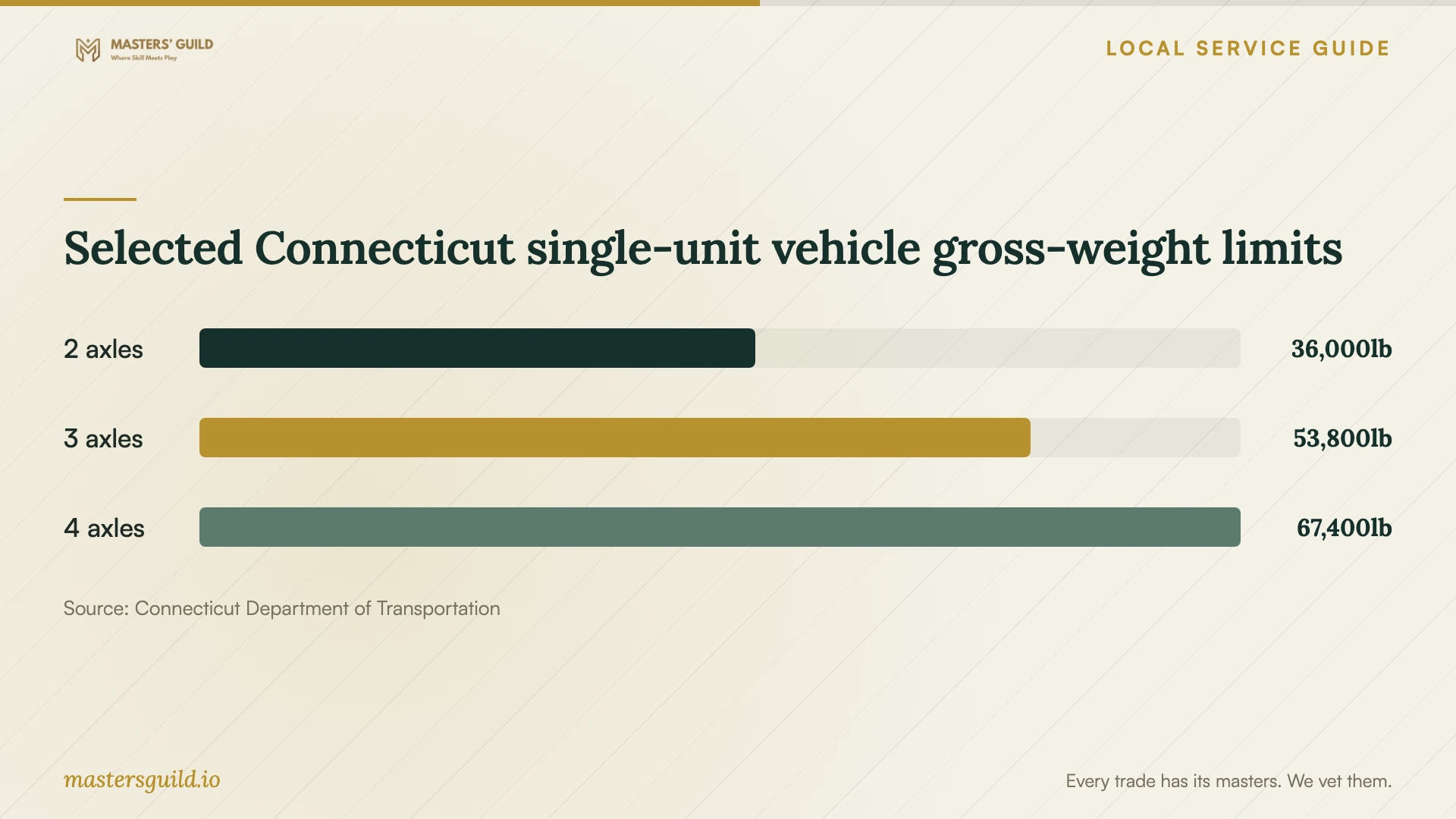
The weight chart provides selected statewide limits for single-unit vehicles. Use it to frame a question about the truck and load together. Ask the carrier for an assessment rather than comparing your item's weight alone with a gross vehicle limit. [4]
Selected Connecticut single-unit vehicle gross-weight limits
Local details that affect your job
Merritt Parkway restrictions change the truck route
For travel involving the Merritt Parkway, ask the mover which permitted roads its truck will use and whether the quote includes that route. CTDOT prohibits box trucks, rental trucks and trailers on the Merritt, Wilbur Cross and Milford parkways. A passenger-car route estimate is an unsuitable basis for planning a prohibited truck's trip. [2]
Winter staging needs a current parking check
Bridgeport's February 21, 2026 emergency notice required vehicles to leave posted snow emergency streets and follow alternate-side parking elsewhere, with fines and towing for violations. This dated notice does not establish an active October ban. Before a winter move, check current city notices and street signs, then agree with the mover on lawful loading access or a rescheduling plan. [3]
Choose the next step for your move
| Situation | Next step | Detail to settle |
|---|---|---|
| Household item stays within Connecticut | Check CTDOT credentials and the household-goods roster | Match the carrier name and certificate details to the contract |
| Item crosses a state border | Check federal registration requirements | Request the mover's rights and responsibilities booklet |
| Truck route involves a parkway | Ask for a permitted route | Box trucks, rental trucks and trailers face parkway prohibitions |
| Winter move requires curbside loading | Check current Bridgeport notices and posted signs | Agree on loading access if the city declares a snow emergency |
| Unusually large or heavy shipment | Ask the carrier to assess the loaded vehicle | Determine whether oversize or overweight permitting applies |
Your hiring checklist
- Record the item's model, dimensions and documented weight; send photos of its condition.
- Photograph and measure both carrying routes, including stairs, landings, doors and thresholds.
- Identify the carrier that will perform the move and request its applicable credential details.
- Request a written handling plan and identify who performs disassembly and setup.
- Compare binding quotes with the same access details and included work.
- Read damage compensation terms and request written answers about exclusions and claims.
- Confirm the truck route, loading position, building access and weather contingency.
- Keep condition photos, the quote, coverage terms and moving paperwork together.
Frequently Asked Questions
How much will my special-item move cost?
The supplied official guidance does not establish a Bridgeport price range. Request a binding quote after sharing the item and access details. CTDOT warns that staffing, time, weight and equipment can increase an estimate. Compare quotes that include the same packing, disassembly, transport and placement work. [1]
Does the mover's damage coverage pay the item's value?
Read the contract before assuming it does. CTDOT describes usual coverage of 60 cents per pound and recommends putting additional insurance in the contract before signing. Ask the mover to explain the potential payment for your specific item and the claim process. [1]
Does a heavy safe require an overweight permit?
Ask the carrier to assess the vehicle and load together. CTDOT bases its published limits on vehicle configuration, dimensions, gross weight and axle or tire loading. The item's weight alone does not establish whether the transporting vehicle requires a permit. [4]
Sources and scope
This guide combines the sources below with practical planning guidance. Figures apply to the stated geography and period; request a written quote for your property.