
Local service guide
Pest control services in Bridgeport, CT
To arrange pest control services in Bridgeport, request a site assessment and written scope, then check the company's Connecticut pesticide business registration and the responsible applicator's certification before approving pesticide work. Connecticut requires business registration in addition to individual certification. For a food-business opening, ownership change or building demolition, coordinate the city paperwork before committing to a service date. [1] [2] [3] [4]
Define the problem before comparing quotes
Describe what you have seen, where you saw it and when you first noticed it. Send photographs if you can take them without disturbing the pest. Include affected storage areas, food preparation spaces, customer areas and any adjoining premises you control. Ask the contractor to identify the pest during the assessment before proposing treatment.
Give bidders the same access information and operating hours. Ask them to separate inspection, treatment, monitoring and entry-point repairs in the proposal. If you rent, agree with the property owner on who will authorize access and pay for repairs before accepting work. Identify areas the contractor cannot inspect and ask how that limits the proposed scope.
Check the business and treatment supervisor
Connecticut DEEP requires a pesticide application business to register before operating in the state. The requirement covers businesses that offer paid pesticide application or recommendations. DEEP also requires registered businesses to display their PMBR registration number on written pesticide-service contracts. Ask for that number and evidence of current registration before signing. [1]
Ask the company to name its certified commercial supervisor and identify the person attending your premises. Connecticut assigns treatment decisions, including pesticide selection, dosage, timing and precautions, to a commercial supervisory certificate holder. An operational certificate holder applies pesticides under a certified supervisor's direction and receives written instructions for each application. [2]
If the company subcontracts pesticide work, request the application company's name and the responsible supervisor's details. DEEP requires businesses that subcontract pesticide applications to register as well. Ask whose name will appear on the service report and whom you should contact about preparation, follow-up or a treatment concern. [1]
Get a quote you can use to manage the job
Request an itemized total for your premises. Ask the contractor to state the pest identified, areas covered, proposed methods, preparation tasks and access restrictions. Have the contractor explain which tasks your staff must finish before the visit and provide written instructions for returning to treated areas.
For recurring service, ask for the visit schedule, reporting format, cancellation terms and charges for extra visits. For a single treatment, ask what follow-up the price includes and what happens if you report further activity. Request clear exclusions for repairs, inaccessible areas and work outside the agreed premises. Keep those answers with the signed scope.
Plan access, weather contingencies and follow-up
Choose a staff contact who can provide access and receive the contractor's instructions. Before the appointment, ask how to handle stock, food, equipment and cleaning in affected areas. Agree on how the contractor will communicate a change in method or scope if the inspection reveals a different problem from the one you described.
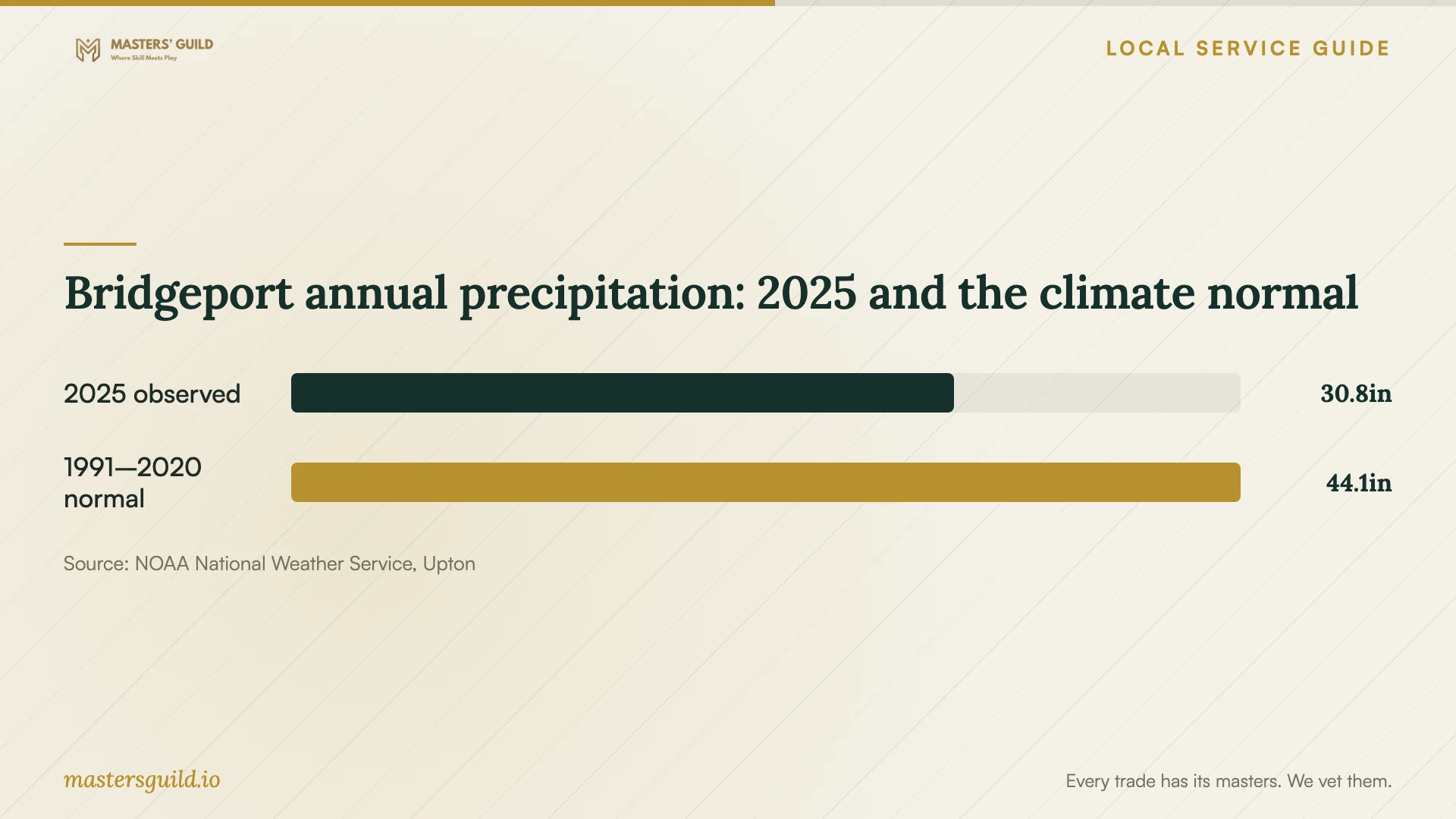
The National Weather Service recorded 30.77 inches of precipitation in Bridgeport during 2025, compared with the 1991–2020 annual normal of 44.09 inches. Treat those figures as background when discussing outdoor work. Ask the contractor what weather would require rescheduling the proposed treatment and how they would notify you. [5]
After the visit, request a report recording the findings, work completed, areas that remain inaccessible and the next review date. Ask the contractor to distinguish completed work from repairs or monitoring still recommended. Keep a record of subsequent sightings so you can discuss specific locations and dates at follow-up.
Bridgeport annual precipitation: 2025 and the climate normal
Local details that affect your job
Food-business openings and ownership changes
Bridgeport's Environmental Health Division requires a copy of a Connecticut licensed exterminator contract among the documents for new food establishments and changes of ownership. Arrange that contract while preparing your application, and ask the contractor to identify the premises and service scope in writing. The city recommends contacting Environmental Health for requirements specific to your establishment's classification at 203-576-7474 or 999 Broad St. [3]
Demolition needs a separate city inspection
Bridgeport requires a Health Department rodent-free inspection before building demolition. To request it, provide the property address and the requester's name, telephone number and email address. The city directs applicants to its current fee schedule and accepts a cashier check or money order payable to the Bridgeport Health Department. The certificate remains valid for 30 days from issuance. Coordinate the contractor's work, city inspection and demolition date around that window. [4]
Choose the next step for your premises
| Situation | Next step | What to clarify |
|---|---|---|
| Unidentified pest activity | Request an assessment before approving treatment. | Pest identification, inspection limits and proposed scope. |
| Paid pesticide application | Check business registration and individual certification. | PMBR number, responsible supervisor and attending applicator. |
| New food establishment or ownership change | Arrange the exterminator contract required for the city application. | Premises covered and classification-specific requirements. |
| Building demolition | Arrange the city's rodent-free inspection before demolition. | Inspection timing, payment and the certificate's 30-day validity. |
| Recurring service proposal | Request written visit and follow-up terms. | Reports, extra charges, exclusions and cancellation. |
Your hiring checklist
- Record sighting locations, dates and photographs before requesting an assessment.
- Give bidders the same premises details, access limits and operating hours.
- Request the business registration number and responsible supervisor's credentials.
- Ask for proposed methods, preparation tasks and return-to-area instructions in writing.
- Separate treatment, monitoring, repairs and extra-visit charges in the quote.
- Assign responsibility for access, staff communication and property-owner approvals.
- Keep the signed scope, service reports and follow-up observations together.
Frequently Asked Questions
Does business registration replace applicator certification?
No. Connecticut DEEP requires pesticide business registration in addition to individual applicator certification. Ask for both, and identify the certified supervisor responsible for treatment decisions. [1] [2]
Can an operational certificate holder choose the treatment?
Connecticut assigns pesticide selection, dosage, timing and application precautions to a commercial supervisory certificate holder. An operational certificate holder works under a certified supervisor's direction with written instructions for each application. Ask who will supervise your job. [2]
What pest-control paperwork does a new food business need?
Bridgeport lists a copy of a Connecticut licensed exterminator contract among the required documents for new food establishments and ownership changes. Confirm the requirements for your establishment's classification with Environmental Health before submitting the application. [3]
Can a contractor's rodent treatment replace the demolition inspection?
Bridgeport requires the Health Department to complete a rodent-free inspection before demolition. Arrange the city inspection as a separate step and account for the certificate's 30-day validity when scheduling demolition. [4]
Sources and scope
This guide combines the sources below with practical planning guidance. Figures apply to the stated geography and period; request a written quote for your property.