
Local service guide
Mold Removal in Bridgeport, CT: Hiring and Permits
For Mold Removal in Bridgeport, choose a residential remediator whose Connecticut Home Improvement Contractor registration covers mold remediation, request proof of NORMI or IICRC certification, and get a written plan for fixing the moisture source. Before approving demolition or rebuilding, confirm the permit scope with the city. Connecticut health guidance recommends fixing moisture and cleaning up mold; it says testing is usually unnecessary when you can see growth. [1] [2] [4]
Choose a contractor for the residential scope
Connecticut’s Department of Consumer Protection places residential mold remediation under Home Improvement Contractor registration and requires certification from NORMI or IICRC. Its definition includes removal, cleaning, sanitizing, demolition and other treatment of mold-contaminated material. Ask the contractor to provide registration details that cover mold remediation and the applicable certification before you sign. [1]
Ask who will inspect the affected rooms, supervise cleanup and arrange any separate repairs. Request insurance documentation and identify the company responsible for each part of the job. Keep the contractor’s credential details with the estimate so you can compare proposals without relying on a certification logo in an advertisement.
Tell the contractor how you use the property. Connecticut states that commercial mold remediation falls outside this Home Improvement Contractor registration. For a property with residential and business space, describe both areas and ask the Department of Consumer Protection which registration requirements apply to the proposed work. [1]
Agree on the moisture problem before buying tests
Connecticut’s Department of Public Health recommends finding and fixing the moisture problem, then cleaning up mold using safe procedures. It identifies flooding, leaks and high humidity as conditions that can trigger indoor growth. For visible mold, the department says sampling is expensive and usually unnecessary. [4]
Show the estimator where you first noticed growth, staining or an odor. Bring photographs and describe any connection with rain, plumbing use or a previous water incident. Ask the estimator to distinguish observed damage from areas they propose opening for further inspection.
If a proposal includes testing, ask what question the test will answer and how the result would change the work. Request a separate price and an explanation of who will interpret the result. Also ask how the contractor will document the moisture repair and decide that the cleanup is complete.
Settle permits before opening walls
Bridgeport requires a building permit for work that alters, repairs or demolishes an existing building or structure. The city also lists exemptions, including specified finish work without new construction, structural changes or alterations. Give the Building Department the proposed removal and repair scope rather than asking whether mold removal as a whole needs a permit. [2] [3]
The city distinguishes stopping certain plumbing leaks from replacing defective concealed piping. Its exemption page says concealed pipe replacement counts as new work and requires a permit and inspection. If a leak behind a wall caused the problem, ask the contractor to describe both the cleanup and the pipe repair when confirming requirements. [3]
Bridgeport directs applicants to create a Park City Portal account, apply for a building permit and also apply for a Zoning Plan. Applicants must submit documents as PDFs. The city places responsibility on the property owner to ensure contractors have permits before work begins. Put responsibility for applications and inspections in your agreement. [2]
Compare the complete job and prepare the house
Ask each contractor to price the same written scope. Request separate amounts for assessment, cleanup, material removal, disposal, moisture-source repair and rebuilding. Ask which items the contractor excludes and how they will price additional damage discovered after opening a wall. Use those answers to decide how much unfinished repair work you would accept.
Before scheduling, ask which rooms you can use during work, whether you need to move belongings and how workers will access the affected area. Agree on protection for adjacent rooms, daily cleanup and responsibility for furniture or stored items. If someone in the household has health concerns, discuss them with a health professional and share relevant occupancy needs with the contractor.
Request a proposed sequence for moisture repairs, cleanup, inspections and rebuilding. Ask the contractor to explain what could change the schedule and when they would seek your approval for extra work. At handover, keep photographs, repair records and any agreed completion documentation together.
Use rainfall context to describe the problem
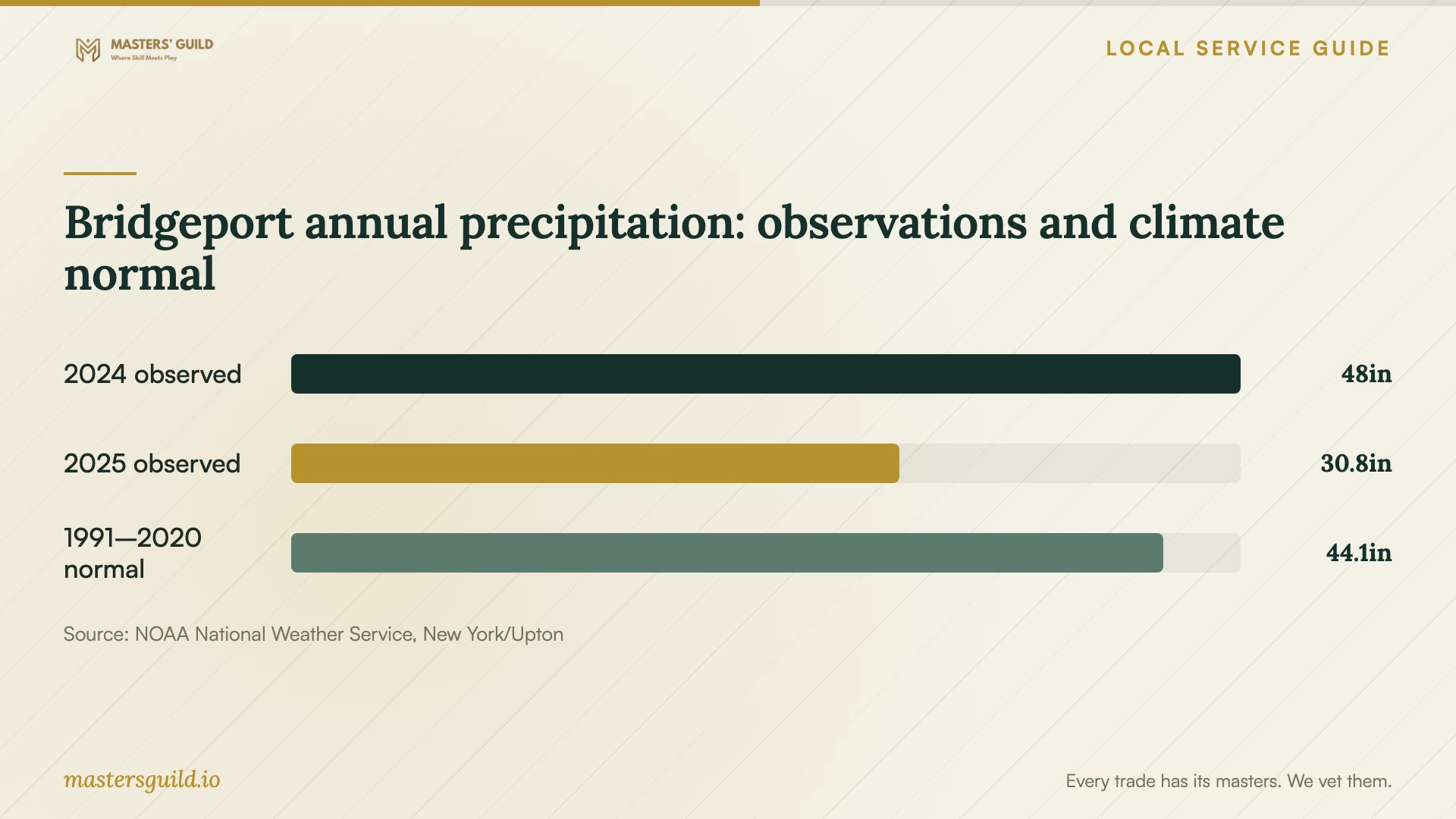
The National Weather Service’s Bridgeport annual report lists 30.77 inches of precipitation in 2025, compared with 48.01 inches in 2024 and a 1991–2020 annual normal of 44.09 inches. These figures describe outdoor weather at the reporting location. They do not establish whether your house has mold or identify its moisture source. [5]
If you notice dampness after rain, record the affected location and photograph the change. Give the estimator that history and ask them to explain the proposed investigation. Use observations inside your house to guide the repair discussion rather than assuming annual rainfall explains the damage.
Bridgeport annual precipitation: observations and climate normal
Local details that affect your job
Connecticut residential remediation credentials
For a home here, request a Home Improvement Contractor registration that covers mold remediation plus NORMI or IICRC certification. Connecticut’s residential registration does not cover commercial mold remediation, so describe any business space before choosing a contractor. [1]
Bridgeport permit applications and owner responsibility
For work requiring a building permit, Bridgeport directs you to the Park City Portal and requires a Zoning Plan application alongside the building permit. Submit documents as PDFs and assign application responsibility in writing. The city says the owner must ensure contractors have permits before work starts. [2]
Check a potential permit delay before booking
Bridgeport says its Building Department cannot issue permits when property taxes or WPCA sewer user fees are delinquent. If your remediation includes permitted repairs, check these accounts before committing to a construction start date. [2]
Choose the next step for your proposed work
| Situation | Next step | Reason |
|---|---|---|
| Visible mold with a known moisture problem | Request a moisture-repair and cleanup plan; ask what any proposed test would change. | Connecticut health guidance says visible growth usually does not need sampling. |
| Residential remediation contractor | Request the applicable Home Improvement Contractor registration and NORMI or IICRC certification. | Connecticut requires these credentials for residential mold remediation. |
| Wall removal or reconstruction | Give the city the detailed scope and confirm permits before starting. | Bridgeport requires permits for repairs, alterations and demolition, subject to exemptions. |
| Replacement of defective concealed piping | Include the pipe replacement in the permit discussion. | The city’s exemption guidance treats this as new work requiring a permit and inspection. |
| Permitted repairs with overdue property accounts | Check property tax and WPCA sewer fee status before booking construction. | Bridgeport prohibits permit issuance when these accounts are delinquent. |
Your hiring checklist
- Photograph affected surfaces and write down when you noticed moisture or growth.
- Request registration details, mold-remediation certification and insurance documentation.
- Ask the estimator to identify the proposed moisture repair and who will perform it.
- Request separate quote items for cleanup, removal, repairs and rebuilding.
- Confirm the permit scope with the city using a detailed work description.
- Agree on room access, belongings, occupancy and protection for adjacent spaces.
- Define approval for extra work and the documentation you expect at completion.
Frequently Asked Questions
Do I need mold testing before hiring someone?
Connecticut’s Department of Public Health says testing is usually unnecessary when you can see mold. Ask anyone proposing a test to explain the question it answers and how the result would change the cleanup or moisture repair. [4]
Does mold removal require a Bridgeport building permit?
Confirm the actual work scope with the Building Department. The city requires permits for repairs, alterations and demolition and exempts specified work. Describe any wall removal, rebuilding or concealed pipe replacement instead of relying on the service name alone. [2] [3]
Which credentials should a residential remediator provide?
Request Connecticut Home Improvement Contractor registration details that cover mold remediation and proof of NORMI or IICRC certification. The Department of Consumer Protection identifies these requirements for residential work. [1]
How should I compare mold-removal quotes?
Give each estimator the same photographs and scope. Ask for separate cleanup, moisture-repair and rebuilding prices, then compare exclusions, extra-work approval, room access and completion documentation. Ask who takes responsibility for each repair.
Sources and scope
This guide combines the sources below with practical planning guidance. Figures apply to the stated geography and period; request a written quote for your property.