
Local service guide
Heavy Lifting in Bridgeport, CT: Plan Your Job
Arrange Heavy Lifting in Bridgeport by deciding whether you need an indoor move, loading help, household-goods transport or removal for disposal. Give the crew item dimensions, stairs, route photos and a clear destination before accepting a quote. For transport within Connecticut, check the mover’s state carrier credentials; for curbside staging or disposal, confirm the city requirements that apply to your plan. [1] [2] [4]
Define the lifting job before requesting a quote
Start with an item list and an end point for each item: another room, an upstairs bedroom, your rental truck or a disposal facility. Separate carrying from transport and disposal in your request. Ask who supplies the vehicle and who takes responsibility for securing the load. Have the provider confirm each part of the work rather than relying on the phrase moving help.
Send photographs of the item, doorway, stairs and tightest turn. Include dimensions and the manufacturer’s weight if you have it; label an unknown weight as unknown. Describe steps at the entrance, stair landings, elevator access and the distance from the parking spot to the door. Ask the crew to review the route before committing to the lift.
For a safe, piano or awkward appliance, ask about experience with that specific item and the equipment the crew intends to use. Agree on any disassembly and reassembly. For connected appliances, arrange appropriate disconnection before the carrying crew arrives, and confirm whether the provider includes that work in its scope.
Screen the provider for the work you need
For an in-state household move, Connecticut’s Department of Consumer Protection says movers must hold a Household Goods Carrier Certificate or Motor Contract Carrier permit issued by the Connecticut Department of Transportation, with a corresponding registration number. It also says movers must provide a bill of lading after loading belongings onto the truck. Ask the transport provider for its credential details and paperwork arrangements before booking. [4]
The state guidance addresses movers transporting household goods. Do not use that page as proof of a licensing requirement for a crew hired to reposition furniture inside your home. Describe who will drive and who will carry, then ask the provider which credentials apply to its role. [4]
Ask for evidence of insurance and an explanation of how the provider handles damage to the item, floors or stair rails. Get a written quote that identifies the crew, booked time, minimum charge, travel, equipment and any stair or disposal charges. Ask how the provider approves extra time and what you owe if the crew arrives but cannot complete the proposed route.
Settle access and removal before arrival
Choose a proposed loading spot and share it with the crew. If the plan involves occupying a city street or public right of way with equipment or staging, ask Bridgeport’s Licensing & Permits office whether an occupancy permit applies. The city identifies this office as the issuer of those permits; its page does not establish that every furniture move needs one. [1]
For unwanted furniture, agree on the receiving destination before scheduling the carry. Bridgeport excludes bulky items, including furniture and mattresses, from green trash toters. Its transfer station also excludes cabinets and construction debris. Do not assume that a residential trash destination accepts an item because the crew can fit it into a truck. [2] [3]
Ask a removal provider to name the facility it will use and confirm acceptance of your exact items. If you intend to use the city transfer station, confirm whether your eligibility and the provider’s delivery arrangement meet the facility’s rules. Include transport, unloading and disposal charges in the written scope.
Prepare the route and agree on a weather plan
Clear the carrying route before the crew arrives. Move loose rugs, keep children and pets away from the work area, and point out fragile surfaces. Discuss floor protection and where the crew can set the item down during the move. Avoid removing doors or rails until you and the provider have agreed on who will restore them.
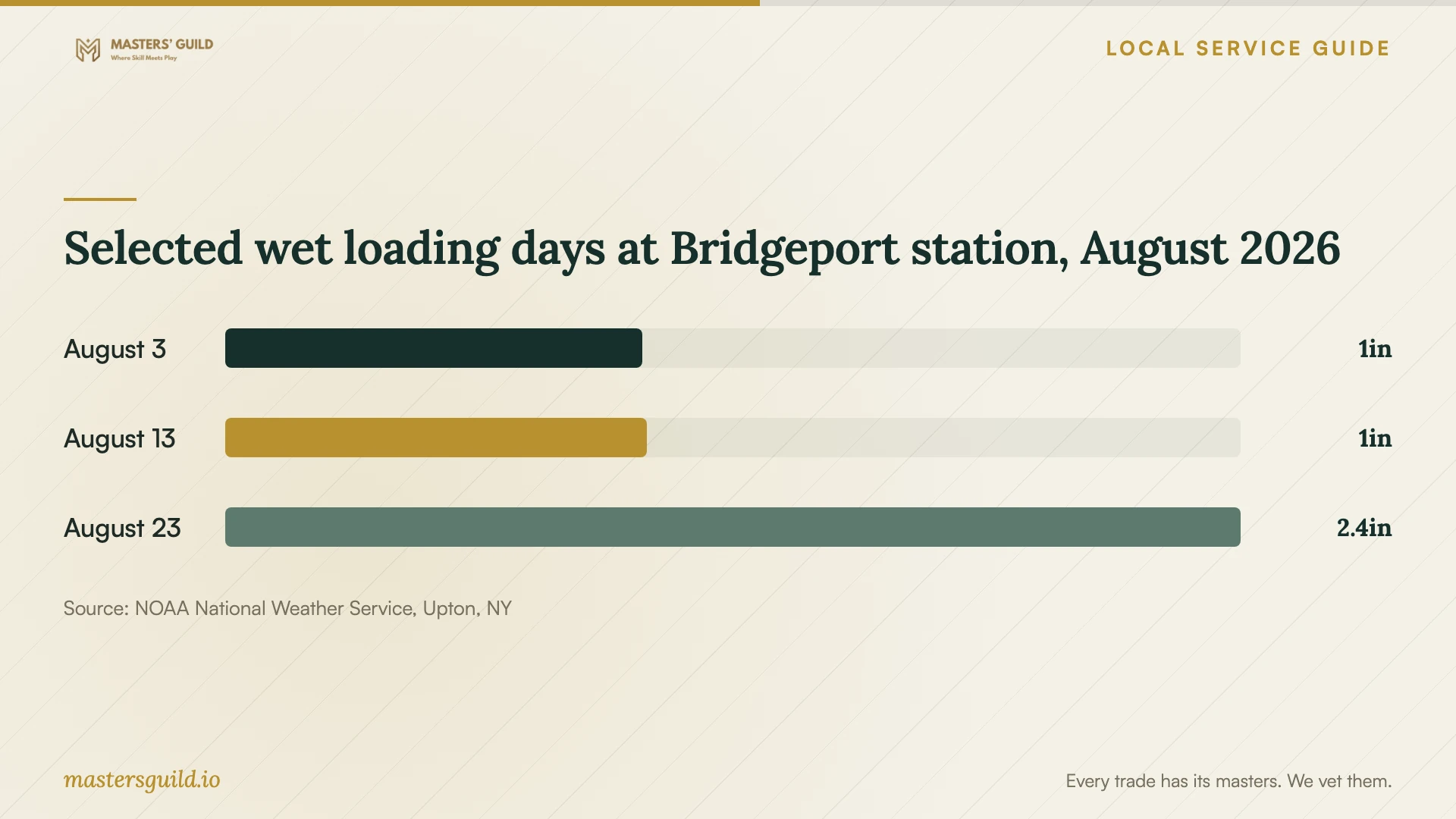
For exposed loading, check the forecast near the appointment and agree on a rain or unsafe-access contingency. The historical chart shows selected wet days at the Bridgeport weather station in August 2026. Use it as context for protecting an outdoor route, not as a forecast for your booking. [5]
Before lifting starts, walk the route with the crew and confirm the final position of each item. Pause if the proposed route differs from the one used for the quote. Inspect the item and surrounding surfaces with the provider before closing out the job, and record any concerns through the agreed damage-reporting process.
Selected wet loading days at Bridgeport station, August 2026
Local details that affect your job
Street occupation: contact the permit office
Bridgeport’s Licensing & Permits office provides occupancy permits for the public right of way and lists a form for the right to occupy a city street. Contact the office at 203-576-7123 with the proposed location, staging arrangement and timing. The city lists office hours as Monday through Friday, 7:30 am to 3:00 pm, at 45 Lyon Terrace. Establish applicability before committing to a street-based loading plan. [1]
Transfer-station restrictions affect removal plans
The city lists its transfer station at 475 Asylum Street, open to residents Monday through Saturday from 7:00 am to 3:00 pm. It requires covered, secured loads and excludes cabinets and construction debris. People who live outside the city but own property here must bring proof of ownership and may make one trip per day. Confirm acceptance and delivery eligibility before arranging a removal crew. [2]
Confirm mattress preparation before lifting
The transfer-station page instructs users to cut mattresses in half, while the sanitation page excludes mattresses from green trash toters. Confirm the intended facility’s current preparation instructions before altering a mattress or asking a crew to remove it. Include preparation and destination in the job scope so the crew arrives with an agreed plan. [2] [3]
Match the provider to the job
| Your plan | Scope to request | Check before booking |
|---|---|---|
| Move furniture within your home | Carrying, protection and final placement | Ask the crew to review the route and confirm suitable equipment. |
| Load your rental truck | Carrying, loading and agreed load securing | Identify who drives and who accepts responsibility for securing items. |
| Transport household goods within Connecticut | Carrying and in-state transport | Check the mover’s CTDOT carrier credential and bill-of-lading arrangements. |
| Stage equipment in public space | Lifting plus the proposed street-access plan | Ask Bridgeport Licensing & Permits whether an occupancy permit applies. |
| Remove unwanted furniture or cabinets | Carrying, transport and an approved destination | Furniture cannot go in green toters; the city transfer station excludes cabinets. |
Your hiring checklist
- List each item and its final destination, including the room or receiving facility.
- Send dimensions, known weights and photographs of stairs, landings and tight turns.
- Confirm who supplies the vehicle, lifting equipment, padding and floor protection.
- Ask for insurance details and the procedure for reporting damage.
- Get written terms for minimum time, extra hours, travel, disassembly and disposal.
- Resolve building access and any proposed public-space staging before arrival.
- Agree on weather contingencies, final placement and an inspection before closeout.
Frequently Asked Questions
How should I compare heavy-lifting quotes?
Give each provider the same item list, route photos and destination. Ask each to state crew size, minimum time, equipment, travel and extra-hour terms. For removal, include the receiving facility and disposal charges. Compare the complete agreed scope before choosing a quote.
Does an indoor furniture move need a mover’s certificate?
The supplied Connecticut guidance concerns transporting household goods and does not establish a certificate requirement for indoor lifting alone. If the provider also transports your belongings within the state, ask for its CTDOT Household Goods Carrier Certificate or Motor Contract Carrier permit details. [4]
Can the crew leave an old sofa for regular trash collection?
Bridgeport excludes bulky items such as furniture from green trash toters. Agree on an accepted disposal destination and include transport in the removal scope before the crew carries the sofa out. [3]
Do I need a permit for the moving truck?
The city page does not say every moving truck needs a permit. Bridgeport’s Licensing & Permits office issues public right-of-way occupancy permits. Describe your proposed street occupation or equipment staging to that office and ask which requirements apply. [1]
Sources and scope
This guide combines the sources below with practical planning guidance. Figures apply to the stated geography and period; request a written quote for your property.