
Local service guide
Duct and Vent Cleaning in Bridgeport, CT
Arrange Duct and Vent Cleaning in Bridgeport after a contractor shows you substantial contamination and gives you a written scope and total price. EPA recommends cleaning as needed for substantial mold growth, vermin or excessive debris. If the proposal includes duct repairs or replacement, confirm mechanical permit requirements with the city before approving that work. [1] [2]
Decide whether you need cleaning or another repair
Start with an inspection of the problem you want to solve. Ask the contractor to show you deposits inside the ducts, evidence of pests or suspected mold. EPA identifies substantial contamination as a reason to consider cleaning and explains that dust on a return register is normal. You can vacuum or remove and clean that grille without treating it as proof that the entire system needs service. [1]
Ask who will correct the underlying cause before cleaning begins. EPA warns that contamination can return when homeowners leave moisture or other causes unresolved. EPA recommends replacing wet or moldy duct insulation because cleaning cannot address it. For suspected mold, ask for evidence and an explanation of how the contractor identified it; appearance alone does not establish that a substance is mold. [1]
Keep expectations specific. EPA says duct cleaning has not been shown to prevent health problems, and evidence that cleaning ducts alone improves system efficiency is limited. Describe your concern in concrete terms, such as visible debris blowing from a register, rather than accepting a promise to cure allergies or reduce energy bills. [1]
Get a quote you can compare
Ask at least three providers for written estimates. EPA recommends agreeing on total cost and scope before work begins. Have each provider identify the system, its duct materials, the components included and any exclusions. Ask whether the quote covers supply and return ducts, grilles, the blower, coils and drain pans, and who has the qualifications to clean those components. [1]
Request separate prices for cleaning, component service, duct repairs and any proposed chemical treatment. Ask the provider to explain how system size, access and contamination affect the estimate; EPA lists these among the factors affecting cost. Compare totals for the same scope instead of comparing a register-only offer with a whole-system proposal. [1]
Tell bidders whether you also want a dryer exhaust or bathroom exhaust inspected, and ask them to list that work separately. Describe access constraints, share photographs of equipment locations and ask how long the crew expects to need the system off. Require your approval for added work before the crew starts it.
Agree on methods before the crew arrives
Ask how the crew will capture dislodged debris and protect your rooms. EPA recommends vacuum equipment that exhausts outdoors or HEPA vacuum equipment when it exhausts indoors. The crew should protect furnishings, choose brushing methods suited to the duct material and seal and reinsulate access openings after cleaning. Ask how the provider will avoid damaging fiberglass lining or flexible duct. [1]
Treat sanitizers and interior coatings as separate decisions. EPA advises homeowners to understand the benefits and risks before allowing chemical treatments and states that it has registered no biocides for fiberglass duct board or fiberglass-lined ducts. Ask for the product label, the intended application area and the reason physical cleaning and moisture correction would not address the problem. [1]
Clear a route to the equipment and agreed access points. Move fragile belongings, arrange access to locked rooms and tell the crew where pets will stay. Ask the supervisor to contact you before cutting an additional opening, disturbing questionable insulation or changing the agreed scope.
Check the result and plan maintenance
Ask the contractor to show you the cleaned components before you accept the job as complete. EPA recommends a visual inspection and notes that providers can use remote photographs to document duct interiors. Check that the crew reattached registers, closed access openings and demonstrated system operation. Ask the contractor to explain any areas they could not reach. [1]
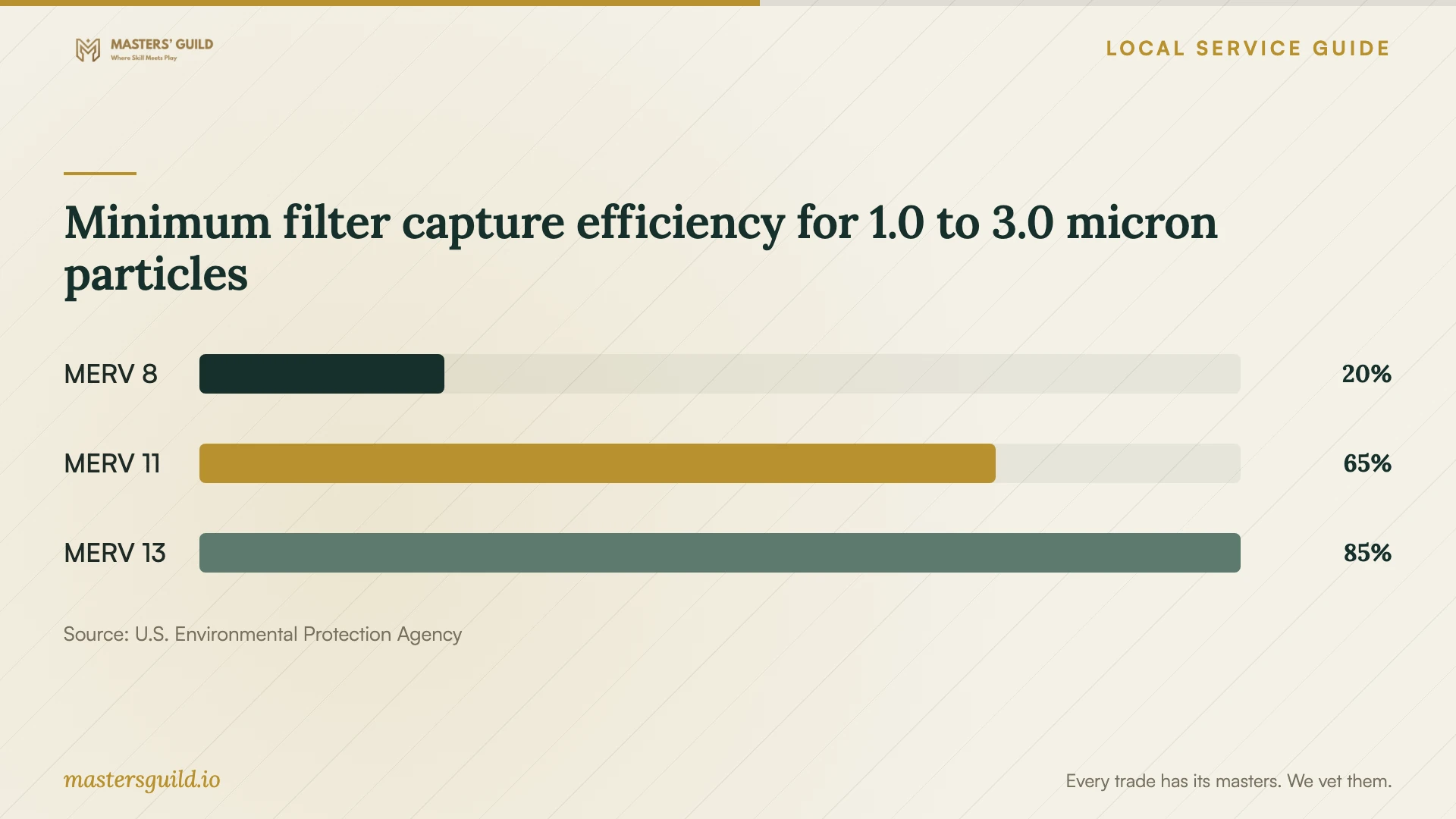
Discuss filtration during that review. EPA recommends choosing MERV 13 or the highest efficiency your system fan and filter slot can accommodate when upgrading a filter. Ask your HVAC technician to confirm compatibility, fit and the manufacturer's replacement instructions. Use the chart to compare filter capture thresholds in one particle-size band, rather than to judge a cleaning job. [4]
Keep the estimate, approved changes and completion photographs together. Record any moisture repairs or insulation replacement still needed. Follow manufacturer guidance on filters and arrange inspection and service of fuel-burning heating equipment before heating season, as EPA recommends. [1] [4]
Minimum filter capture efficiency for 1.0 to 3.0 micron particles
Local details that affect your job
Bridgeport mechanical permits for added work
Bridgeport lists duct and exhaust systems among mechanical work subject to permit requirements for alterations, repairs and replacement. Its HVAC page does not establish a blanket permit rule for a cleaning-only visit. If your contractor proposes mechanical changes, confirm the exact scope with the Building Department. The city directs applicants to the Park City Portal and requires PDF documents, including the contractor's current Connecticut license card and a detailed written scope. Ask who will handle the application before approving repairs. [2]
Connecticut asbestos assessment before disturbance
If the inspection raises concern about insulation or register materials, pause disturbance and arrange an assessment. EPA says cleaners should inspect for asbestos-containing materials before cleaning. Connecticut DPH assigns identification, condition assessment and sampling of suspected materials to licensed asbestos Inspectors; an Inspector/Management Planner may also perform Inspector duties. Choose a Connecticut-licensed Inspector or Inspector/Management Planner and verify both license status through eLicense and current accreditation for the inspection discipline. DPH prohibits practice with expired accreditation even when the license remains active. A Project Designer or Project Monitor credential alone does not establish Inspector qualifications. [1] [3]
Choose the next step from the inspection
| Finding | Next step |
|---|---|
| Dust on a return grille alone | Clean the grille and ask for evidence before approving whole-system service. |
| Excessive duct debris or particles escaping supply registers | Request a cleaning scope and identify the cause of contamination. |
| Wet or moldy duct insulation | Arrange replacement and moisture correction. |
| Suspected asbestos insulation or register material | Pause disturbance. Arrange assessment by a Connecticut-licensed asbestos Inspector or Inspector/Management Planner qualified for inspection. Verify license status and current Inspector accreditation. |
| Proposed duct or exhaust repair | Confirm Bridgeport mechanical permit requirements for the proposed scope. |
Your hiring checklist
- Photograph the concern and describe when you notice it.
- Request an inspection and evidence before approving whole-system cleaning.
- Compare written scopes, exclusions and total prices.
- Separate cleaning from repairs, replacement and chemical treatments.
- Confirm responsibility for permit questions and applications if the scope expands.
- For suspected asbestos, request an Inspector's license and current accreditation, and verify the license through Connecticut's eLicense process.
- Agree on access, debris capture and protection of furnishings.
- Review completion photographs and remaining repairs before accepting the work.
Frequently Asked Questions
How often should I book duct cleaning?
Use inspection findings to decide. EPA recommends cleaning as needed rather than as a routine maintenance service. A dusty grille alone does not establish a need for whole-system cleaning. [1]
Does a cleaning visit require a Bridgeport permit?
The city's published HVAC guidance does not settle the question for cleaning alone. It covers mechanical alterations, repairs and replacement, including duct and exhaust systems. Ask the Building Department about your exact scope if the contractor proposes additional work. [2]
How should I compare prices?
Request written estimates for the same components and access conditions. Ask providers to separate repairs and treatments from cleaning, identify exclusions and state the total cost before work begins. [1]
Should I accept an EPA-certified duct cleaner?
Ask the provider to explain that claim. EPA states that it does not certify, endorse or approve duct-cleaning companies. Check references, relevant credentials and experience with your duct materials. [1]
Sources and scope
This guide combines the sources below with practical planning guidance. Figures apply to the stated geography and period; request a written quote for your property.