
Local service guide
Concrete work in Bridgeport, CT: Hiring and Permits
For Concrete work involving a Bridgeport sidewalk, curb or driveway apron, plan for the city's published $150 permit and hire a contractor with city licensing and bonding. For residential driveway or patio work, check Connecticut home improvement registration, subject to the state's exemptions. Before signing, ask the contractor to separate private-property work from sidewalk and apron work, specify materials and preparation, and identify who will obtain permits. [1] [3]
Define the work before asking for bids
Walk the site with each bidder and mark the areas you want repaired or replaced. Describe the problem you need to solve: a trip at the front walk, water collecting beside the garage, broken steps or a larger patio. Ask the contractor to explain the proposed repair and the reason for choosing it. For a repair proposal, request an explanation of what will remain and what the contractor will remove.
Separate the driveway on your property from its apron at the street in the written scope. Bridgeport publishes specific apron requirements: eight inches of concrete, wire mesh and Class C concrete. For sidewalks, the city calls for five-inch thickness or matching neighboring concrete, plus a broom finish. Ask the bidder to identify which city specifications apply to each part of your project. [1]
Give bidders the same photos, approximate dimensions and access information. Point out gates, parked vehicles, nearby buildings and the route from the street to the work area. Ask each contractor to price demolition, disposal, excavation, base preparation, concrete placement and cleanup as distinct parts of the proposal so you can discuss omissions before signing.
Check the contractor's registration and permit eligibility
Connecticut DCP requires an individual or business contracting with a consumer for residential improvements to register, subject to listed exemptions. The state includes driveways and patios in its definition of home improvement. Ask for the registration number and use DCP's license lookup option to check the business you will contract with. [3]
For sidewalk, curb and driveway apron permits, Bridgeport accepts applications only from contractors licensed and bonded with the city. The city rejects expired documents. Ask the bidder to confirm this eligibility before you agree to a demolition date; state home improvement registration alone does not establish that the contractor meets the city's separate application requirement. [1] [3]
Request proof of insurance and ask who will supervise the work. If a contractor proposes subcontracting, identify who will handle preparation, placement and finishing, and who will answer your questions after completion. Keep the contracting business's name consistent across the proposal, contract and payment receipts.
Arrange permits, inspections and street access
Bridgeport offers online applications for sidewalk, curb and apron permits and states that standard review takes a minimum of one week. Its application requirements include the exact address, cross street, type of work, excavation length, CBYD reference number, traffic plans and work date. Have the contractor account for that review period before promising a start date. [1]
The city requires the contractor to contact the permits department for pre-work and post-work inspections and the overtime police office for traffic-control officers. Contractors may use certified flaggers only after contacting that office and finding that officers are unavailable. If the work blocks the street and sidewalk, the traffic plan must address both road users and pedestrians. [1]
For corner sidewalk work, ask about ramp requirements before approving the scope. Bridgeport requires ramps to follow DOT standards and directs contractors working at a signal-controlled corner to inform the engineering department before sidewalk demolition. Ask the contractor to include these arrangements in the proposal rather than treating them as a later scheduling detail. [1]
Compare complete quotes and agree on payments
Compare bids against the same written specification. Ask each contractor to state slab thickness, concrete specification, reinforcement, base preparation, finish, joints and drainage approach. Request a sketch showing the proposed edges and elevations. Agree on how the contractor will document preparation before placing concrete and how you will approve any change in scope or price.
Connecticut requires a written, signed and dated home improvement contract. DCP says it must include the contractor's name, address and registration number, both signatures, cancellation information, start and completion dates, and the full agreement on work and price. DCP also advises including materials, cleanup duties, permit responsibility and a payment schedule. Put changes in writing and keep a copy. [4]
DCP recommends a three- or four-part payment schedule tied to progress, with final payment after completion to the homeowner's satisfaction. It advises that an upfront payment generally should not exceed one-third of the total, warns against paying all or most of the price upfront, and tells homeowners to avoid cash and obtain receipts. Ask the contractor to define each payment milestone in the contract. [4]
Before the pour, agree on protection for adjacent surfaces, pedestrian access and the contractor's instructions for reopening the area. Request written guidance for walking, vehicle use and maintenance suited to the concrete and conditions on your job. At handover, review cleanup, the completed scope and any inspection documentation before making the final payment.
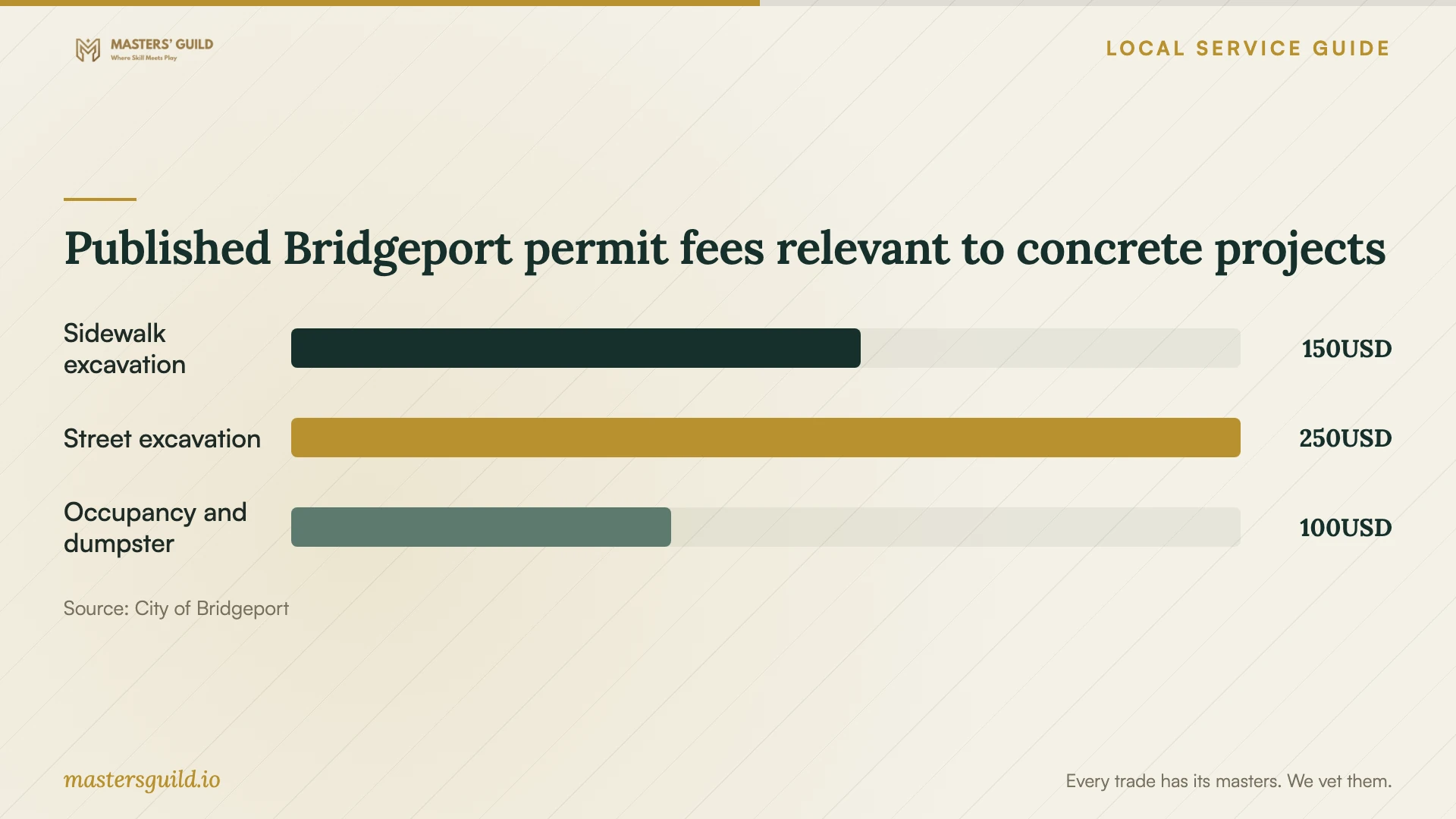
Published Bridgeport permit fees relevant to concrete projects
Local details that affect your job
A sidewalk or apron job changes who can apply
Bridgeport limits sidewalk, curb and driveway apron permit applications to contractors licensed and bonded with the city. Ask about city eligibility when requesting bids, especially if you want one contractor to replace both the private driveway and its apron. [1]
The apron needs its own material specification
The city requires eight-inch driveway aprons with wire mesh and Class C concrete. Its sidewalk guidance calls for five-inch thickness or matching neighboring concrete and a broom finish. Require separate descriptions for these areas so the contractor prices the applicable preparation and materials. [1]
Street logistics belong in the schedule and quote
Bridgeport requires pre-work and post-work inspection scheduling and contact with the overtime police office for traffic control. The fee schedule also lists a $100 occupancy and dumpster permit per location. Ask whether your demolition and disposal plan needs that permit and who will pay the applicable fees. [1] [2]
Match the project to the next step
| Project | Requirement or planning issue | Next step |
|---|---|---|
| Residential patio or private driveway | Connecticut includes patios and driveways in home improvement registration requirements, subject to exemptions. | Check the contracting business's registration and agree on a detailed written scope. |
| Sidewalk, curb or driveway apron | Only city-licensed and bonded contractors may apply; standard permit review takes at least one week. | Confirm applicant eligibility and allow for review before fixing the demolition date. |
| Driveway apron replacement | Bridgeport requires eight-inch thickness, wire mesh and Class C concrete. | Ask for a separate apron specification and price. |
| Sidewalk at a signal-controlled corner | The city requires engineering notification before demolition and DOT standards for ramps. | Have the contractor confirm coordination and ramp scope before signing. |
Your hiring checklist
- Photograph each work area and mark the proposed repair or replacement boundaries.
- Ask the contractor to identify private driveway, apron, sidewalk and curb work separately.
- Request registration information and confirmation of city permit eligibility for the proposed scope.
- Compare written specifications for preparation, thickness, reinforcement, finish, joints and drainage.
- Ask who will arrange permits, inspections, traffic control and disposal.
- Agree on written payment milestones and a process for approving changes.
- Request reopening instructions and review the completed work and cleanup before final payment.
Frequently Asked Questions
Can I apply for the sidewalk or driveway apron permit myself?
Bridgeport says only contractors licensed and bonded with the city may apply for this permit. Ask your contractor to confirm eligibility and provide the permit documentation before work begins. [1]
How much should I budget for concrete installation?
These sources provide municipal fees and requirements, but no verified local installation price range. Request site-specific quotes with the same scope and ask contractors to distinguish construction charges, applicable permits, traffic control and disposal. [1] [2]
Does every patio or driveway project need the same permit?
The city's cited permit page covers sidewalks, curbs and driveway aprons. It does not establish the permit requirements for every private patio or driveway project. Describe your scope to the city and confirm applicable approvals before work starts; DCP advises homeowners to verify permit approval with their town. [1] [4]
Can I cancel after signing a home improvement contract?
DCP states that the contract must include the right to cancel before midnight on the third business day after signing and a separate cancellation notice. Connecticut counts Saturday as a legal business day. Check the cancellation date and retain your signed copy. [4]
Sources and scope
This guide combines the sources below with practical planning guidance. Figures apply to the stated geography and period; request a written quote for your property.