
Local service guide
Yard Cleanup in Boston, MA: Plan the Job
Arrange Yard Cleanup by agreeing on the areas to clear, the material to remove, and who handles disposal before accepting a quote. In Boston, decide whether the crew will prepare eligible debris for a scheduled city collection or haul it away. The City excludes buildings with more than six units from yard waste collection, so check your building’s eligibility before choosing curbside preparation. [1]
Define the cleanup before comparing quotes
Describe the result you want in each part of the yard. Specify leaf removal from the lawn, debris removal from beds, weeding, or clearing a path. Mark plants you want the crew to preserve. Ask the contractor to list pruning, shrub removal, stump work, and hauling as separate tasks rather than treating them as implied parts of a cleanup.
Send photos of the work areas and the route between the yard and the loading point. Include gates, steps, and any shared passage. Tell the contractor where the crew can stage bags and whether you need to coordinate access with a neighbor. Ask the contractor to inspect anything the photos leave unclear before fixing the price.
Request a written scope with the total charge, disposal arrangement, exclusions, and process for approving extra work. For an hourly offer, ask how many workers the rate covers and agree on a spending limit. Compare offers against the same tasks and finished condition rather than choosing on the quoted total alone.
Choose curbside preparation or hauling
Boston schedules curbside yard waste collection for certain weeks from April to December. During those weeks, collection falls on your trash day, or the first trash day of the week if you have two. Check your address in the City’s Trash and Recycling Day app before scheduling a crew to leave bags at the curb. [1]
For eligible debris, ask the crew to use large paper bags or open barrels labeled YARD WASTE with a City-issued sticker. Boston requires branches to measure no more than three feet long and one inch thick, tied with string. Place bags, barrels, and branches curbside by 6 a.m. on collection day. [1]
Boston does not accept plastic bags, large contractor or landscape barrels, collapsible containers, or City-issued recycling bins for yard waste. The City also excludes dirt and mulch, and directs residents to put invasive plant material in regular trash. Ask the contractor to identify and separate those materials before packing the collection load. [1]
Check the disposal destination
Boston does not collect yard waste from buildings with more than six units. Its yard waste drop-off events serve Boston residents, require proof of residency, and reject waste from businesses. If a contractor proposes using a city drop-off event, ask how that plan complies with the resident-only and no-business-waste rules before accepting the offer. [1]
For a hauling quote, ask the contractor to name the disposal destination and explain which materials the price covers. Agree on how the crew will handle branches outside the city collection limits and other excluded material. Request approval before the contractor adds a disposal charge or leaves material behind. [1]
Check before expanding into vegetation removal
If your proposed cleanup includes vegetation removal or ground disturbance near a wetland, check whether the Conservation Commission needs to review the work. Boston directs property owners to MassMapper and an address-based flood map as starting points. If you remain unsure, contact the Commission at 617-635-3850 and describe the proposed work. [2]
The City requires a permit for projects subject to the Wetlands Protection Act. Ask the Commission to determine whether your work falls within its jurisdiction before authorizing that part of the job. Give the contractor a written boundary for the agreed cleanup so the crew does not expand into removal or excavation you have not approved. [2]
Agree on weather changes and the finished condition
Ask how the contractor will handle rain, wet ground, or a postponed visit. Agree on a replacement date and where any unfinished piles will remain. For leaf work, decide whether you want one visit or separate passes, and specify whether the crew will return for leaves that fall after the agreed cleanup.
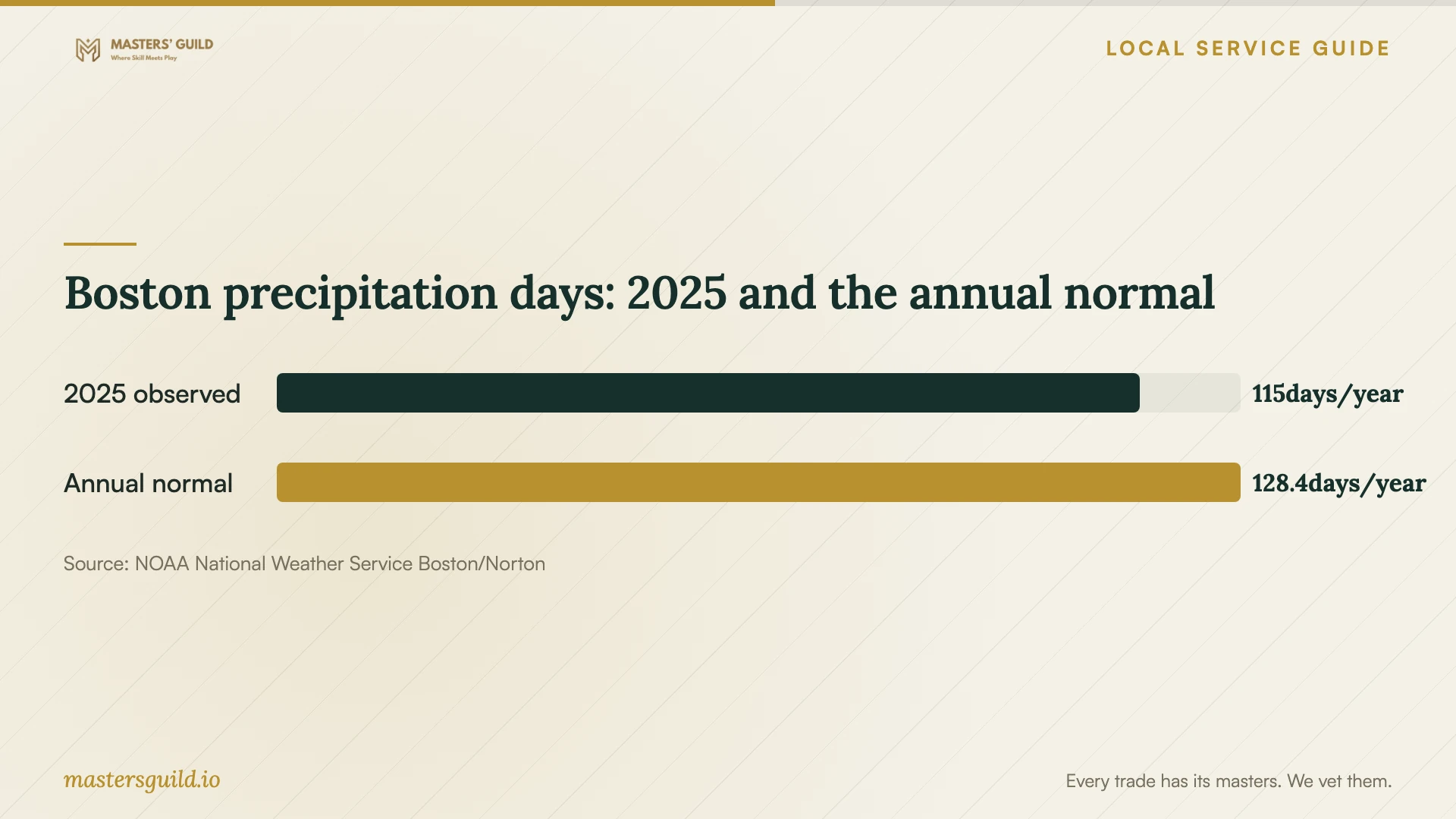
The National Weather Service reported 115 days with at least 0.01 inch of precipitation in Boston during 2025, compared with a 1991–2020 annual normal of 128.4 days. Those annual figures support discussing weather contingencies, but they do not predict rain on your appointment date or establish how long your cleanup will take. [3]
Before the crew leaves, walk through the agreed areas together. Check beds, corners, and access paths, then confirm that the crew has removed or staged debris as promised. Use the written scope to resolve unfinished tasks, and record any return visit before treating the job as complete.
Boston precipitation days: 2025 and the annual normal
Local details that affect your job
Building size changes your disposal plan
Boston excludes buildings with more than six units from city yard waste collection. If you own a unit in a larger building, coordinate disposal with the property manager and request a hauling plan instead of assuming the crew can leave yard waste for city pickup. [1]
Wetlands uncertainty has a city contact
Boston’s Conservation Commission helps owners determine whether work falls within its jurisdiction and requires a filing. Use the City’s suggested wetland and flood mapping checks, then call 617-635-3850 if the proposed clearing remains uncertain. Settle that question before adding vegetation removal or ground disturbance to the cleanup. [2]
Match the disposal plan to your property
| Situation | Arrangement to request | Check before booking |
|---|---|---|
| Eligible building and suitable collection week | Cleanup with curbside preparation | Confirm the address schedule, approved containers, and branch limits. |
| Building with more than six units | Cleanup with an agreed hauling destination | Boston excludes these buildings from city yard waste collection. |
| Dirt, mulch, or invasive plants in the load | Separate disposal arrangements | Boston rejects dirt and mulch from yard waste and directs invasive plants to regular trash. |
| Contractor proposes a city drop-off event | Clarify the disposal plan | Events require Boston residency proof and reject business waste. |
| Uncertain work near wetlands | Define clearing limits before authorizing work | Ask the Conservation Commission whether jurisdiction and permit requirements apply. |
Your hiring checklist
- Photograph the work areas, gates, steps, and loading route.
- Mark plants to preserve and identify the areas the crew may clear.
- Request a written scope with exclusions and a limit for extra charges.
- Confirm city collection eligibility and the scheduled week if choosing curbside preparation.
- Agree on containers, material separation, and the disposal destination.
- Check with the Conservation Commission if wetlands jurisdiction is uncertain.
- Agree on weather rescheduling and inspect the finished work with the crew.
Frequently Asked Questions
Does a cleanup quote include hauling?
Ask the contractor to state that in writing. Specify whether the crew will haul debris away or prepare it for city collection. If you choose collection, confirm that your building qualifies and that the scheduled week matches the work date. [1]
Can the crew leave leaves in plastic bags?
Boston will not collect plastic bags as yard waste. Request large paper bags or open barrels labeled YARD WASTE with a City-issued sticker, and agree who will place them curbside by 6 a.m. [1]
Can I use a resident drop-off event for contractor debris?
Do not assume that arrangement qualifies. Boston limits these events to residents with proof of residency and rejects waste from businesses. Clarify the proposed disposal arrangement with the City and contractor before relying on an event. [1]
Does clearing an overgrown yard require wetlands approval?
That depends on whether the proposed work falls within the Conservation Commission’s jurisdiction. Boston requires a permit for projects subject to the Wetlands Protection Act. Check the suggested maps and contact the Commission if you are unsure. [2]
Sources and scope
This guide combines the sources below with practical planning guidance. Figures apply to the stated geography and period; request a written quote for your property.