
Local service guide
Tree cutting in Boston: arborists, permits and quotes
Tree cutting in Boston starts with checking who controls the tree and whether wires or public space affect the work. For a private tree, arrange an arborist assessment and a written scope covering pruning or removal, equipment access, hauling and stump work. For a City sidewalk tree, start with Boston 311: only Urban Forestry and its contractors may prune those trees. Before accepting a work date, assign responsibility for utility coordination and any street occupancy application. [1] [4]
Confirm responsibility before requesting quotes
Boston describes a public shade tree as a tree within a street’s public right of way, generally between the curb and the back edge of the sidewalk. Parks and Recreation maintains these trees. If you cannot tell whether the tree stands on your property or in the public right of way, ask Urban Forestry to clarify before authorizing cutting. [2]
For street-tree limbs touching your house or hanging low over the sidewalk, submit a 311 case by phone or app. Boston says a City arborist will inspect within a few weeks. If the arborist finds pruning necessary, Urban Forestry adds the work to a contractor’s neighborhood schedule. The City does not promise a pruning completion date in this guidance. [1]
For a private tree, describe the problem you want resolved: a damaged limb, roof clearance, concern about stability or a proposed building project. Ask the arborist to explain whether pruning, monitoring or removal addresses that problem. Request the reasoning in writing before agreeing to removal.
Choose an arborist and compare the same scope
Ask who will assess the tree and who will supervise the crew. Request evidence of the assessor’s arborist credentials, liability coverage and workers’ compensation coverage, then confirm the documents with the issuing organization or insurer. Have the contractor explain how the crew will protect your house, garden, fences and neighboring property.
Give each bidder the same tree description, photographs and access information. Request separate amounts for assessment, pruning or removal, equipment, hauling and stump grinding. For pruning, identify the branches or clearance objective. For removal, specify whether the crew will leave any trunk, logs, chips or stump behind.
Include grinding depth, disposal of grindings, backfill and surface restoration in the written scope. Name who obtains approvals and pays associated charges. Agree on payment terms and how you will approve additional work. Compare quotes against those details rather than accepting an undefined promise to clear the site.
Resolve wires and utility cleanup
Confirm your electricity provider before applying utility guidance. For Eversource customers, the utility distinguishes its outage-prevention vegetation work from maintenance around the service line running from a pole to a home. Eversource assigns property owners responsibility for maintaining their trees around that line and directs them to a qualified tree professional. It says it does not trim service lines unless significant chafing or mechanical strain occurs. Ask your provider and contractor to coordinate before cutting near wires. [3]
For planned Eversource tree work in Massachusetts, its contractors chip branches but leave wood. During power restoration, emergency work or unscheduled vegetation management, Eversource assigns removal and disposal of cut trees or branches on or near the property to the property owner. If Eversource cuts down a tree on your property because it threatens reliability and safety, you are responsible for stump removal. [3]
After utility work, photograph what remains and request a cleanup quote that identifies the logs, branches and stumps you want removed. Describe access and ask whether the price includes hauling, grinding and restoration. Confirm your provider’s cleanup arrangements before hiring a separate crew.
Arrange equipment access before setting the date
Ask where the contractor will place the truck, chipper, lift or crane and how the crew will move material out. If the plan requires restricting street or sidewalk access, review Boston’s street occupancy process. The City requires an application at least seven business days before you need the space, plus scope information, bonding proof, a traffic plan and information about plans for a Boston police detail. [4]
Boston asks applicants for truck length and the length and width of street space they will use. For sidewalk obstruction or closure, applicants must address an ADA compliant pedestrian detour. Name the permit applicant and include permit charges and notice duties in the quote. [4]
Agree on rescheduling arrangements before paying a deposit. Name who will update permit dates, notify neighbors and confirm utility arrangements if the work moves. Clear the access route and agree on where the crew can place material during the job.
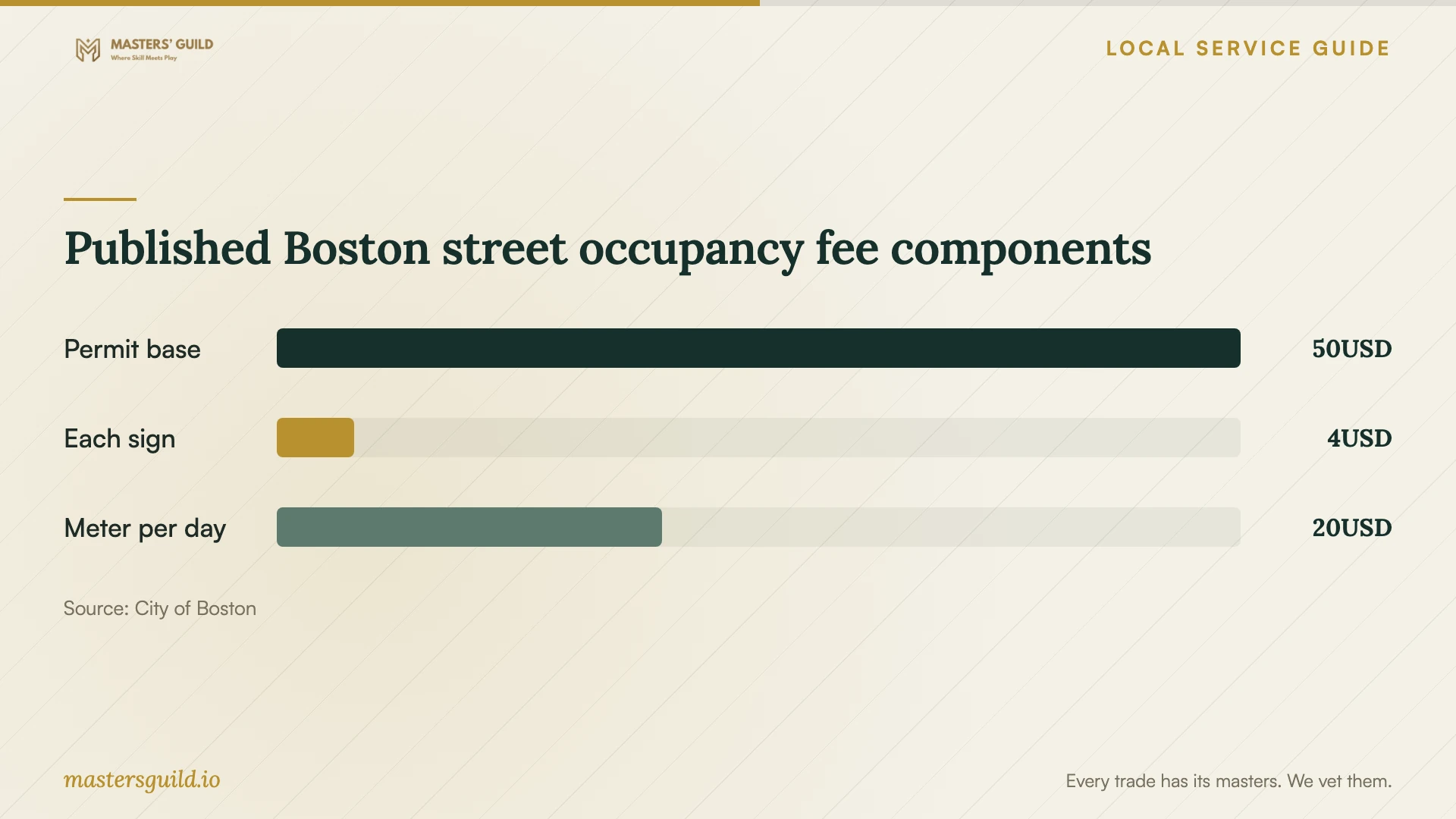
Published Boston street occupancy fee components
Local details that affect your job
Healthy street-tree removal needs a hearing
To request removal of a healthy public shade tree for a project, send Urban Forestry the completed hearing request form, site plan and pertinent documents. The City begins review after you submit complete documentation. It schedules virtual hearings for the first Thursday of each month at 10 a.m., or the second Thursday when the first is a City holiday. Boston says it sends the outcome within two weeks of the hearing. The applicant pays the newspaper notice cost. If the City approves removal, the applicant also pays removal costs and a replacement fee that Boston lists as $550 per diameter inch. Measure the tree’s diameter 4.5 feet above grade. Confirm the fee and ask about the possible replacement-fund recovery described in the City’s guidance. [2]
Reserved street space requires advance notices
After you receive an occupancy permit for residential space, post signs at least three days before the job. Distribute the City’s flier each day for at least two days before work, within a half-block of the occupied space. For metered spaces, Boston requires signs at least two days before work and fliers at least one day before. Assign these tasks to a named person before accepting the start date. [4]
Raised sidewalks follow a separate City process
For a street tree lifting the sidewalk, submit a Sidewalk Repair Case through 311 and attach photographs in the app. Urban Forestry can coordinate with Public Works to examine the roots. Boston says it cannot remove a living, healthy street tree because it affects the sidewalk. Arrange the City review before seeking removal. [1]
Choose the first step for your tree problem
| Situation | First step | Planning implication |
|---|---|---|
| City sidewalk tree needs clearance | Submit a Boston 311 case | Only Urban Forestry and its contractors may prune it |
| Healthy public shade tree conflicts with construction | Request a public tree hearing | Budget for notice and, if the City approves removal, removal and replacement charges |
| An Eversource customer’s private tree interferes with a pole-to-house service line | Coordinate with Eversource and a qualified tree professional | Eversource assigns routine service-line vegetation maintenance to the property owner |
| Equipment requires restricted street or sidewalk space | Arrange the street occupancy application | Apply at least seven business days before using the space |
| Eversource removes a tree on your property because it threatens reliability and safety | Arrange stump removal if you want the stump removed | Eversource assigns stump removal to the property owner under these conditions |
Your hiring checklist
- Confirm tree ownership or City responsibility before authorizing work.
- Send bidders photographs of the tree, wires, structures and equipment access route.
- Request the assessor’s credentials and current insurance documentation.
- Define the pruning objective or removal scope in writing.
- Separate hauling, stump grinding, backfill and restoration in the quote.
- Confirm your electricity provider and assign utility coordination.
- Name who handles approvals, permit charges and street notices.
- Agree on payment terms, additional-work approval and rescheduling.
Frequently Asked Questions
Can I hire someone to prune the sidewalk tree outside my house?
Boston says only Urban Forestry and its contractors may prune trees on City sidewalks. Report clearance concerns through 311 so a City arborist can inspect and determine the next step. [1]
Does the public tree hearing fee cover removal?
Boston charges no administration fee for the hearing itself. The applicant pays the newspaper notice cost. If the City approves removal of a healthy, viable tree, the applicant pays for removal and the replacement fee. [2]
Will Eversource remove the stump and all the wood?
If you are an Eversource customer, its Massachusetts guidance says contractors chip branches but leave wood after planned work. If Eversource cuts down a tree on your property because it threatens reliability and safety, you are responsible for stump removal. Confirm your electricity provider and the cleanup arrangements before hiring a separate contractor. [3]
What should I ask when an arborist recommends removal?
Ask the assessor to describe the concern, explain alternatives and document the recommendation. Request a removal plan covering equipment access, property protection, debris disposal and stump treatment.
Sources and scope
This guide combines the sources below with practical planning guidance. Figures apply to the stated geography and period; request a written quote for your property.