
Local service guide
Tile setting in Boston: hiring and project planning
For tile setting in Boston, choose an installer who will put preparation, installation, debris removal, and responsibility for permits in writing. Before agreeing to a start date, ask Inspectional Services whether your scope needs a permit, particularly if you plan to open walls. Boston identifies minor alterations and repairs as possible Short-Form Permit work. For a shower, ask the installer to describe the proposed waterproofing work and explain who will handle any related plumbing. [1]
Give installers a scope they can price
Describe the room, the surfaces you want tiled, and whether you want the installer to remove the existing finish. Send photographs of the full space, corners, doorways, and transitions to adjoining floors. Identify the tile you are considering, including its dimensions, and ask whether the installer wants to inspect the space before quoting.
Ask for separate descriptions of demolition, preparation, setting materials, tile installation, grout, edge trim, and cleanup. For a shower, request a written waterproofing scope. For a backsplash, agree on the stopping points and treatment around outlets. For a floor, ask how the installer proposes to handle thresholds and the finished height.
Ask how the contractor will document conditions discovered after removal. Agree on a process for photographs, a revised price, and your approval before extra work begins. Request examples of completed projects with a similar layout or material, and ask who performed the work shown.
Resolve the permit question before demolition
Boston says a Short-Form Permit covers minor alterations that do not change a building’s structure or use. The city lists opening a wall and some repairs or replacements as work that may need this permit. Send Inspectional Services your actual scope rather than assuming that all tile work follows the same permit route. You can contact the department at 617-635-5300. [1]
If your project needs a Short-Form Permit, identify who will apply and include the permit responsibility in the contract. Boston requests a description covering materials, floors, rooms, and related permits. The published application fee is $20 plus $10 for each $1,000 of estimated work. The city instructs applicants to wait until it issues the permit before starting. [1]
Ask your installer to distinguish tile work from any proposed changes to plumbing, electrical systems, or the building structure. Then give Inspectional Services the combined scope and ask which approvals apply. Keep the response with your project documents.
Agree on access, deliveries, and debris removal
Before accepting the schedule, walk through the delivery route with the installer. Agree on material storage, protection for shared halls, working hours, and removal of broken tile. If you have a building manager or condominium association, ask about access arrangements and obtain its requirements before booking deliveries.
If the contractor proposes a dumpster, storage container, or truck setup that restricts street or sidewalk access, resolve street occupancy permitting before scheduling that part of the job. Boston asks applicants for details such as dumpster size, truck length, occupied area, and sidewalk obstruction. Applicants must apply at least seven business days before they need the public space. [2]
For residential-area occupancy, the city requires signs at least three days before the job and fliering each day for at least two days before work. For metered spaces, it specifies signs at least two days before the job and fliering at least one day before work. Assign these tasks to a named person in your project plan. [2]
Compare the total commitment and the handover
Ask each bidder to identify what you supply, what the contractor supplies, and which costs remain allowances. Request a written explanation of exclusions and extra-work rates. If two quotes differ, compare preparation, waterproofing scope where relevant, disposal, access arrangements, and finishing before choosing.
Request a schedule that distinguishes working days from waiting periods and states when you may walk on the floor, use the shower, or reinstall fixtures. Ask the installer to base those instructions on the materials they propose. Record who will return for remaining trim, cleanup, or agreed corrections.
For work under a Short-Form Permit, Boston requires a completion inspection. The city directs applicants to schedule through its portal or call center and recommends checking that the permit application has closed after completion. Include that closeout step in your agreement. [1]
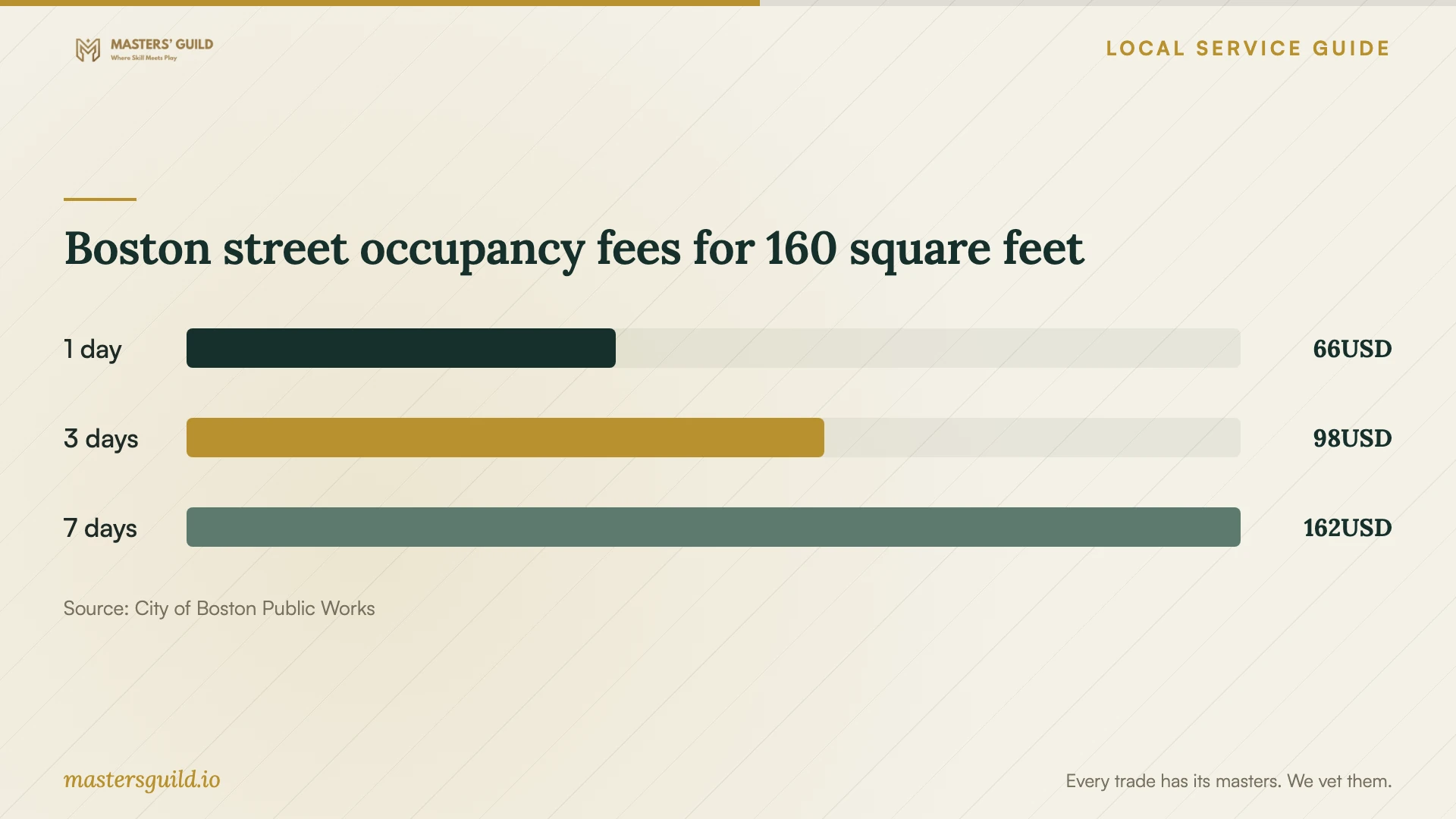
Boston street occupancy fees for 160 square feet
Local details that affect your job
A condo can change who may perform Short-Form permitted work
If your project requires a Short-Form Permit, Boston limits the homeowner application route to people doing their own work in an owner-occupied one- or two-family home. Within that permit process, condo owners in buildings with three or more dwellings must hire a contractor to perform the work. Confirm whether your scope requires this permit before deciding who will handle demolition or installation. [1]
A missing occupancy record requires the owner’s involvement
If the permit portal displays Please Confirm Occupancy, Boston requires the property owner to call 617-635-5300 to request a Confirmation of Occupancy inspection and attend to provide access. The contractor cannot request or schedule this inspection. The city will withhold permits until the owner resolves the record, so keep in contact with the applicant after submission. [1]
Reserved curb space has separate project costs
Boston’s street occupancy charges include a $50 base fee, area charges for each day, $4 per sign, and $20 per occupied meter per day. Ask whether the contractor’s disposal or staging price includes these charges and who will manage the application and notices. [3]
Match the next step to your project
| Your situation | Next step |
|---|---|
| You plan to open a wall | Ask Inspectional Services whether a Short-Form Permit applies before demolition. |
| Your project requires a Short-Form Permit and you own a condo in a building with three or more dwellings | Hire a contractor to perform the work, as Boston requires within its Short-Form Permit process. |
| You need restricted street space for a dumpster or staging | Plan the occupancy application at least seven business days before you need the space. |
| The permit portal requests occupancy confirmation | The owner must arrange the confirmation inspection; the contractor cannot schedule it. |
| Your work under a Short-Form Permit has finished | Arrange the completion inspection and verify permit closure. |
Your hiring checklist
- Photograph the work area and identify the tile, pattern, and finished edges.
- Request a written scope for removal, preparation, installation, and cleanup.
- Ask Inspectional Services to confirm the permit route for the proposed scope.
- Confirm building access rules and delivery arrangements.
- Assign responsibility for debris removal, curb-space applications, and notices.
- Agree on written approval for extra work discovered during removal.
- Record return-to-use instructions and responsibility for permit closeout.
Frequently Asked Questions
Does replacing tile require a Boston building permit?
Ask Inspectional Services about your specific scope. Boston says minor alterations, repairs, or replacements may need a Short-Form Permit and identifies opening a wall as a possible trigger. Its guidance does not establish a blanket exemption for tile replacement. [1]
How should I compare tile installation quotes?
Give bidders the same tile selection and scope. Ask them to identify preparation, removal, waterproofing where relevant, finishing, disposal, and exclusions. Agree on how they will price and obtain approval for conditions discovered after demolition.
How much street occupancy lead time should I allow?
Boston requires an application at least seven business days before you need the public space. Allow for the required signs and neighborhood notices too, and assign responsibility before confirming the delivery or dumpster date. [2]
Sources and scope
This guide combines the sources below with practical planning guidance. Figures apply to the stated geography and period; request a written quote for your property.