
Local service guide
Legal Document Preparation in Boston, MA
For Legal Document Preparation in Boston, ask for a written quote that identifies the documents, who will review your choices, and who will arrange signing and any recording. For a will, plan for the Massachusetts statute’s general requirement of at least two witnesses. For property documents, separate the preparer’s charge from Suffolk Registry recording fees. Choose the provider after you understand those responsibilities. [2] [3]
Choose help around the decisions you need to make
Start by naming your task: preparing a will, completing a document you have chosen, or arranging a property filing. Describe the result you want in ordinary language. Ask the provider to identify the proposed documents and explain what you must decide before drafting starts.
If you need someone to advise you about beneficiaries, ownership changes, competing family interests or the effect of an existing document, seek a lawyer’s review before authorizing the draft. Ask who will answer those questions and whether that review falls within the quoted work. Do not choose a document based on its name alone.
For a typing or form-completion assignment, write down which information you will supply and which choices you have already made. Ask the preparer to flag missing information for your review. Request a readable draft before you arrange signatures, and identify who will handle corrections.
Compare quotes for the complete assignment
Request a quote that names each document and its deliverables. Ask whether the charge includes an intake meeting, review by a lawyer, a draft for your approval, revisions, printed copies and a signing appointment. Set a target date and ask what information the provider needs to meet it.
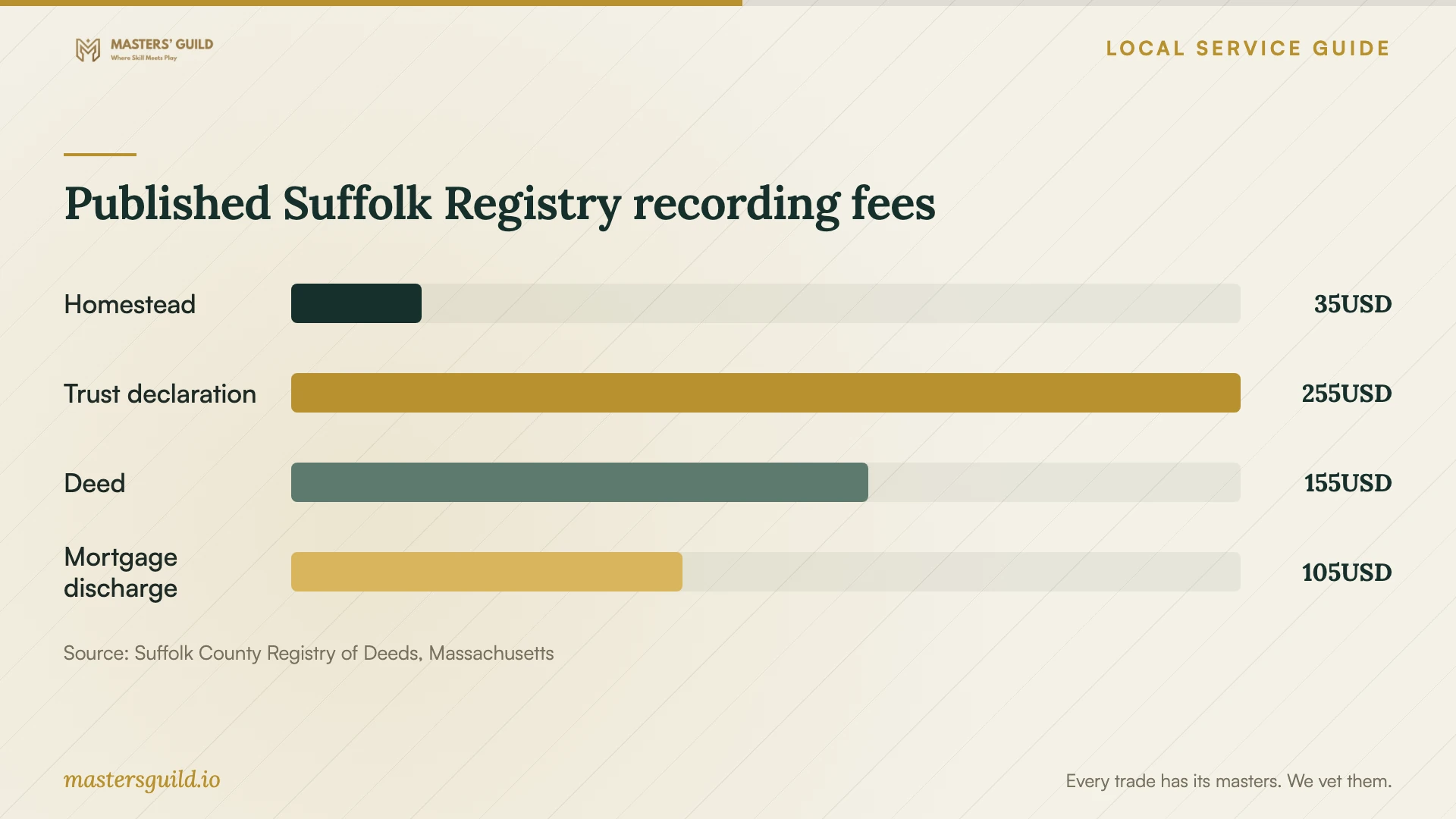
For a property filing, ask who will submit the document, pay the recording charge and give you confirmation afterward. Suffolk Registry lists a $35 recording fee for a declaration of homestead, $255 for a declaration of trust and $155 for a deed, unit deed or easement. These are recording charges; request a separate preparation quote. [2]
Ask how the provider prices additional documents or changes after your approval. If two offers cover different work, request a revised breakdown before comparing totals. Keep the agreed scope with your draft so you can check the completed assignment against what you ordered.
Arrange the signing before accepting the final draft
For wills, Massachusetts General Laws Chapter 190B, Section 2-502 states the general execution rule: the will must be in writing, carry the testator’s signature or a signature made at the testator’s direction and in their conscious presence, and carry signatures from at least two witnesses. The witnesses must have witnessed the signing or the testator’s acknowledgment of the signature or will. The section identifies exceptions, so ask your lawyer to confirm the procedure for your document. [3]
Ask who will arrange the witnesses and guide the signing. If you also plan to use a notary, confirm which part of the paperwork needs notarization. Include witness arrangements in your discussion rather than assuming a notary visit completes the will-signing process. [3]
At Boston’s City Clerk’s Office, all signers must attend, present the full document and leave it unsigned and undated until they appear before the notary. Each signer needs valid government-issued photo identification. If your document requires a witness, the office instructs you to bring someone personally known to you who also has valid photo ID. [1]
Prepare for handoff and keep proof of completion
Gather the existing documents you want the provider to review, the names and contact details of relevant people, and the property information you want checked. Use the provider’s intake list to decide what to send. Ask how to transmit sensitive records and who will have access to them.
Before approving the draft, check names, addresses, your stated instructions and any blanks. Ask the provider to explain unfamiliar terms. Agree on who will retain originals, how you will receive copies and how to request a correction after delivery.
If you plan to record at Suffolk Registry, arrange payment before the visit. The Registry accepts cash, checks or money orders and does not accept credit or debit cards. For mailed recordings, it requires recording checks in the exact amount, payable to Commonwealth of Massachusetts. It also requires separate checks for excise tax and for Recorded Land and Registered Land. [2]
Published Suffolk Registry recording fees
Local details that affect your job
City Hall offers walk-in notarization
The City Clerk provides notary service without appointments during its published hours of 8 a.m. to 4:30 p.m., at 1 City Hall Square, Room 601. The charge is $5 per document. Confirm availability before traveling, and ask your preparer whether this visit fits the signing plan. [1]
Check City Clerk restrictions before choosing the venue
The office cannot copy or notarize birth, death or marriage certificates. Its guidance also requires direct communication between the notary and the person seeking notarization, and allows the notary to decline requests involving authenticity, ambiguity or uncertainty. Discuss any concern with the office before arranging attendance. [1]
Plan the Registry visit around recording hours
Suffolk Registry is at 24 New Chardon Street. It publishes Monday through Friday recording hours of 8:30 a.m. to 4:15 p.m.; research hours continue to 4:30 p.m. Its holiday list includes October 12, 2026. Confirm the office schedule before arranging a filing trip, and account for its payment restrictions in your handoff plan. [2]
Match the arrangement to your next step
| Your task | Ask the provider | Planning detail |
|---|---|---|
| Complete a form you have chosen | Which information and decisions must I supply? | Agree on drafting, review and correction responsibilities. |
| Prepare a will | Who will confirm execution requirements and arrange witnesses? | The Massachusetts general rule requires at least two witness signatures. |
| Use City Hall notarization | Can everyone attend with the full unsigned document and photo ID? | The City Clerk charges $5 per document and requires all signers to attend. |
| Record a property document | Who submits it and supplies the recording payment? | Suffolk Registry accepts cash, checks or money orders, with exact-amount recording checks for mailed documents. |
Your hiring checklist
- Name each document and describe the result you want.
- Identify the decisions you want a lawyer to review.
- Request an itemized scope covering drafts, revisions and delivery.
- Agree on who will arrange witnesses and any notary visit.
- Ask for an attendance and identification list for signing.
- Confirm who will submit any property filing and arrange payment.
- Check the draft against your instructions before approval.
- Agree on delivery of originals, copies and filing confirmation.
Frequently Asked Questions
Does a City Hall notary visit cover my will’s witness requirements?
Plan the witness arrangements with your provider. Massachusetts generally requires signatures from at least two people who witnessed the will’s signing or the testator’s acknowledgment of the signature or will. The City Clerk tells customers to bring their own witness when one is required. Ask your lawyer to confirm the complete signing procedure. [1] [3]
Can I sign before going to the City Clerk?
The City Clerk’s instructions say to leave the document unsigned and undated until you appear before the notary. Bring the full document, valid government-issued photo ID and all signers. Bring a witness with valid photo ID if your document requires one. [1]
How much should I budget for preparation?
Request a quote for your documents and the review you want. The published local figures here cover notarization and recording. They do not establish a preparation fee. Ask the provider to identify those charges apart from drafting, review, revisions and submission work. [1] [2]
Can I pay Suffolk Registry recording fees by card?
The Registry’s published payment policy excludes credit and debit cards. It accepts cash, checks or money orders. Mailed recording checks must match the exact amount, and the Registry requires separate checks for excise tax. [2]
Sources and scope
This guide combines the sources below with practical planning guidance. Figures apply to the stated geography and period; request a written quote for your property.