
Local service guide
Kitchen Remodeling in Boston: Hiring and Permit Planning
For Kitchen Remodeling in Boston, choose a contractor who explains the permit route, names the licensed trades, and includes demolition, installation, disposal, and inspections in the written scope. Boston requires licensed trade contractors for plumbing, electrical, and exhaust work. Before signing, confirm whether your proposed layout involves moving structural walls or egresses that require a Long-Form permit. [1]
Choose the scope before comparing contractors
Write down what you want to keep and what you want to move: cabinets, sink, appliances, walls, windows, and doorways. Give each bidder the same list, photographs, and appliance specifications. Ask them to separate the base scope from optional changes so you can decide which improvements fit your budget.
Boston directs projects that move structural walls or egresses toward a Long-Form permit. In that context, the city gives examples such as expanding the kitchen, creating a new window, or creating or removing a doorway. Its general permit guidance describes Short-Form permits as covering minor work that does not change structure or use. Describe your exact kitchen scope to Inspectional Services rather than assuming that keeping the room size settles the permit question. [1] [2]
Check who will perform and permit the work
Ask for the names and license details of the contractors handling plumbing, electrical, and exhaust work. Boston allows only contractors with valid, non-expired Massachusetts trade licenses to apply for the corresponding Plumbing, Electrical, or Sheet Metal permits and perform that work. If the project installs, replaces, or moves fire alarms or sprinklers, the city also directs homeowners to hire a Fire Protection Engineer. [1]
For contractor Long-Form applications, Boston requests license documentation, current liability insurance, a workers’ compensation affidavit, and a signed homeowner contract, among other documents. Ask your bidder to explain who will prepare the application and provide those records. The contractor performing the work must be the permit applicant. [2]
Put permit fees, application preparation, design services, and inspection coordination into the proposal. Ask who pays for revisions if you change the layout after approval. Request a written change order that states the price and schedule effect before authorizing extra work.
Build a quote you can compare
Request separate amounts for demolition and disposal, cabinets, countertops, flooring, appliances, trade work, and finishing. For each allowance, ask what product and quantity the contractor has assumed. Specify whether the quote includes appliance delivery, installation, cabinet hardware, wall repair, and cleanup.
Boston charges a $50 Long-Form application fee plus $10 for each $1,000 of estimated work cost, with fees due upfront. Treat that as one permit expense within the project budget. Ask the contractor to identify other applicable permits and charges rather than presenting the building permit fee as the total approval cost. [2]
Budget from written proposals for your selected layout and finishes. Ask each bidder to explain exclusions and how they would price concealed damage discovered during demolition. Keep any owner reserve separate from the agreed contract amount.
Arrange access before demolition
Walk the delivery route with the contractor. Measure doorways and discuss stairs, elevator reservations, floor protection, storage, and debris removal. If you belong to a condominium association, ask the manager for the building’s renovation requirements before agreeing to work dates.
Boston requires street occupancy applicants to apply at least seven business days before they need public space. The city asks for details such as dumpster size, sidewalk obstruction, truck dimensions, and metered parking locations. Agree on the occupied area and dates before the contractor orders a dumpster or arranges staging. [3]
For residential street occupancy, Boston requires signs at least three days before the job and neighborhood fliering each day for at least two days before work. Metered spaces have different notice requirements. Assign that task in writing and ask the contractor to confirm the requirements for the approved location. [3]
Tie the schedule to approvals and completion
Boston says Long-Form review timing depends on planning and zoning review, additional information, and other approvals. The city prohibits starting work before permit issuance. Ask for a schedule that distinguishes application, approval, material readiness, demolition, and installation instead of treating the proposed start date as fixed. [2]
For Long-Form completion, Boston directs applicants to arrange an inspection through the ISD call center or online portal. The licensed contractor must attend. After the inspection passes and no further work remains, check that the permit appears closed in the portal. [2]
Agree on how you will cook, wash dishes, and protect belongings during the work. Before signing off on completion, walk through cabinet operation, appliance installation, finish defects, and cleanup with the contractor. Record unresolved items and agree on dates for corrections.
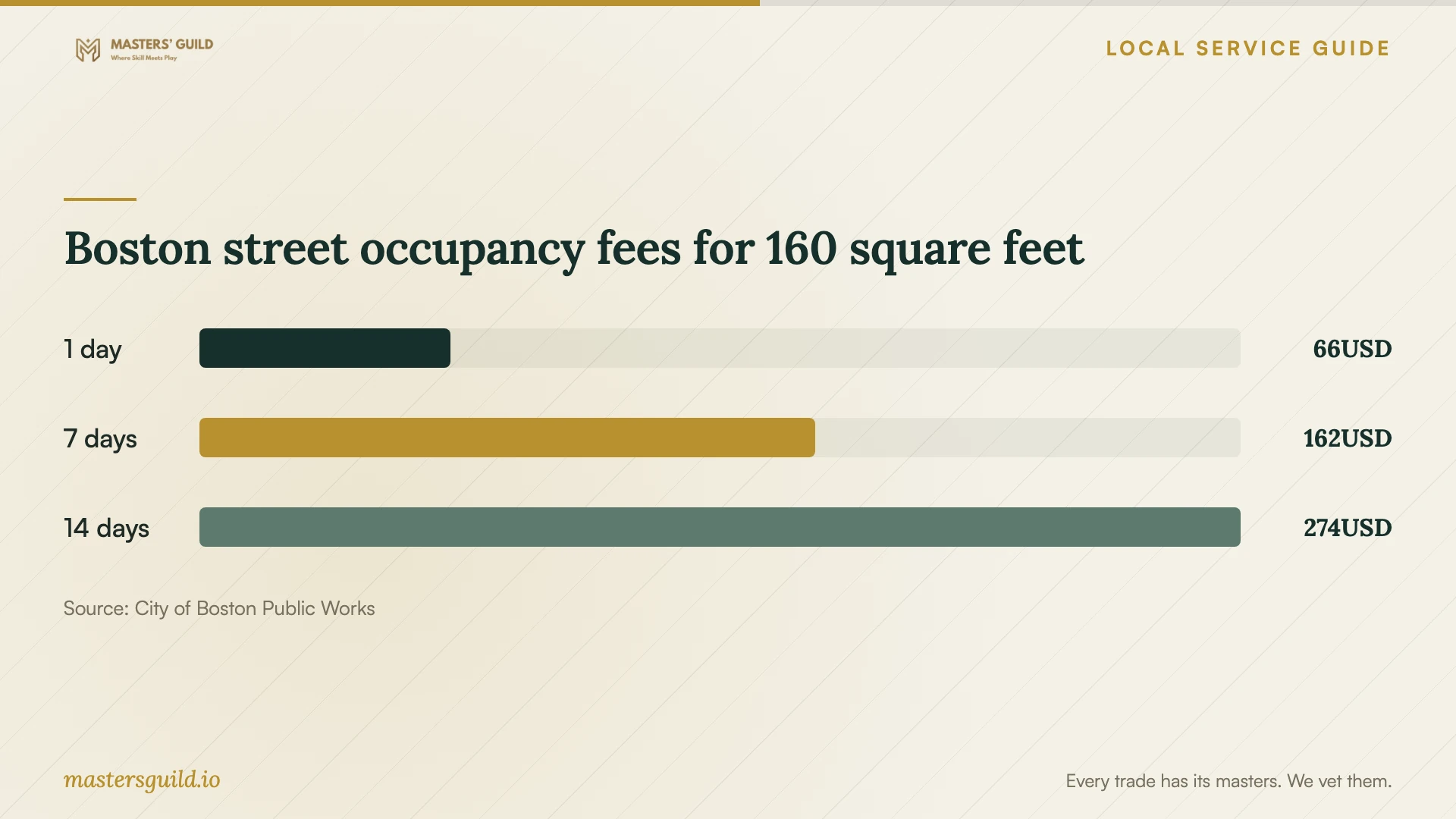
Boston street occupancy fees for 160 square feet
Local details that affect your job
Three-decker owners need a contractor for Long-Form work
Boston’s Long-Form homeowner application route covers owners doing their own work in owner-occupied one- or two-family homes. If you own a unit in a building with three or more dwellings, including one floor of a three-decker, the city requires a licensed contractor to perform the work. Use the building’s dwelling count when discussing eligibility. [2]
A missing occupancy record requires owner action
If the Long-Form portal displays Please Confirm Occupancy, the property owner must call ISD at 617-635-5300 to request a Confirmation of Occupancy inspection and attend to provide access. Contractors cannot request or schedule it. Boston will withhold permits until the occupancy record issue is resolved, so assign yourself this task if the message appears. [2]
Historic-district review can affect the application
Boston’s Long-Form guidance identifies Landmarks Commission approval as a possible requirement for projects in historic districts. Required agency approvals appear in the portal’s Review section. The applicant must contact the agencies and upload approvals; ISD does not request them. Ask the contractor to check this before promising a demolition date. [2]
Match the proposed work to the next step
| Your situation | Permit or hiring implication | Next step |
|---|---|---|
| Minor work without structure or use changes | Boston describes Short-Form as the minor-work route. | Confirm the exact kitchen scope with ISD. |
| Moving structural walls or egresses | Boston identifies Long-Form permitting for this work. | Ask for a plan and application preparation scope. |
| Plumbing, electrical, or exhaust work | Valid Massachusetts trade license holders must apply for the relevant trade permits and perform the work. | Request names, license details, and permit responsibilities. |
| Long-Form work in a building with three or more dwellings | The unit owner must hire a licensed contractor. | Discuss the building’s dwelling count with bidders. |
| Occupying street or sidewalk space | Boston requires application at least seven business days ahead. | Agree on area, duration, notices, and charges. |
Your hiring checklist
- Give bidders one scope with the same layout, appliance specifications, and finish selections.
- Ask who will confirm the permit route and prepare any required plans.
- Record the names and license details of the proposed trade contractors.
- Separate fixed prices, allowances, exclusions, and optional work.
- Assign delivery access, debris removal, street occupancy arrangements, and neighbor notices.
- Agree on written change orders and a temporary cooking arrangement.
- Include inspection coordination, permit closeout, and a final defect walkthrough in the scope.
Frequently Asked Questions
Can I apply for the building permit myself?
Boston allows homeowners and contractors to apply for building permits, subject to the application rules. Its Long-Form homeowner route permits owners to perform work in owner-occupied one- or two-family homes. Owners of units in buildings with three or more dwellings must hire a licensed contractor. Licensed trade contractors must handle the specified trade permits and work. [1] [2]
Does keeping the existing layout settle the permit question?
Ask ISD to review the scope. Boston distinguishes minor work from structural or use changes, but kitchen work can also involve separate plumbing, electrical, or sheet metal permits. Keeping the layout does not establish which trade permits your project needs. [1] [2]
How much should I budget for street occupancy?
Boston lists a $50 base fee, daily area charges, $4 per sign, and $20 per occupied meter per day. The chart illustrates base and area fees for 160 square feet. Ask your contractor to price the actual footprint, duration, signage, and metered spaces. [4]
Can the contractor guarantee the permit approval date?
Boston says Long-Form issuance depends on review, additional information, and other approvals. Ask the contractor to identify those dependencies and explain how delays affect the work schedule. Do not authorize a start before the city issues the required permit. [2]
Sources and scope
This guide combines the sources below with practical planning guidance. Figures apply to the stated geography and period; request a written quote for your property.