
Local service guide
Furniture Assembly in Boston: Plan Your Appointment
Arrange Furniture Assembly in Boston by sending the assembler your product models, instructions, item count, and access details before accepting a quote. Ask them to list assembly, wall attachment, carrying, cleanup, and old furniture removal as separate tasks. Coordinate the appointment with delivery and assign responsibility for parking. If delivery uses a moving truck, consider Boston's optional curb-space reservation, which applies to moving trucks rather than personal vehicles. [1]
Get a quote for the exact build
Send the product name, model number, quantity, and assembly instructions with your request. Include photos of the boxes and the room where you want each piece. For furniture you have started assembling, photograph the current build and explain which steps you completed. Ask the assembler to quote the remaining work.
Ask whether the quote uses a fixed amount or an hourly rate. For hourly work, request the minimum charge, billing increments, and a procedure for approving extra time. For a fixed quote, ask what could change the total. Describe carrying boxes upstairs, moving existing furniture, attaching pieces to walls, and taking packaging away before comparing offers.
Set your assembly budget from quotes for your item list. Keep delivery access and disposal expenses separate so you can compare the same tasks across assemblers. Ask each provider to identify parking charges and return-visit charges before you accept. These sources establish municipal parking fees, not local assembly labor prices. [1] [2] [4]
Agree on wall attachment and completion checks
Read the manufacturer's instructions before deciding what to include. If they call for wall attachment, ask the assembler to include that step and explain what they need to know about the wall. Send a photo of the intended position and ask who supplies the attachment hardware. Resolve any permission you need from a building manager or owner before the visit.
Agree on what you will inspect together before the assembler leaves. Ask them to demonstrate drawers, doors, moving parts, and adjustments covered by the instructions. Keep spare hardware and the instructions in a labeled bag. For missing or damaged parts, agree on whether to pause, contact the seller, or arrange a return visit, including any additional charge.
Coordinate delivery, carrying, and parking
Confirm whether the delivery team will leave boxes at the entrance or carry them to the room. Describe stairs, elevator access, entry arrangements, and building appointment rules. Ask who will move the boxes and whether they need another person. Leave time between delivery and assembly to check the boxes against your order.
Boston's standard moving-truck reservation covers two parking spaces for one day, from 7 a.m. to 5 p.m. The City says a permit is optional and guarantees legal parking for the move. For a moving-truck delivery, decide who will apply and handle the signs and fliers. Arrange separate parking for an assembler arriving in a personal vehicle because the City excludes those vehicles from moving-truck permits. [1]
Most Boston meters operate Monday through Saturday, from 8 a.m. to 8 p.m. Drivers must check each location's posted hours and time limits. The City offers free metered parking on Sundays and City holidays while enforcing other parking regulations. Discuss the intended parking location and responsibility for charges before accepting the quote. [4]
Plan cleanup and old furniture disposal
Ask the assembler to specify whether cleanup means gathering packaging, carrying it to your building's collection area, or hauling it away. Use Boston's Trash Day app to check your collection schedule and its sorting tool to check packaging disposal. The City lists recyclable paper, cardboard, and paperboard among curbside recycling materials. [3]
Boston allows furniture with normal curbside trash and recycling on your scheduled collection day. The City requires separate scheduling for mattresses and does not collect construction debris. Identify what you are discarding before adding removal to the quote. For buildings with seven or more units, consult the City's large-building guidance through its trash page and ask your manager about disposal arrangements. [3]
Include moving an old piece downstairs in the written scope. Agree on where the assembler should leave it and who will handle curbside placement. Clear the carrying route and choose the final position for each new piece before anyone opens the boxes.
Boston moving-truck reservation fees for delivery planning
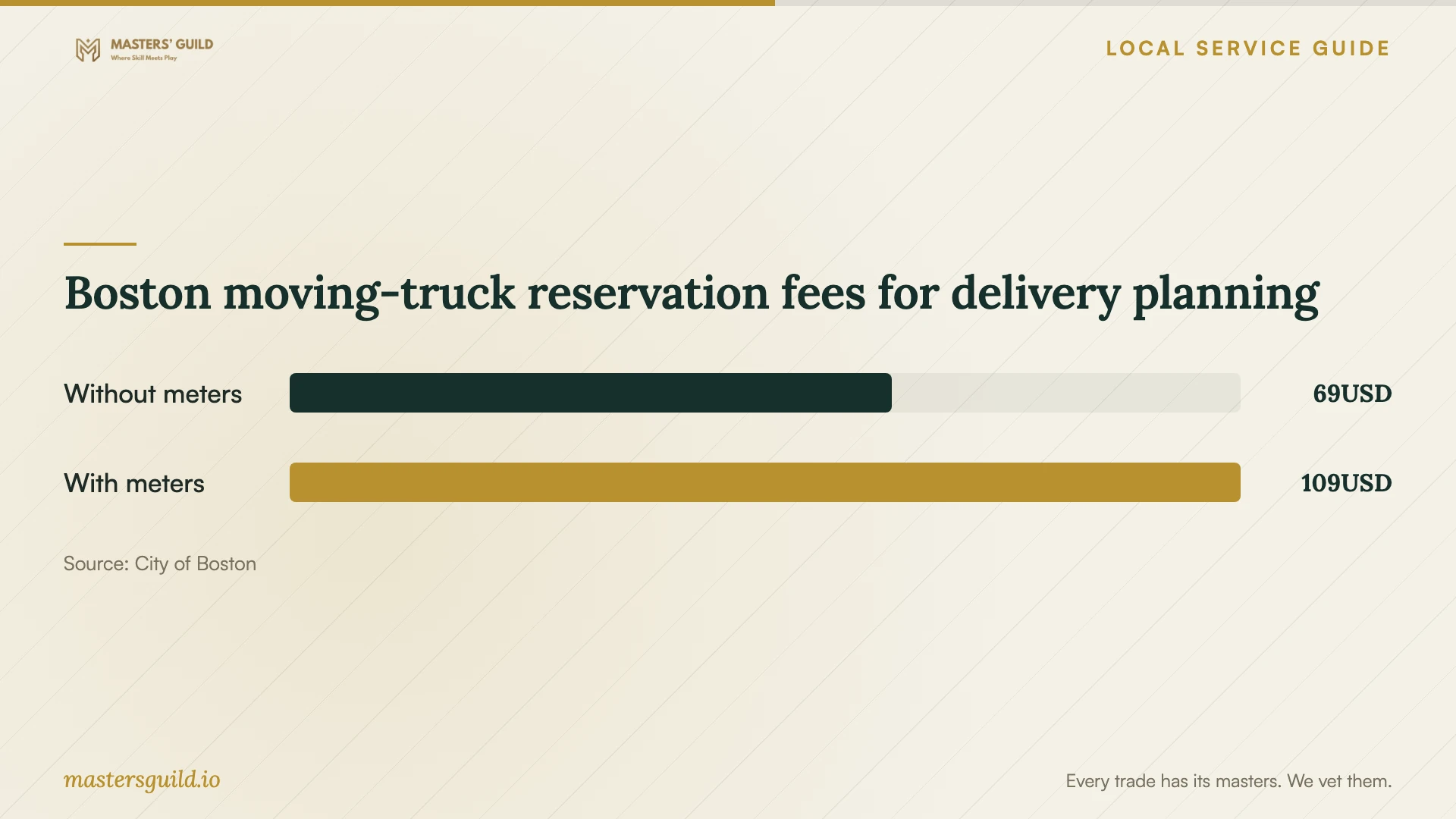
Local details that affect your job
Allow time for the reservation and street notices
Boston's parking instructions allow online applications from 15 days to eight weeks before the move, or in-person applications from three days to eight weeks before it. Post signs at least 48 hours before the permit's 7 a.m. start; the City recommends three days. Make copies of the supplied flier and place them on cars within a half-block of the reserved spaces each day for at least two days before the move. For metered spaces, the City requires fliering one day before the move. Assign someone to remove signs and fliers afterward and clean up debris. The portal describes its online minimum as two weeks; use the instructions page's longer 15-day lead time when planning. [1] [2]
Check who controls the delivery street
Boston's moving-truck portal says the City cannot issue permits on listed state-owned roads, including all of Jamaicaway, Arborway, Riverway, Fenway, Charlesgate East, and Charlesgate West. Check the portal's full exclusion list for your address. If your delivery uses a listed road, consult its DCR permit guidance before arranging reserved curb space. [2]
Avoid a short-stay parking plan
The City lists some Back Bay and Beacon Hill meters with a 30-minute maximum. It also lists a 15-minute maximum on the south side of Boylston Street between Arlington and Clarendon Streets. Ask the assembler to choose parking that accommodates the planned visit and check the posted limit before agreeing on parking expenses. [4]
Choose the next step for your appointment
| Situation | Next step | Confirm before booking |
|---|---|---|
| Boxes are already in the room | Request assembly and any instructed wall attachment | Models, hardware, cleanup, and scope |
| Delivery uses a moving truck | Consider an optional two-space City reservation | Who applies, posts signs, distributes fliers, and removes notices |
| Delivery uses a listed state-owned road | Consult the portal's DCR permit guidance | Correct authority for reserved curb space |
| Assembler plans to use metered parking | Check posted hours and maximum stay | Parking location and responsibility for charges |
| Replacement includes an old mattress | Schedule mattress collection | Separate carrying and pickup arrangements |
Your hiring checklist
- Send product models, quantities, instructions, and photos of any partial assembly.
- Confirm billing terms and how you will approve extra work.
- List carrying, wall attachment, room placement, cleanup, and removal in the quote.
- Check delivery placement, elevator arrangements, and entry access.
- Assign the parking plan and, for a truck reservation, the application and street notices.
- Clear the work area and choose each piece's final position.
- Agree on a missing-parts procedure and inspect the completed work together.
Frequently Asked Questions
Do I need a moving-truck permit for an assembly appointment?
Boston says moving-truck permits are optional and apply to moving trucks, not personal vehicles. Consider one if your appointment includes a moving-truck delivery. For an assembler arriving by car, agree on legal parking and check posted restrictions. [1] [4]
Does the assembly quote include wall attachment?
Ask the assembler to state that in the quote. Send the manufacturer's instructions and a photo of the intended wall, then confirm hardware, permission to drill, and responsibility for completing the attachment.
Can I put old furniture out after assembly?
Boston allows furniture with normal curbside collection on your scheduled day. Its resident trash instructions say to bring containers out after 5 p.m. the evening before collection and have trash curbside by 6 a.m. Mattresses require scheduled collection. Check your collection schedule and building arrangements before asking the assembler to leave furniture outside. [3]
How should I handle missing parts?
Agree on the procedure before work starts. Ask the assembler to identify missing or damaged parts, retain their labels, and discuss whether to pause the build. Confirm any return-visit charge before arranging replacement parts with the seller.
Sources and scope
This guide combines the sources below with practical planning guidance. Figures apply to the stated geography and period; request a written quote for your property.