
Local service guide
Duct and Vent Cleaning in Boston, MA
Arrange Duct and Vent Cleaning in Boston by identifying the system first: heating and cooling ducts or commercial cooking exhaust. For kitchen exhaust, consult Boston Fire Prevention's registered-cleaner and inspector resources and reporting guidance before choosing a contractor. For HVAC ducts, request evidence of contamination and a written scope. EPA's residential guidance offers useful questions about cleaning methods, but it does not establish commercial maintenance requirements. [1] [2]
Define the job before requesting quotes
Tell each bidder whether you need HVAC duct cleaning, cooking hood exhaust service, or separate proposals for both. Include photographs of the equipment, the areas it serves, and the problem you want investigated. Have the contractor identify the equipment they propose to service before you compare totals.
Boston's Special Occupancy unit enforces City laws on cooking hood and ventilation systems. Its Hood Exhaust section lists an application and instructions, registered cleaners and inspectors, inspection and deficiency-report resources, and sticker instructions. Consult those resources when arranging cooking exhaust work. [2]
For leased premises, agree with the owner or building manager on access, authorization, and responsibility for shared equipment. Identify who can approve additional work if the contractor finds damage. Put those arrangements in writing before booking a shutdown.
Request evidence before buying HVAC duct cleaning
EPA's home duct-cleaning guidance identifies substantial visible mold on hard surfaces, pest infestation, and excessive debris or particles coming from supply registers as reasons to consider cleaning. EPA recommends residential duct cleaning as needed. Use these observations to frame questions about your premises, while having a commercial HVAC professional assess your equipment and maintenance needs. [1]
Have the contractor show you the material they call mold. EPA explains that appearance alone cannot confirm mold and that expert assessment may require laboratory analysis. Its guidance also calls for correcting the underlying cause of contamination. Address moisture or another identified cause before paying to clean a system that could become contaminated again. [1]
Treat promises of healthier air or lower energy bills with caution. EPA says duct cleaning has not been shown to prevent health problems and finds little evidence that cleaning ducts alone improves system efficiency. Its discussion distinguishes duct cleaning from cleaning dirty coils, fans, and heat exchangers. [1]
Compare scope and completion evidence
Request separate line items for inspection, duct cleaning, equipment cleaning, access work, and any proposed treatments. Have each bidder state exclusions and explain who will handle repairs. Compare proposals for the same equipment and outcome. A list of cleaned grilles leaves you without an explanation of the work inside the system.
EPA describes residential system cleaning as including supply and return ducts, registers, coils, drain pans, fans, and air-handler housing. It recommends outdoor vacuum exhaust or HEPA vacuum equipment when exhausting indoors, protection for furnishings, and sealing and re-insulating access holes. Have a commercial contractor explain the appropriate method for your system before adopting a residential specification. [1]
Agree on completion evidence before work starts. EPA recommends visual inspection and having the cleaner show the cleaned components. For your job, request labeled photographs tied to the agreed scope, an account of inaccessible areas, and a list of remaining defects. Keep kitchen exhaust documentation separate from HVAC cleaning records. [1]
Prepare access and review proposed extras
Request a work window and details of any equipment shutdown. Coordinate access with your building manager, move stock away from the work area, and identify who will receive the crew. Agree on protection for occupied areas and the conditions for restarting equipment before choosing a date.
Review any chemical treatment as a separate decision. EPA advises understanding the benefits and risks before allowing biocides or internal sealants in residential ducts. It also says cleaners should inspect for asbestos-containing materials before cleaning and that trained, equipped specialists must handle those materials. Have the contractor explain how they will assess suspect materials and stop work if needed. [1]
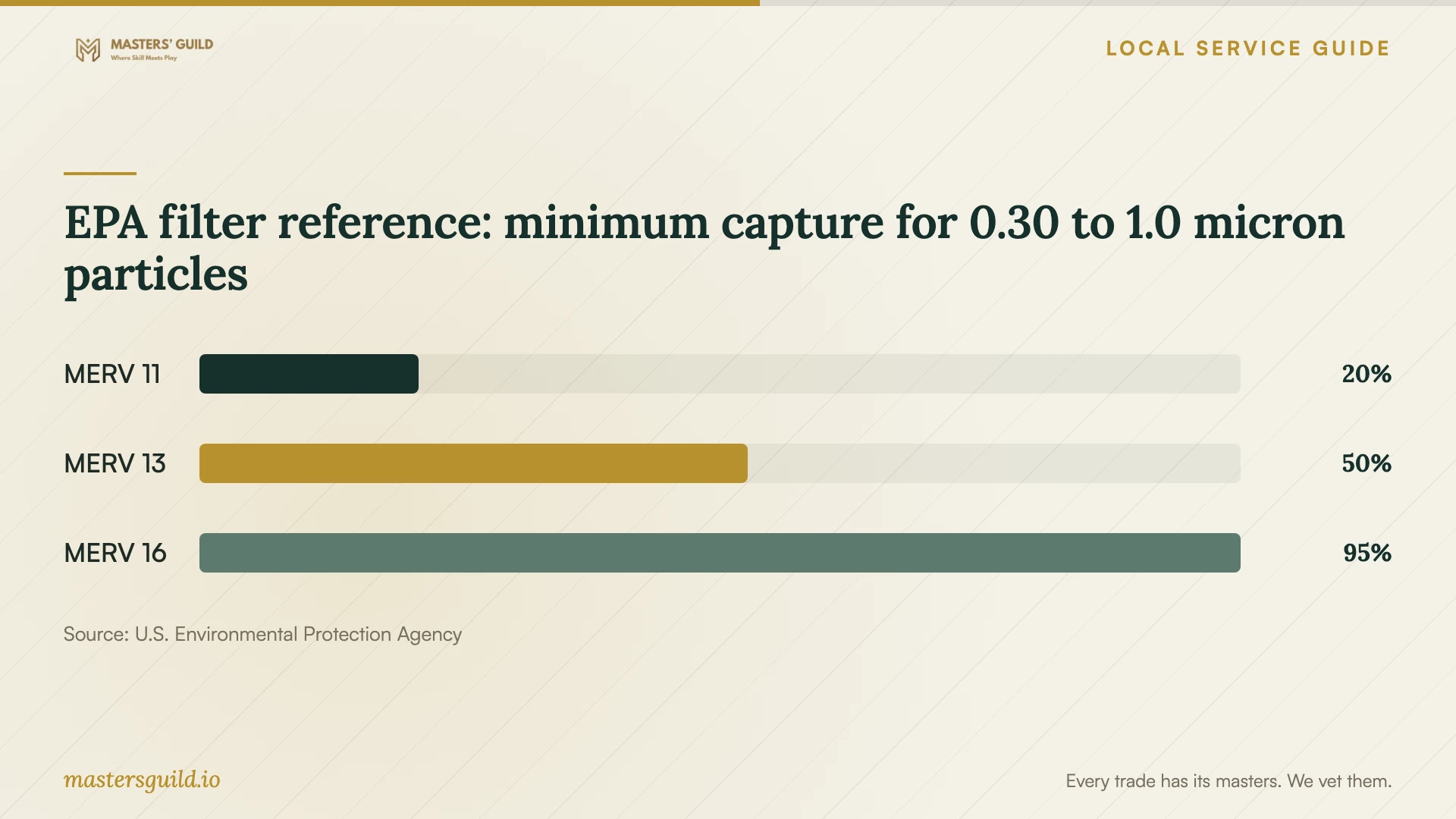
If recurring dust prompted the request, discuss filter fit and maintenance alongside cleaning. EPA explains that higher MERV ratings indicate better capture of specified particle sizes, but the fan and filter slot limit the filter you can use. Have your HVAC technician identify a compatible option and its replacement schedule. [3]
EPA filter reference: minimum capture for 0.30 to 1.0 micron particles
Local details that affect your job
Check the City's kitchen exhaust provider resource
Boston Fire Prevention lists a 2026 Registered Cleaners and Inspectors resource in its Hood Exhaust section. Before hiring for cooking exhaust, consult that resource and have the bidder identify their listed business and proposed role. Boston's landing page does not reproduce the roster or establish a particular bidder's registration status. [2]
Set documentation expectations before booking
The City's Hood Exhaust section provides a Sample Inspection and Deficiency Report, an Advisory on Deficiency Reports, and Sticker Requirements and Instructions. Review the applicable resources and agree with the contractor on the records they will deliver. Boston's landing page does not specify report contents, sticker rules, or inspection intervals. [2]
Resolve cooking exhaust questions with Fire Prevention
Boston lists Fire Prevention at 617-343-3628 for questions about this service area. Use that contact to clarify which hood-exhaust application or guidance applies to your proposed work before accepting a contractor's interpretation. Boston's landing page lists an application resource but does not state when a particular cleaning job requires it. [2]
Choose the next step for your system
| Situation | Next step | Evidence boundary |
|---|---|---|
| Commercial cooking hood or exhaust | Consult Boston's Hood Exhaust provider and documentation resources | City guidance concerns cooking hood and ventilation systems |
| HVAC contamination claim | Request visible evidence and a system assessment | EPA's cited cleaning guidance concerns homes |
| Mold claim | Request evidence and a plan to correct the moisture cause | EPA says expert identification may require laboratory analysis |
| Recurring dust and a filter upgrade proposal | Have an HVAC technician check fan and filter-slot compatibility | MERV efficiency does not establish compatibility or a need for cleaning |
Your hiring checklist
- Identify HVAC ducts, cooking exhaust, and any shared equipment in the job description.
- Agree with the owner or building manager on authorization and access.
- For cooking exhaust, consult the City's provider and documentation resources.
- Have bidders show the problem and identify equipment included in their scope.
- Request written exclusions, pricing for extras, and a process for approving changes.
- Agree on shutdown timing, work-area protection, and restart arrangements.
- Specify photographs, completion records, and a list of unresolved defects.
Frequently Asked Questions
Can one contractor handle HVAC ducts and kitchen exhaust?
Have the bidder demonstrate suitability for each job and provide separate scopes. Boston provides registered-cleaner and inspector resources for hood exhaust. Verify the bidder's status for cooking exhaust work alongside their HVAC cleaning experience. [2]
Does this guidance establish a commercial cleaning schedule?
No. EPA's cited duct-cleaning guidance addresses homes, and Boston's landing page does not state hood-exhaust cleaning intervals. Clarify the applicable schedule with Fire Prevention and the professionals responsible for your equipment. [1] [2]
Should I accept an EPA-certified duct cleaner claim?
EPA says it does not certify, endorse, or approve duct-cleaning companies. Have the bidder name the actual credential they hold and explain its relevance to your proposed work. [1]
Does a higher MERV filter remove the need for cleaning?
The MERV rating describes particle capture performance. It does not establish the condition of your ducts. Check filter compatibility with an HVAC technician and assess any contamination as a separate question. [1] [3]
Sources and scope
This guide combines the sources below with practical planning guidance. Figures apply to the stated geography and period; request a written quote for your property.