
Local service guide
Tax Preparation and Accounting in Boise
Arrange Tax Preparation and Accounting in Boise by defining which business and personal returns you need, whether your books need cleanup, and who will handle tax notices. Confirm credentials and request a written scope, itemized estimate, and completion schedule. For IRS audits, collections, or appeals, choose a CPA, enrolled agent, or attorney with unlimited representation rights. [5]
Define the work before comparing accountants
Start with a short description of your business, its tax classification, the tax year, and the condition of your records. Have the accountant identify the federal and state returns included in the engagement. Add your personal return as a separate item if you want the same person to coordinate business income with your household filing.
For bookkeeping, specify the accounts, period, and deliverables you want reviewed. Discuss whether the engagement includes reconciling bank and credit-card accounts, correcting prior entries, preparing financial statements, or handing clean records to another preparer. Assign responsibility for supplying missing documents and approving corrections.
Request an itemized estimate and completion schedule. Separate cleanup, entity returns, owner returns, additional states, planning, and notice responses. Agree on what triggers extra charges and require approval before the accountant expands the work. Include dates for document delivery, draft review, and filing confirmation.
Match credentials to the help you need
Paid federal return preparers must have an IRS-issued preparer tax identification number, or PTIN, and enter it on the return filed with the IRS. The IRS distinguishes preparation authority from representation rights. Enrolled agents, CPAs, and attorneys can represent clients in IRS audits, collections, and appeals. [5]
A preparer with only a PTIN and no qualifying credential or Annual Filing Season Program participation has no IRS representation authority for current returns. Program participants have limited rights for returns they prepared and signed; those rights exclude appeals and collections. Identify who would handle a notice or appeal and whether that work needs a separate engagement. [5]
Use the Idaho Board of Accountancy's license-search route to check a claimed Idaho CPA credential and its discipline link to review disciplinary information. The board began transitioning to biennial licensure on May 1, 2026. Check the current record rather than interpreting a renewal date from an old document. [4]
Discuss the candidate's experience with your business's tax classification and the Idaho issues in your records. Request a named contact, a review process, and a secure method for sharing documents. Discuss professional-liability coverage and how the firm handles a discovered error.
Coordinate Idaho business and owner returns
Idaho's pass-through guidance covers partnerships, LLCs taxed as partnerships or S corporations, S corporations, trusts, and estates. Owners typically report their shares of income, losses, deductions, and credits. The entity must include Form PTE-12 and an Idaho K-1 for each owner with its business return. Assign someone to prepare those documents and check the owner's return against them. [3]
A partnership or S corporation can elect Idaho affected business entity treatment, allowing the entity to pay Idaho income tax and members to receive a credit. The entity must make that election for each year it wants the treatment. Have the accountant explain the choice for your ownership structure and document who makes it. [3]
For nonresident individual owners with at least $1,000 of Idaho distributable income, the Tax Commission identifies owner agreements, composite filing, and withholding as reporting options. Bring an owner list with residency information and have the preparer identify the applicable route for each person. Confirm each owner's obligations alongside the entity filing. [3]
Prepare records for residency and filing review
Idaho taxes residents on income from all sources, including income outside Idaho, and may allow a credit for taxes paid to another state. For part-year residents, Idaho taxes income received while living in Idaho and Idaho-source income received while nonresident. Give your preparer move dates, prior-state returns, and a breakdown of income around the move. [1]
Bring prior returns, income documents, business account records, payroll records if applicable, asset-purchase details, and any tax notices. Identify missing records before agreeing to a completion date. Have the accountant distinguish unresolved questions from items ready for filing, and reserve time to review the completed return before signing.
Idaho directs individual taxpayers to keep returns and supporting documentation for at least seven years. Request a complete copy of the filed return and organize the supporting records by tax year. [1]
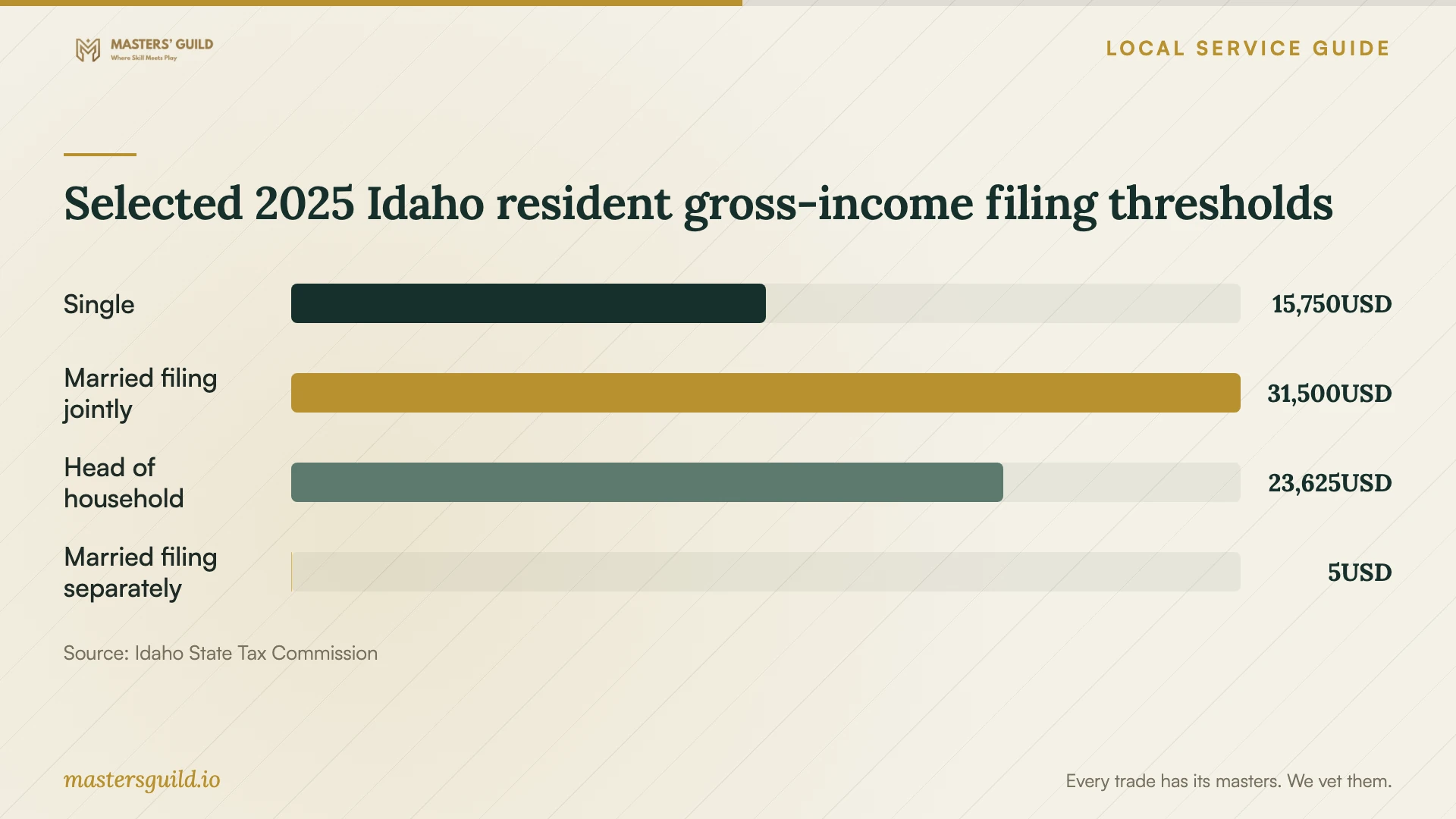
Selected 2025 Idaho resident gross-income filing thresholds
Local details that affect your job
An immediate Idaho deadline for extended 2025 returns
As of October 12, 2026, confirm whether a prospective preparer can complete your qualifying extended 2025 Idaho return by October 15. The Tax Commission says taxpayers must submit the return and full payment by that date and owe 6% interest on income tax they did not pay by April 15. Confirm your extension eligibility and payment history before relying on the deadline. [2]
An annual Idaho election needs an explicit decision
For a Boise partnership or S corporation considering Idaho's affected business entity election, include election review and owner-credit coordination in the scope. Idaho requires an election each year. Calendar-year ABEs must pay tax by April 15. For the sale of Idaho property, ABEs must pass the Idaho capital gains deduction to owners to take on their individual returns. [3]
A move to Boise changes the residency review
Request an Idaho residency review if you moved during the tax year or retained ties to another state. Idaho uses Form 40 for residents and Form 43 for part-year residents and nonresidents. Part-year residents must file when combined gross income from all sources during residency and Idaho sources during nonresidency exceeds $2,500. Prepare an income breakdown for those periods. [1]
Choose the scope for your situation
| Your situation | Work to request | Question to ask |
|---|---|---|
| Records need correction | Bookkeeping cleanup before preparation | Which accounts and periods will you reconcile? |
| Partnership or S corporation | Entity and owner-return coordination | Who prepares PTE-12 and each Idaho K-1? |
| Considering Idaho ABE treatment | Annual election and owner-credit review | Who documents this year's election decision? |
| Moved into Idaho | Residency and state-income review | Which income belongs on my Idaho return? |
| IRS audit, collection, or appeal | Representation by a CPA, enrolled agent, or attorney | Will you accept a separate representation engagement? |
Your hiring checklist
- Identify the tax year, business tax classification, owners, and states involved.
- Describe missing records and request a separate cleanup scope.
- Confirm the preparer's PTIN and check any claimed CPA credential.
- Assign responsibility for entity returns, owner documents, and personal returns.
- Request an itemized estimate and an approval process for additional work.
- Agree on document delivery, review dates, and the person who confirms filing acceptance.
- Discuss who handles notices and obtain copies of completed returns.
Frequently Asked Questions
Do I need a CPA to prepare my taxes?
The IRS authorizes professionals with a PTIN to prepare federal returns for compensation. Credentials matter when you need representation: CPAs, enrolled agents, and attorneys have unlimited IRS representation rights. Choose someone whose training and engagement scope fit your work. [5]
Does my Idaho entity return cover my personal return?
Idaho resident and part-year resident pass-through owners must report their entity income on their Idaho returns. The entity cannot include those owners in a composite filing. Confirm whether your quote includes your personal return and coordination with the entity's Idaho K-1. [3]
Can I use the chart to decide whether I must file?
Use it as a starting point for selected 2025 Idaho resident filing categories. It does not cover all ages, statuses, part-year residents, nonresidents, federal obligations, or entity filings. Have your preparer check the requirements for your circumstances. [1]
Sources and scope
This guide combines the sources below with practical planning guidance. Figures apply to the stated geography and period; request a written quote for your property.