
Local service guide
Plan concrete work in Birmingham, AL
Arrange concrete work by having contractors inspect the site and compare proposals for the same dimensions, intended use, drainage needs and finish. Before committing to demolition or a driveway layout, resolve Birmingham’s approval requirements for substantial improvements or access changes and check whether the property lies in a Special Flood Hazard Area. The City includes paving, excavation, grading and filling among activities requiring a floodplain development application in those designated areas. [1] [2]
Decide what the concrete needs to do
Describe the job as a driveway, patio, walkway, steps or repair. Tell the contractor what vehicles will cross it, where you need access and where you have noticed standing water or uneven surfaces. Share photographs and rough measurements, then have each bidder confirm the dimensions during a site visit.
For existing concrete, ask the contractor to explain the cause they suspect and compare patching, leveling, section replacement and full replacement where appropriate. Have them identify the problem each option addresses and the conditions it leaves unresolved. For steps or concrete connected to the house, discuss whether you need a designer or engineer before choosing a repair.
Check street access before finalizing the layout
BDOT requires a Sidewalk & Driveway Permit when a property undergoes substantial improvement or an owner proposes changes to access. Its driveway guidance covers City-maintained streets. For a new entrance crossing City right-of-way, the City Traffic Engineer reviews access and the City Engineer conducts a separate review covering matters such as materials, durability and stormwater. [1]
During development or substantial improvement, existing vehicular access is subject to change pending City Traffic Engineer review. Where a property can obtain reasonable alley access, BDOT’s policy requires closure of existing driveway entrances from the City-maintained street and says the alley should become the vehicular access point. Discuss the proposed access arrangement with BDOT before pricing a replacement entrance. [1]
The City also requires sidewalks facing all City-maintained streets when a property is developed or substantially improved. Ask BDOT which frontage work your project requires before agreeing to a scope limited to the driveway itself. [1]
Prepare for floodplain review
Birmingham requires a completed floodplain development permit application for development within a designated Special Flood Hazard Area, alongside other applicable permits. Its list includes excavation, grading, paving and filling. Check the current FEMA Flood Insurance Rate Map or call Floodplain Management at (205) 254-2479 for help determining the property’s designation. [2]
For an affected property, prepare a project description, site plans and construction drawings. Depending on the work, City staff may require drainage plans, surveys or engineering analyses. The City lists an average review time of 3 to 5 business days; staff may request more information when documentation is incomplete. Allow for that review before booking demolition or concrete delivery. [2]
Evaluate the contractor and the price
Compare removal and disposal, excavation, base preparation, drainage work, placement, finish and cleanup. Have each bidder specify the proposed thickness, reinforcement, joint layout and concrete specification for your intended use. Keep decorative options separate. For extra excavation or other uncertain work, agree on a price or pricing method before signing.
The Alabama Home Builders Licensure Board’s definition covers construction, repair or improvement of qualifying residential structures when the undertaking exceeds $10,000. Confirm how that definition applies to your concrete project with the Board. Check the contractor’s legal business name and applicable credentials rather than assuming that price alone determines the license requirement. [3]
Review proof of liability insurance and applicable workers’ compensation coverage, references for comparable projects, payment stages and warranty terms. Name the person responsible for permits and inspections in the contract. Include a process for approving changes and a description of the condition in which the crew should leave the site.
Plan the pour and household access
The National Weather Service describes Birmingham’s summer rainfall as scattered afternoon and early evening thunderstorms. It identifies spring, especially March and April, as the period with the greatest severe-thunderstorm and tornado risk. Discuss forecast checks, postponement decisions and protection of the work with the contractor near the scheduled date. [4]
Walk through truck access, material storage and the route your household will use during construction. Identify nearby surfaces and landscaping you want protected. Before the crew leaves, obtain curing-care instructions and conditions for resuming foot traffic, furniture placement and vehicle use. Arrange alternate parking around those conditions.
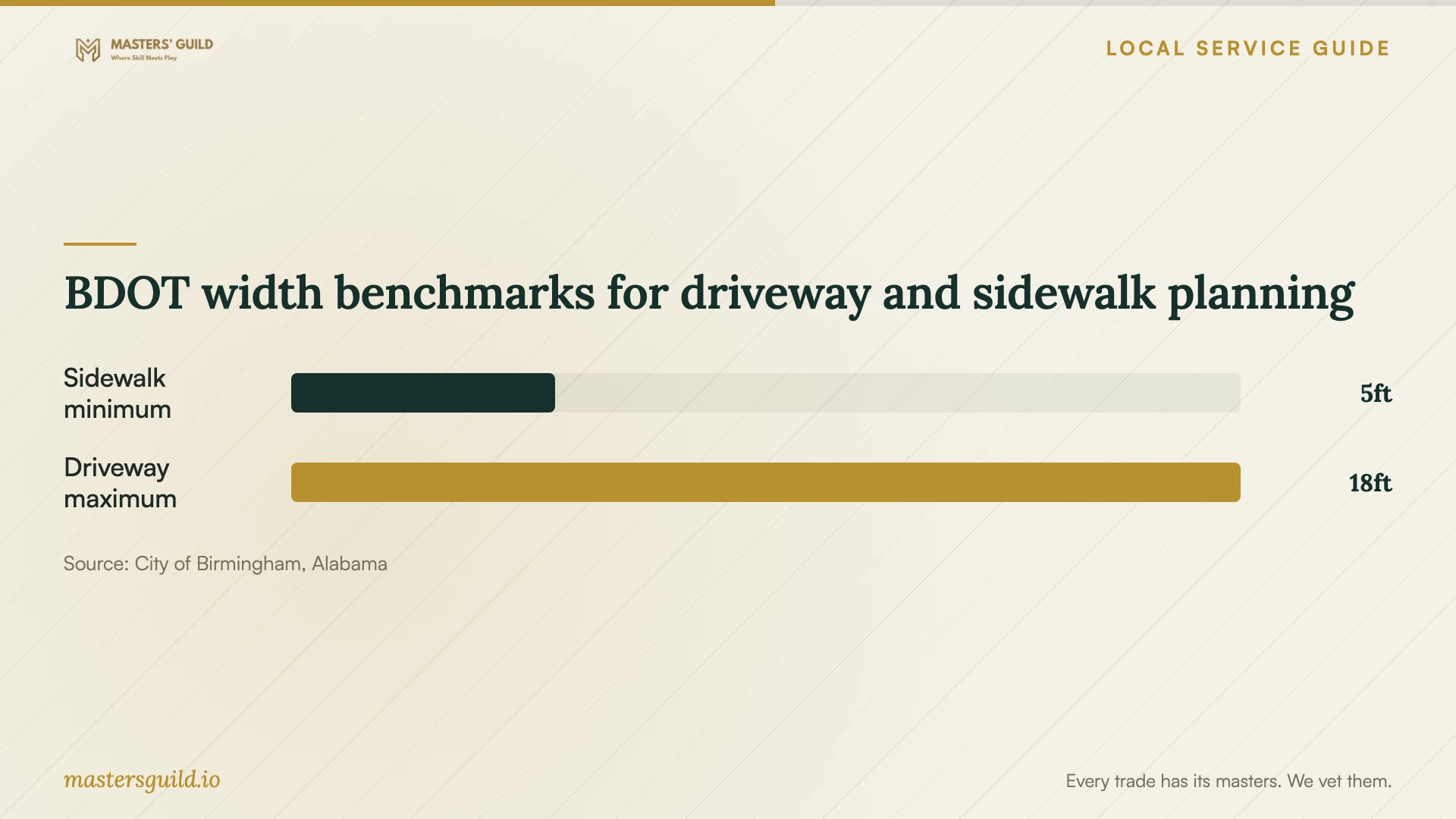
BDOT width benchmarks for driveway and sidewalk planning
Local details that affect your job
Review a new entrance before accepting its layout
For a necessary new residential driveway entrance, BDOT lists a minimum distance of 40 feet from an intersection, subject to City Traffic Engineer review on a case-by-case basis. This benchmark does not establish a setback requirement for every existing driveway. BDOT requires Sidewalk & Driveway Permit approval before work begins under its new-driveway requirements. Take an entrance sketch to BDOT before accepting a layout for a new street connection. [1]
Floodplain paving has a separate application
For work in a Special Flood Hazard Area, obtain the floodplain development application through Birmingham’s permitting office at City Hall, second floor, Room 210. The City lists (205) 254-2904 for permit assistance. Describe the paving and associated excavation so staff can identify the supporting documents and other permits your project needs. [2]
Choose the next step for your project
| Project situation | Next step | Question to resolve |
|---|---|---|
| Existing patio or walkway repair | Arrange a site assessment and compare repair options. | What underlying problem does each option address? |
| New entrance crossing City right-of-way | Discuss access and engineering review with BDOT. | Can the proposed location and design receive approval? |
| Development or substantial improvement with potential alley access | Resolve the access plan with BDOT and City Traffic Engineer review before pricing the entrance. | Does reasonable alley access trigger closure of the existing street driveway? |
| Paving or excavation in a Special Flood Hazard Area | Prepare a floodplain development application. | Which plans and supporting analyses does City staff require? |
| Residential undertaking exceeding $10,000 | Confirm whether the Board’s licensing definition applies to the scope. | Does the contractor hold the applicable residential home builders license? |
Your hiring checklist
- Photograph uneven areas and water accumulation before the site visit.
- Mark the intended project boundaries and explain vehicle or household use.
- Resolve the proposed street entrance and flood-zone designation with City staff.
- Compare preparation and concrete specifications alongside the total price.
- Review applicable credentials, insurance, references and warranty terms.
- Confirm payment stages and who can authorize extra work.
- Reserve alternate parking and keep a usable route into the house.
Frequently Asked Questions
Does replacing a driveway require a permit?
Describe the exact scope to BDOT. BDOT’s published policy requires a Sidewalk & Driveway Permit for substantial property improvement or proposed access changes. That policy does not settle every replacement within an existing footprint. Explain any changes to the entrance, curb or sidewalk before arranging work. [1]
How should I set a budget?
Use site-specific proposals with separate prices for the underlying work and optional finishes. Have bidders identify allowances and exclusions, including disposal and any proposed drainage changes. Decide how you will approve extra work before choosing a contractor.
Is October a good month to schedule the pour?
The National Weather Service describes October as Birmingham’s driest month. That climatology does not predict conditions on your scheduled date. Use the near-term forecast with the contractor and agree on the conditions that would trigger postponement. [4]
Sources and scope
This guide combines the sources below with practical planning guidance. Figures apply to the stated geography and period; request a written quote for your property.