
Local service guide
Lighting installation in Billings, MT
Lighting installation in Billings starts with a clear scope: identify which fixtures you want replaced, which locations need new wiring, and who will handle permits and inspections. Choose a Montana licensed electrical contractor and verify credentials before booking. Confirm whether your property falls inside city limits, because Billings does not issue electrical permits outside its boundary. Ask the contractor to assess your proposed fixtures and provide a written quote that separates installation, wiring changes, permit handling, and finish repairs. [1] [2] [3]
Define the work before comparing quotes
Make a room-by-room list with the fixture count, existing locations, proposed locations, ceiling height, and control preferences. Distinguish replacing a light in its current position from adding pendants, sconces, or recessed lights elsewhere. Include room photos and fixture product information so each contractor quotes the same request.
Ask the electrician to assess the existing wiring, mounting box, fixture support, and access route before you commit to the installation scope. For a heavy chandelier, provide its weight and mounting instructions. For recessed lighting, ask where the electrician expects to open the ceiling and who will patch and paint afterward. Include ceiling openings and repairs in the quote.
Check credentials and assign permit responsibility
The Montana State Electrical Board requires an electrical contractor to have a Montana licensed master electrician as the responsible party. Its contractor page also lists workers compensation and unemployment insurance compliance, or an Independent Contractor Exemption, among licensing requirements. Ask for the contractor’s license number and responsible electrician’s name, then check them through the board’s license lookup navigation. Ask about liability coverage separately. [3]
Billings’ Building Division FAQ says most electrical permits can only be issued to licensed electricians. It also says the owner is responsible for obtaining permits and may designate that responsibility to a contractor. Ask whether your specific fixture replacement or new lighting work needs a permit. Record who will obtain any required permit and coordinate inspections, then request the permit reference and inspection approvals. [2]
Select the light and controls together
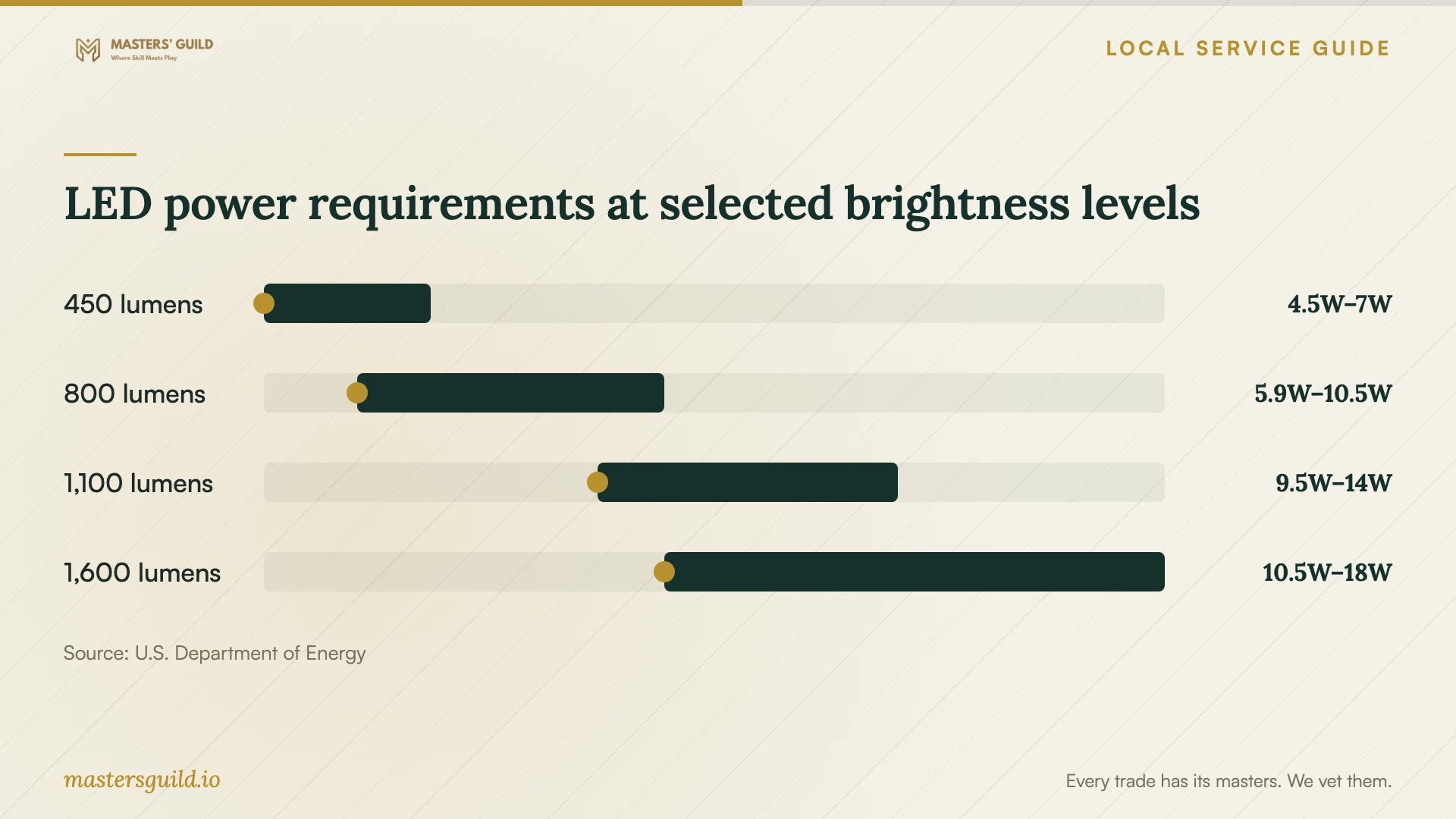
The Department of Energy identifies lumens as the measure of visible light output and watts as power input. Use your preferred brightness as the starting point rather than matching the wattage of an old incandescent bulb. In DOE’s June 2023 reference comparison, an 800-lumen LED uses 5.9 to 10.5 watts, while the incandescent comparison uses 60 watts. [5]
Check color temperature before ordering several fixtures for one room. DOE lists 2,700 K as warm and 3,000 K as soft, with homes among the applications for both. Compare a sample in your room if you are changing the light appearance. For an enclosed fixture, check the bulb’s packaging or specifications for suitability. For dimming, confirm both the LED’s dimming capability and its compatibility with the dimmer. [5]
Compare the complete installed scope
Request separate amounts for fixtures, labor, wiring or switch changes, access equipment, permit handling, and finish repairs. Ask whether the electrician will supply the lights or install products you purchase. Agree on who handles a damaged, missing, or incompatible fixture before installation day, and ask the contractor to identify exclusions.
Request a project-specific price and schedule, including any return visits for inspections or unfinished work. Compare written quotes for the same scope and ask how the contractor will price hidden wiring problems discovered during installation. Set an approval process for additional work, including the description and added cost, before the electrician starts.
LED power requirements at selected brightness levels
Local details that affect your job
Outside city limits changes the permitting route
The City of Billings says it does not issue electrical permits outside city limits and directs owners toward Montana Building Codes. It also notes that county ordinances may apply. For an address beyond the boundary, confirm the authority before asking a contractor to obtain a city permit. The city’s outside-limits page lists Montana Building Codes Division at 406-841-2051. [1]
Keep inspection coordination in the agreement
For work under Billings jurisdiction, the Building Division lists 406-657-8270 for inspection requests. The city tells owners who delegate permitting to confirm that the contractor obtains the appropriate permits and receives inspection approvals. Ask for the permit reference and applicable approval records as part of the completion paperwork. [2]
Plan noisy work within the city’s stated hours
Billings Public Works describes a general noise-limit exemption for construction and building activities between 7 a.m. and 8 p.m. It also describes waivers for circumstances such as construction before 7 a.m. If your installation includes drilling or ceiling access, agree on working hours and ask about a waiver before scheduling work outside that window. [4]
Match the next step to your project
| Your situation | Next step | Question to resolve |
|---|---|---|
| Replacing a fixture in place | Request an assessment of wiring and mounting support. | Does this specific scope need a permit? |
| Adding lights in new locations | Include wiring routes and ceiling repairs in the quote. | Who handles openings, patching, and painting? |
| Adding LED dimming | Check the LED and dimmer specifications together. | Does the manufacturer identify compatible controls? |
| Property outside city limits | Confirm requirements with Montana Building Codes and any applicable county authority. | Which authority handles this address? |
| Contractor handles permits | Request permit references and applicable inspection approvals. | Who schedules inspections and supplies the records? |
Your hiring checklist
- List fixture counts, locations, ceiling heights, and desired controls.
- Send room photos and fixture specifications, including weight and mounting instructions.
- Ask the electrician to assess wiring, mounting support, and access before finalizing the scope.
- Ask for contractor and responsible electrician credentials for verification.
- Confirm the permit authority and assign permit and inspection tasks in writing.
- Check brightness, color temperature, bulb fit, and dimmer compatibility before ordering.
- Agree on finish repairs, change approval, working hours, and completion paperwork.
Frequently Asked Questions
Does a replacement ceiling light need a permit?
Confirm the requirement for your exact scope with the electrician and the permit authority. Billings’ Building Division FAQ says most electrical permits can only be issued to licensed electricians. Describe whether you plan to replace a fixture in place, move it, or add wiring when asking about permit requirements. [2]
How do I check an electrical contractor’s credentials?
Request the contractor license number and the responsible Montana master electrician’s name. The State Electrical Board’s contractor page provides license lookup navigation and identifies the lookup system as the primary source for checking Montana professional credentials. [3]
Can I keep my existing dimmer when switching to LEDs?
Check the proposed LED and existing dimmer specifications before deciding. DOE advises buyers to confirm that LEDs support dimming and that they are compatible with the dimming system. Ask the electrician to include a control replacement option in the quote if needed. [5]
Sources and scope
This guide combines the sources below with practical planning guidance. Figures apply to the stated geography and period; request a written quote for your property.