
Local service guide
Duct and Vent Cleaning in Billings, MT
Arrange Duct and Vent Cleaning in Billings by requesting evidence of contamination and comparing at least three written estimates for the same system components. EPA recommends cleaning as needed for substantial mold, pest infestation, or excessive debris. Identify and correct the underlying cause before considering cleaning. Separate proposed repairs from cleaning so you can check Montana licensing applicability and confirm permit requirements with the city before approving an expanded job. [1] [3] [4]
Decide whether cleaning addresses your problem
Have the contractor show you the affected duct or equipment component before you approve work. EPA identifies substantial visible mold on hard surfaces, rodents or insects in ducts, and excessive debris clogging ducts or escaping through supply registers as reasons to consider cleaning. Identify and correct the underlying cause first so contamination does not recur. [1]
For apparent mold, request its location and the basis for identification. EPA says an expert may need laboratory analysis to confirm the finding. Correct the moisture source before considering cleaning. EPA advises replacement of wet or moldy duct insulation because cleaning cannot address it effectively. [1]
Describe your concern in the estimate request: debris blowing from a register, pests, moisture, or dust after remodeling. Have the contractor connect the proposed work to an inspection finding and explain how they will address the cause. EPA has not established that duct cleaning prevents health problems, and it finds little evidence that cleaning ducts alone improves system efficiency. [1]
Compare the complete scope and price
Request a component list covering supply and return ducts, registers, grilles, air-handler housing, blower, coils, and drain pans. EPA advises cleaning all components of a contaminated heating and cooling system because an untreated component can contaminate the system again. Confirm who will handle equipment components outside the cleaner's qualifications. [1]
EPA's consumer guidance lists a broad reference range of $450 to $1,000 per heating and cooling system, depending on services, size, access, region, and contamination. The underlying publication dates to October 1997. Treat that range as historical national guidance and use written estimates for your home to establish a current budget. [1]
Request one total for the agreed scope, with separate prices for optional work. Confirm whether the contractor includes access openings, their closure, and any proposed dryer-vent cleaning. Give each bidder the same system information so you can compare offers. Agree in advance that the contractor must obtain your approval before adding work.
Confirm how the cleaner will protect your home
Find out where the vacuum will exhaust. EPA recommends equipment that exhausts particles outdoors, or HEPA vacuum equipment when exhaust stays indoors. Have the crew explain how they will protect furnishings, choose brushes for your duct material, and seal and reinsulate access holes after cleaning. [1]
Treat chemical sprays and interior coatings as separate decisions. Request the reason, product label, approved use, and duct material involved. EPA advises understanding the risks and benefits before authorizing biocides or sealants and states that no biocides are registered for fiberglass duct board or fiberglass-lined ducts. [1]
Before the visit, clear a route to the equipment and registers. Confirm how much space the crew needs, whether you should move furniture, how they will manage pets, and how long they expect interruptions to last. Keep photos of the original condition and the written scope available for the final walkthrough.
Check the result and plan maintenance
Have the cleaner show you the cleaned components, including several supply and return locations. EPA recommends a visual inspection and says system components should have no visible debris after cleaning. Check that the crew has reattached registers, closed access openings, and demonstrated heating and cooling operation. [1]
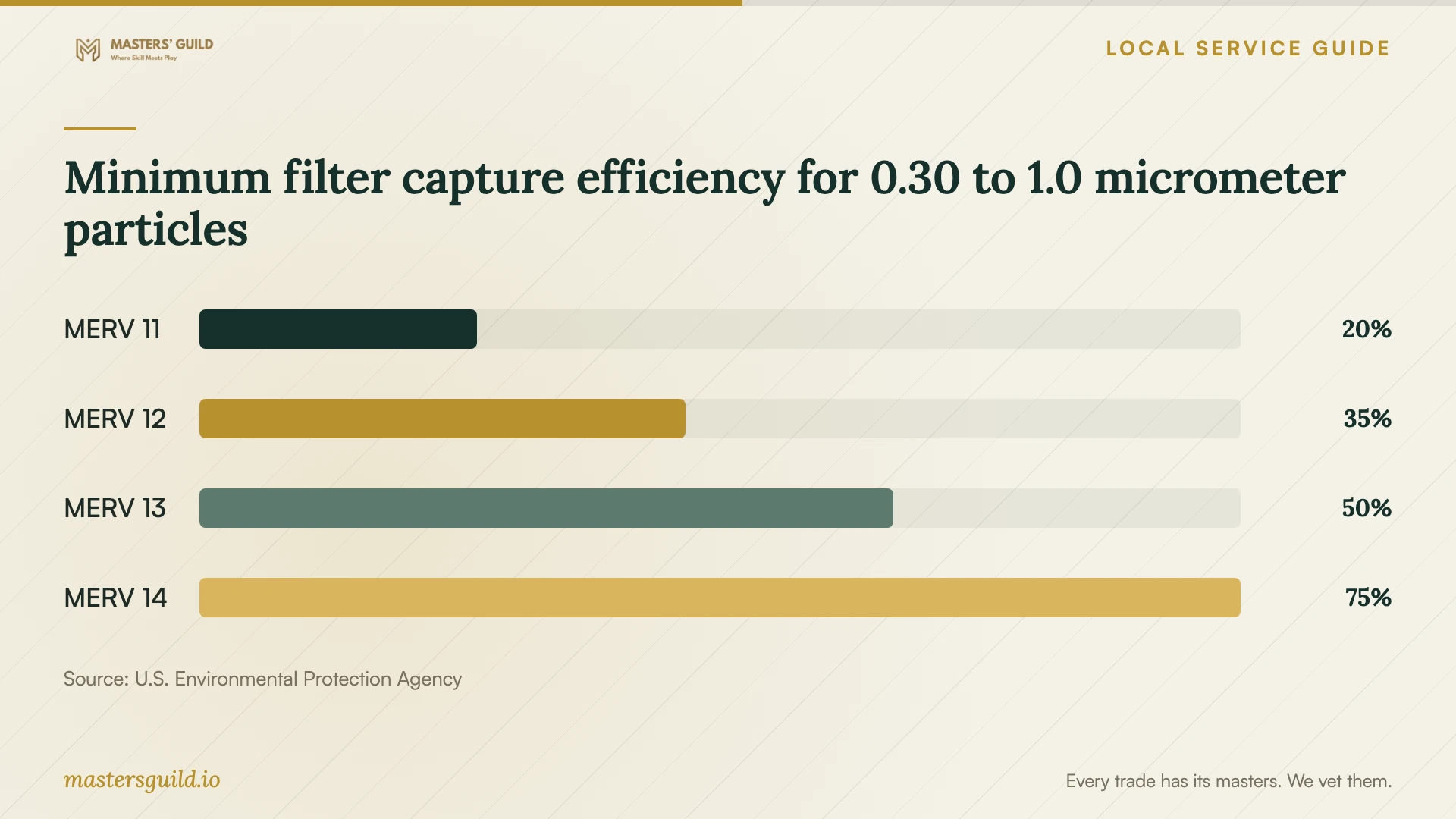
Discuss filtration with your HVAC technician before buying a higher-rated filter. When upgrading, EPA recommends MERV 13 or the highest rating your system fan and filter slot can accommodate. The chart compares published minimum capture efficiencies for small particles; it does not measure your home's air quality or establish a need for duct cleaning. [5]
For a fuel-burning furnace, arrange inspection and service before the heating season. EPA recommends that maintenance to protect against carbon monoxide poisoning. Plan that appointment alongside any separate decision about duct cleaning, and follow the equipment manufacturer's filter replacement guidance. [1] [5]
Minimum filter capture efficiency for 0.30 to 1.0 micrometer particles
Local details that affect your job
Billings permit questions when cleaning expands into repairs
If a bidder proposes duct replacement, mechanical alterations, or equipment work, give the Billings Building Division the property address and exact scope. Confirm whether that scope requires a permit before approving it. Call 406-657-8270. The city requires online submissions for all permits. Confirm requirements for cleaning-only work with the division rather than assuming that it requires a permit. [4]
Montana credentials for construction work
Montana's construction-contractor licensing requirement took effect January 1, 2026. Its definition covers construction, alteration, and repair, subject to statutory exceptions. If cleaning expands into duct repair or replacement, request the contractor's license number and use the program's license lookup. Ask DLI at 406-444-6880 about applicability if the scope or an asserted exemption is unclear. Confirm applicability for cleaning-only work rather than assuming that the construction license requirement covers it. [3]
Montana asbestos exemptions still require planning
Montana DEQ says it does not regulate asbestos in single-family residences or housing with four or fewer units under its stated residential exemption. A residence used to offer services to the public can qualify as a regulated facility. DEQ encourages homeowners to obtain inspection before renovation and says owners who know of asbestos in materials to be renovated or demolished must tell the contractor. If access or repair work could disturb suspect insulation, pause that work and ask the Asbestos Control Program at 406-444-5300 about your property and scope. [1] [2]
Choose the next step from the inspection finding
| Finding | Next step | Question to ask |
|---|---|---|
| Dust on a return grille | Clean the grille and assess the system before booking duct cleaning. | Can you show substantial contamination beyond this grille? |
| Excessive debris or particles escaping supply registers | Identify and correct the underlying cause before considering cleaning. | Which components need attention, and how will you correct the cause? |
| Apparent mold or wet duct insulation | Confirm the finding and correct the moisture source before considering cleaning; replace wet or moldy duct insulation. | Who will confirm the material and correct the moisture source? |
| Suspect asbestos near proposed access work | Pause disturbance and seek specialist guidance. | Does the access or repair plan touch this material? |
| Proposed duct repair or mechanical alteration | Check licensing applicability and confirm permit requirements with Billings. | Who handles the repair, credentials, and any required application? |
Your hiring checklist
- Describe the problem and have the bidder show the affected component.
- Require a plan to identify and correct the underlying cause before contamination-related cleaning.
- Give each bidder the same system count, access information, and requested scope.
- Request a written total with inclusions, exclusions, and optional services separated.
- Discuss vacuum exhaust, duct materials, furniture protection, and access-hole closure.
- Disclose known asbestos and pause proposed disturbance of suspect materials.
- Resolve credentials and permit questions before approving repair work.
- Request photographs and a component walkthrough before accepting the completed job.
Frequently Asked Questions
How often should I have my ducts cleaned?
EPA recommends cleaning as needed rather than on a routine schedule. Request evidence of substantial contamination before agreeing to recurring service. Identify and correct the underlying cause before considering cleaning. Maintain filters and heating equipment according to their separate maintenance requirements. [1]
Does the quote include dryer-vent cleaning?
Have the bidder name it in the written scope and price it separately if necessary. Avoid assuming that a proposal for heating and cooling ducts includes your dryer exhaust. Describe both tasks when requesting estimates.
Does a Billings cleaning job need a permit?
Confirm whether your exact scope requires a permit with the Building Division at 406-657-8270. Describe any duct repairs, replacement, or mechanical alterations before approving the work. Ask about cleaning-only work rather than assuming a permit requirement. [4]
Should I upgrade to MERV 13 after cleaning?
Ask your HVAC technician whether your fan and filter slot can accommodate it. EPA recommends MERV 13 or the highest compatible rating when upgrading filtration. Follow the manufacturer's replacement guidance. [5]
Sources and scope
This guide combines the sources below with practical planning guidance. Figures apply to the stated geography and period; request a written quote for your property.