
Local service guide
Kitchen Remodeling in Baton Rouge, LA
For Kitchen Remodeling in Baton Rouge, choose a contractor after you agree on the layout, identify permit-triggering work, and check credentials against the full project value. The City-Parish requires permits for structural wall changes, gas line work, circuit changes, and specified plumbing replacements. Ask each bidder to name who will handle permits, trade work, inspections, and the period without a usable sink or cooking area. [1]
Define the kitchen before comparing contractors
Write a scope that separates the items you want to keep from the items you want to replace. Name cabinets, counters, flooring, appliances, lighting, and the sink location. For an open kitchen, mark the wall you want removed and ask the contractor to assess its structural role before pricing demolition.
The City-Parish requires a permit for structural modifications to interior or exterior walls and to roofs or ceilings. It also lists gas line work, new electrical circuits, circuit replacements or extensions, and replacement of water, vent, drain, or sewer lines. Give bidders the same scope and ask them to identify which listed activities your project includes. [1]
Choose appliance models before approving cabinet dimensions. Ask the contractor to confirm openings, utility connections, and access for installation. Decide who buys each item, who receives deliveries, and who handles a damaged or incorrect order.
Match credentials to the complete contract
The Louisiana State Licensing Board for Contractors requires a residential license for home improvement projects on existing residential structures exceeding $50,000. Its home improvement definition starts at $7,500. The City-Parish residential page says work exceeding $7,500 must use a registered home improvement contractor or licensed residential contractor. If your contract totals exactly $7,500, confirm the applicable credential with the Board before signing. [1] [4]
The Board also lists electrical, mechanical, and plumbing projects exceeding $10,000, including labor and materials, under commercial license requirements. Ask the remodeler to name the trade contractors and explain which credentials apply to their portions of the work. Do not treat that threshold as permission to perform smaller trade jobs without checking applicable requirements. [4]
Request the contractor’s legal business name, credential number, and proof of insurance. Check that the name on the proposal matches the party you will pay. Ask who supervises subcontractors and who remains responsible for correcting incomplete work.
Separate construction costs from permit charges
Ask for a written proposal with separate amounts for demolition, cabinets, counters, installation, trade work, and permit charges. Require bidders to identify allowances for products you have not selected. Compare the same cabinet specifications and appliance scope rather than comparing totals alone.
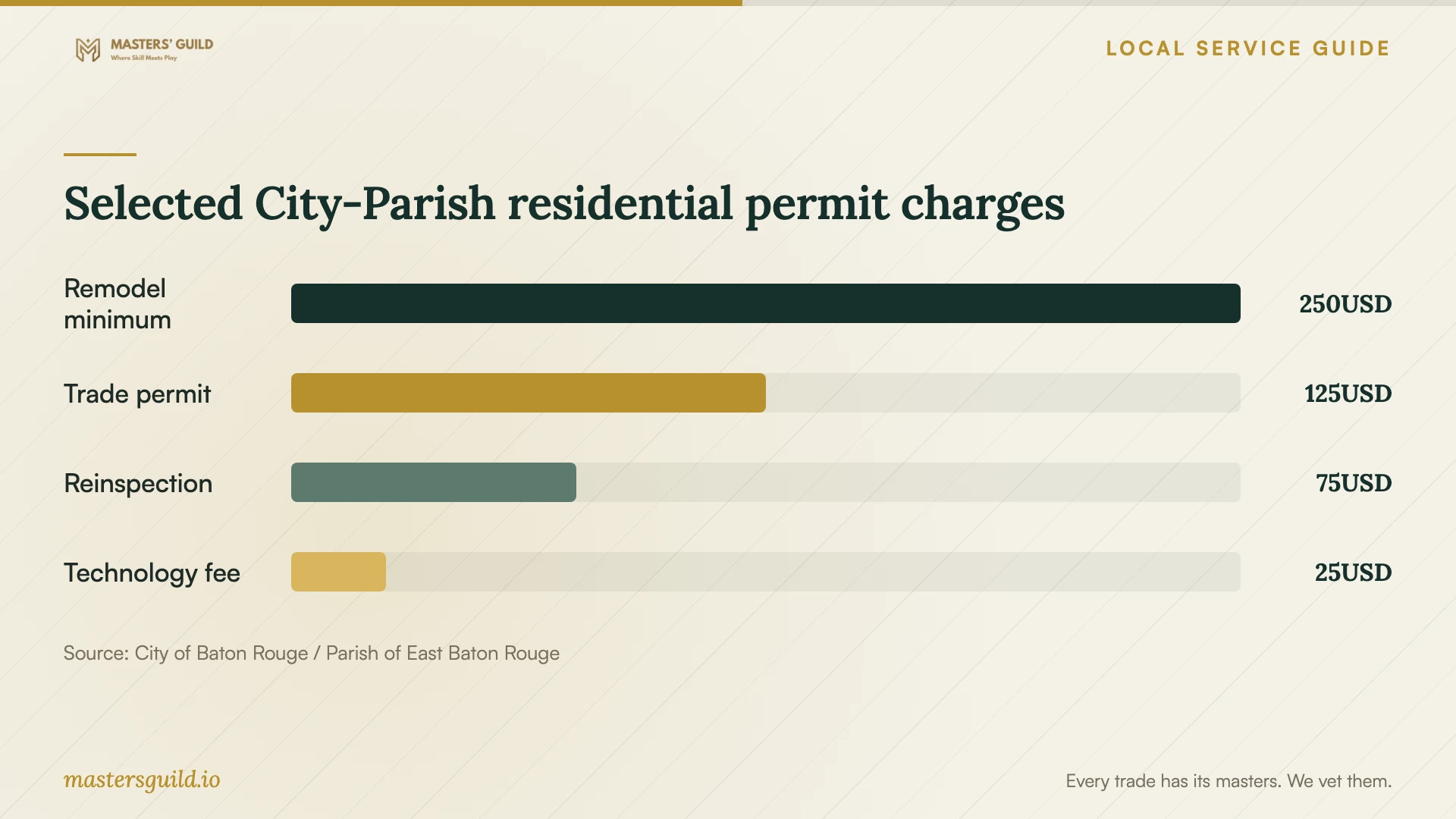
The City-Parish publishes a residential remodel fee of $0.80 per square foot plus $125, with a $250 minimum and electrical, mechanical, and plumbing permits excluded. It lists residential mechanical, electrical, plumbing, and gas trade permits at $125. Ask the permit office how it will measure your remodel area and which separate permits and additional fees apply. [2]
The fee schedule also lists a $25 technology fee, $25 flood zone determination, $75 reinspection fee, and a 5% credit card payment fee. Have the contractor explain which charges the proposal includes. Agree in writing on how you will approve concealed-condition work, substitutions, and changes to the contract price. [2]
Arrange the work around approvals and kitchen access
The City-Parish says residential initial plan reviews take seven business days after receipt of all required information, with resubmittal reviews taking three business days. Officials warn that permit issuance can require additional time. Ask the contractor to distinguish the application date, approval date, material delivery dates, and construction start in the schedule. [3]
The City-Parish allows inspection scheduling for the next business day. Ask your contractor to identify inspection checkpoints and who requests each visit. Avoid treating inspection availability as a guarantee that the kitchen will finish on a particular date. [3]
Before demolition, agree on dust barriers, daily cleanup, debris removal, and access to the refrigerator. Set up a temporary food preparation area and decide how you will wash dishes. Request a written sequence showing when crews disconnect and restore the sink, cooking appliances, and power.
Selected City-Parish residential permit charges
Local details that affect your job
Use the City-Parish portal for the project and its trade permits
The City-Parish directs applicants to MGO Connect for online applications. Its FAQ explains that applicants can add a trade permit to an existing project by selecting Add Permit to Existing Project and locating the project by permit number, address, or name. Ask the remodeler who will submit those applications and request the project number so you can refer to the same record. [3]
Consider expedited review only after preparing a complete submission
The City-Parish offers expedited residential review on many permits: three business days for review after receipt of all required information and two business days for resubmittals. It publishes a charge of $60 plus $0.10 per total square foot under roof. Ask whether your permit qualifies and which area officials will use before paying for this option. The review period does not establish a permit issuance date. [3]
Choose the next step for your proposed scope
| Proposed work | Permit or credential consideration | Next step |
|---|---|---|
| Paint and cabinet hardware | Check whether the scope also includes listed structural or utility work | Submit a precise scope to the permit office before assuming an exemption |
| Remove a wall | Structural wall modifications require a City-Parish permit | Ask for a structural assessment and permit responsibility in the proposal |
| Move the sink or alter circuits | Listed plumbing replacements and circuit changes require permits | Name the trade contractors and identify separate trade applications |
| Home improvement contract exceeding $50,000 | Louisiana requires a residential license | Check the contractor’s residential credential before signing |
Your hiring checklist
- Give each bidder the same layout, finish list, and appliance models.
- Ask the contractor to identify permit-triggering work before finalizing the price.
- Request the business name, credential number, insurance evidence, and named trade contractors.
- Separate product allowances, installation charges, permit costs, and exclusions in the proposal.
- Assign responsibility for applications, inspection requests, and correction work.
- Confirm deliveries and temporary kitchen arrangements before demolition.
- Write down the approval process for changes and the documents you expect at handover.
Frequently Asked Questions
Do I need a permit if I keep the kitchen layout?
Check the actual work. The City-Parish lists circuit replacements and extensions, replacement of water or drain lines, and replacement of plumbing valves or shutoffs as permit-triggering activities. Keeping the sink and cabinets in place does not answer whether your project includes those activities. [1]
How much should I budget for permits?
Start with the published $250 residential remodel minimum, then confirm the area-based calculation and separate trade permits with the permit office. The City-Parish lists residential trade permits at $125 and additional fees separately. These figures describe permit charges, not the construction price. [2]
Can the contractor promise approval within seven business days?
The City-Parish publishes seven business days for initial residential plan review after officials receive all required information. Its FAQ says plan review is one step and permit issuance may take additional time. Ask the contractor to schedule demolition around the actual approval and delivery status. [3]
What should the final walkthrough cover?
Use your written scope to check cabinet operation, finish defects, appliance installation, and cleanup. Ask the contractor to demonstrate the completed fixtures and provide agreed warranties, receipts, and permit or inspection records. Record unfinished items and the agreed correction dates.
Sources and scope
This guide combines the sources below with practical planning guidance. Figures apply to the stated geography and period; request a written quote for your property.