
Local service guide
Baton Rouge concrete work: permits and hiring
For concrete work in Baton Rouge, choose a contractor who will inspect the site, explain the proposed drainage and base preparation, and give you a written scope before you agree to a pour. If you plan to add to or expand a driveway, the City-Parish lists that work as requiring a permit. Decide who will obtain it before signing, and check contractor credentials against the project scope and value. [1] [3]
Define the job before comparing contractors
Describe the result you need: a wider parking area, a replacement patio, repaired steps or a plan for an uneven walkway. Send photos, approximate dimensions and notes about standing water. Ask each contractor to inspect the same area and explain whether they propose repair, leveling, partial replacement or removal and a new pour. Request a reason for the proposed approach.
For a driveway, identify whether the proposal changes its footprint. The City-Parish names additions and expansions as permit situations. Its residential guidance also lists modifications to stairs, handrails and guardrails in an egress path. If your concrete job touches those features, describe the work to Permits & Inspections before accepting a contractor's claim that no permit is needed. [1]
Have the contractor mark the proposed edges and finished elevations during the visit. Ask where water will go, how the work will meet the garage or doorway, and how the crew will protect nearby features. If contractors propose different layouts, settle the layout before comparing their totals.
Confirm permits, fees and credentials
The City-Parish directs applicants to MGO Connect for online permit applications. Ask the contractor to identify who will apply, who will pay the fees and who will arrange any required inspections. Keep the permit information with your contract. For a replacement within the existing footprint, ask the office about your specific scope; the published driveway example addresses additions and expansions. [1]
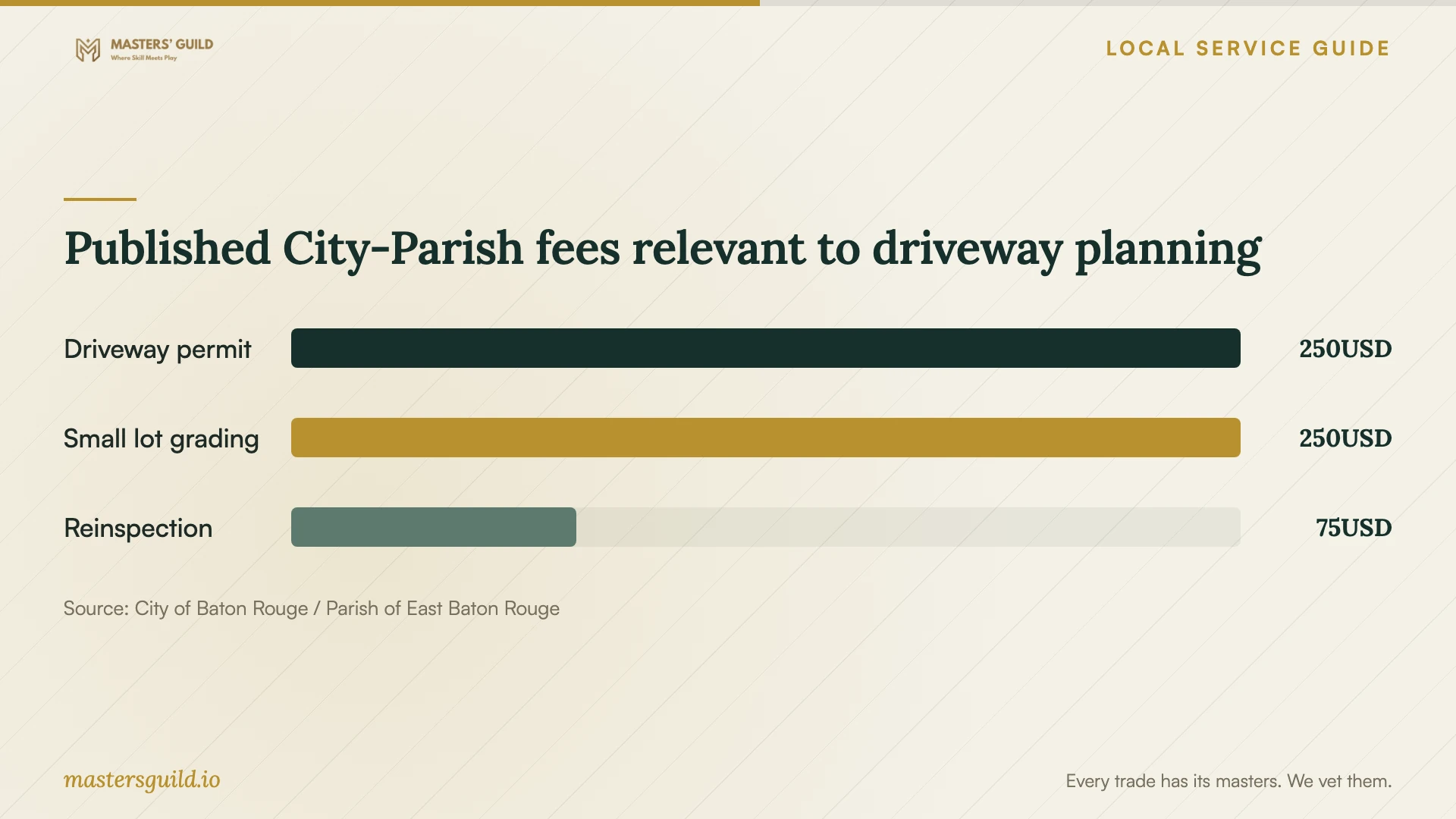
The published fee table lists $250 for a residential driveway permit and $250 for a small lot grading permit. It also lists a $25 technology fee, a $25 flood zone determination charge and a $75 reinspection fee. Ask the permit office which charges apply to your application, then have the contractor show those amounts separately. Do not assume a small lot grading permit applies to every slab project. [2]
Use the full project value when checking credentials. The Louisiana State Licensing Board for Contractors requires a residential license for residential construction and home improvements exceeding $50,000, including labor and materials. Its home improvement definition includes covered work valued at $7,500 or more, while the City-Parish wording addresses residential work exceeding $7,500. At that boundary, ask the board which credential your scope requires. Use its contractor search to check the company named in the contract. [1] [3]
Ask for a drainage plan and relevant experience
Before approving the layout, show the contractor where you have seen water collect and where downspouts discharge. Ask them to describe the proposed slope, water destination and any grading included in the price. Request a separate explanation if the plan changes runoff near a neighboring property or public sidewalk. Resolve those questions before authorizing excavation.
Pervious concrete allows water to pass through the pavement. East Baton Rouge Parish's MOVEBR program uses it on sidewalk projects and requires a certified technician or installer on program projects that include pervious sidewalk construction. The program explains that materials, construction, testing and acceptance differ from traditional concrete. That requirement belongs to MOVEBR projects; it does not establish a certification mandate for every residential pour. [4]
If a contractor proposes pervious concrete at your home, ask for examples of their own installations and an explanation of site suitability, base design and maintenance. Ask whether they hold relevant installer certification. Have them explain how they will assess the ground beneath the proposed pavement and where water will go. Choose the option after that site discussion rather than from a claim that it will solve flooding.
Compare the written scope and arrange access
Request an itemized quote covering dimensions, slab thickness, excavation, base preparation, reinforcement, joints, finish, demolition and disposal. Ask the contractor to identify allowances and exclusions. If a quote leaves out drainage work or removal of the old slab, request a revised total before comparing it with a proposal that includes those tasks. The official permit fees shown here are administrative charges, not local installation prices. [2]
Ask how the crew will reach the work area and where they will place equipment. Discuss parking, gate access, pets and a usable route to your entrance. Get the contractor's weather postponement plan and written instructions for curing, walking and vehicle access. Agree on who will notify you if the schedule changes and what conditions you must meet before you use the finished surface.
Before signing, request evidence of insurance, the payment schedule and written warranty terms. Ask how the contractor will document concealed work before the pour and handle changes after excavation. Define completion in the contract, including cleanup, agreed drainage work and any required inspection records. Keep photos and approved changes with the final invoice.
Published City-Parish fees relevant to driveway planning
Local details that affect your job
Driveway expansion has a named permit path
The City-Parish lists adding to or expanding a driveway as work requiring a permit and directs applicants to MGO Connect. For a widening project, assign application responsibility before signing and ask the office what information your particular site requires. [1]
Separate driveway and small lot grading charges
The City-Parish publishes distinct $250 fees for residential driveway and small lot grading permits. Ask whether your scope needs either or both, and request separate permit line items rather than accepting an unexplained combined charge. [2]
Local pervious sidewalk work calls for specialized installers
MOVEBR requires a certified technician or installer for its projects that include sidewalk construction with pervious concrete. For a residential proposal, use that local guidance to ask about installer training and completed work; do not treat the program's rule as a universal homeowner requirement. [4]
Choose the next step for your concrete project
| Project situation | Next step | Ask before signing |
|---|---|---|
| Driveway addition or expansion | Confirm the required City-Parish permit. | Who applies through MGO Connect and pays the applicable fees? |
| Replacement within the existing driveway footprint | Ask the permit office about the exact scope. | Does this proposal require a permit or related approval? |
| Concrete steps affecting the egress path | Check permit requirements for the proposed modification. | Does the work change stairs, handrails or guardrails? |
| Pervious concrete proposal | Request specialized installation experience and a site assessment. | How will you design the base and explain maintenance? |
Your hiring checklist
- Send photos, approximate dimensions and a description of the result you want.
- Mark the proposed footprint and discuss water flow during the site visit.
- Confirm permit applicability and assign application responsibility before signing.
- Check the company name and relevant credentials against the proposed scope.
- Compare quotes with the same layout, preparation, finish and removal work.
- Request separate permit charges, allowances and exclusions.
- Agree on equipment access, weather postponements and return-to-use instructions.
- Keep the contract, approved changes, photos and completion records together.
Frequently Asked Questions
Do I need a permit to widen my driveway?
Yes. The City-Parish lists addition to or expansion of a driveway among residential projects requiring a permit. It directs applicants to MGO Connect. Confirm application details with Permits & Inspections and agree with your contractor on who will obtain the permit. [1]
How much is the residential driveway permit?
The published City-Parish fee is $250. The office also lists separate administrative and other permit charges, so ask which apply to your application. This fee does not establish the cost of concrete installation or include every possible project expense. [2]
Which contractor credential should I check?
Ask the licensing board about the full scope and value, including labor and materials. It requires a residential license for covered residential construction and home improvements exceeding $50,000. The City-Parish says residential work exceeding $7,500 requires a registered home improvement contractor or licensed residential contractor. [1] [3]
Should I choose pervious concrete for my property?
Ask for a site assessment before deciding. MOVEBR explains that pervious concrete lets water pass through and requires different construction and testing from traditional concrete. Request relevant installer experience, a base and drainage plan, and maintenance instructions for your proposed installation. [4]
Sources and scope
This guide combines the sources below with practical planning guidance. Figures apply to the stated geography and period; request a written quote for your property.