
Local service guide
Bathroom Remodeling in Baton Rouge, LA
For Bathroom Remodeling in Baton Rouge, choose a contractor after you agree on a written scope, check the credentials covering the work, and assign responsibility for permits and inspections. The City-Parish lists plumbing line and valve replacements, electrical circuit changes, and structural modifications as permit triggers. Resolve those requirements before setting a demolition date. [1]
Define the bathroom work before requesting prices
Write down what you want to keep, replace, and move. Give bidders the same fixture list and layout sketch. Separate paint and hardware from shower rebuilding or fixture relocation. Ask each contractor to identify excluded work behind tile or beneath flooring.
For a shower rebuild, request a description of the waterproofing system, treatment of corners and penetrations, and checks before tile installation. Discuss the fan’s discharge route and access for future plumbing repairs. Include those decisions in the written scope.
For easier access, discuss shower entry, door clearance, controls, seating, and grab-bar locations during design. Identify who will provide wall backing. If you have one bathroom, agree on toilet and bathing access during construction before authorizing demolition.
Check credentials against the actual project
The City-Parish’s residential guidance requires a registered home improvement contractor or licensed residential contractor for residential work exceeding $7,500. Ask LSLBC which credential and classification cover your proposed bathroom work and total project value. Do not assume a bidder’s registration covers any scope or amount. [1]
LSLBC counts labor and materials toward project value regardless of who supplies the materials. Include fixtures you buy yourself when discussing the requirement. The board’s FAQ also uses $7,500-or-more wording for residential home improvement subcontractors, so confirm requirements if your project sits at that boundary. [4]
Use the contractor search identified in LSLBC’s FAQ to check the bidder by name, license number, or contractor type. Match the proposal and contract name to the board’s record. LSLBC requires contractors to bid, contract, and perform work under their recorded name. An occupational license or Secretary of State business registration does not establish contractor licensure. [4]
Request current insurance documentation and references for comparable bathroom projects. Have the contractor name the plumbing and electrical subcontractors and explain the credentials covering each trade’s work.
Resolve permit responsibilities before demolition
Check the proposed work against the City-Parish’s residential permit list. Relevant triggers include structural wall or ceiling modifications, new electrical circuits and circuit replacements or extensions, and replacement of water lines, vents, drains, sewer lines, valves, or shutoffs. The city also lists window replacement. [1]
Name the person who will apply, pay fees, upload documents, and schedule inspections. Ask the contractor to identify inspection stages and explain when workers can close walls or cover work. Keep permit records and inspection results with your contract.
The City-Parish directs applicants to MGO Connect. Applicants can add a trade permit to an existing project by searching with its permit number, address, or name. Have whoever manages the application explain how the trade permits connect to your bathroom project. [3]
Compare prices and agree on changes
Request separate amounts for demolition and disposal, substrate repairs, waterproofing, tile, fixtures, plumbing, electrical work, ventilation, and permit administration. Identify allowances for unselected items, who pays for delivery, and who handles damaged or incorrect products.
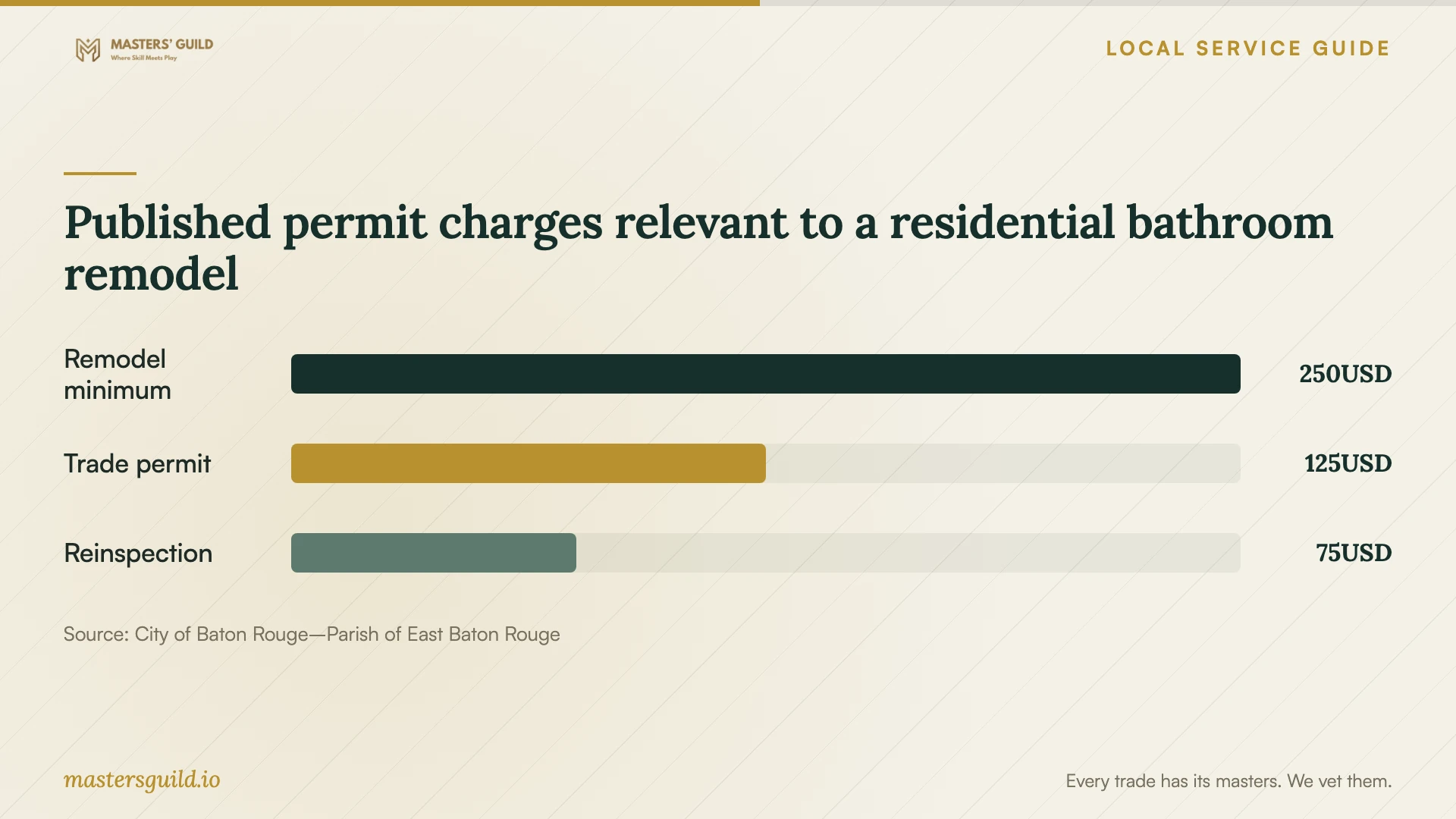
Use published permit charges as separate budget entries. The City-Parish lists a $250 minimum residential remodel permit charge and excludes electrical, mechanical, and plumbing permits from it. It lists residential mechanical, electrical, or plumbing/gas trade permits at $125. Have the applicant confirm the applicable charges for your scope. [2]
Agree on a written change-order process for concealed damage. Have the contractor show the condition, describe the repair, and provide its price and schedule effect before proceeding. Tie payments to agreed milestones and record who supplies each fixture.
Plan approvals, deliveries, and bathroom downtime
Request a schedule covering approvals, deliveries, demolition, trade work, inspections, installation, and final corrections. Confirm fixture selections and delivery arrangements before demolition. Ask for the expected period without a working toilet or shower and agree on how the contractor will communicate delays.
The City-Parish describes initial residential plan review within seven business days after receiving complete information and resubmittal review within three business days. It says permit issuance can take additional time. Its FAQ allows next-business-day inspection scheduling. Ask the contractor to account for corrections and follow-up inspections when proposing your construction schedule. [3]
Published permit charges relevant to a residential bathroom remodel
Local details that affect your job
Check historic approval before changing the exterior
If the design changes a window or adds an exterior fan outlet, check whether your property lies within a locally designated historic district or is a locally designated landmark. The City-Parish requires a Certificate of Appropriateness for street-visible exterior changes there unless it determines the work is ordinary maintenance or repair. Discuss approval before ordering affected materials. Depending on the work, the city uses staff approval or a public hearing. [5]
Review the MGO fee listing before paying
The City-Parish’s MGO instructions direct applicants to open the project and review its Fees tab. If you think a charge is incorrect, contact Permits and Inspections before payment, as the city instructs. Have your contractor share the fee listing and receipts so you can reconcile the permit allowance in the quote before paying the permit charges. [3]
Match the proposed work to your next step
| Proposed work | Question to resolve | Next step |
|---|---|---|
| Paint and hardware refresh | Does the scope include plumbing, circuits, or structural work? | Define the exact tasks and confirm permit requirements. |
| Valve, drain, or circuit replacement | Who will manage the applicable trade permit? | Address the City-Parish’s listed permit triggers in the quote. |
| Street-visible exterior change | Does the property have local historic designation? | Check Certificate of Appropriateness requirements before ordering. |
| Residential work exceeding $7,500 | Which credential and classification cover the work? | Follow City-Parish guidance on registered home improvement or licensed residential contractors; confirm applicability with LSLBC. |
| Owner-supplied fixtures | Has the contractor included their value? | Include labor and materials regardless of who supplies them when confirming credential requirements. |
Your hiring checklist
- Give each bidder the same scope, fixture list, and layout sketch.
- Verify the contractor’s recorded name and confirm the applicable credential and classification with LSLBC.
- Request insurance documentation and names of trade subcontractors.
- Assign permit applications, fee payment, and inspection scheduling.
- Specify shower waterproofing, ventilation discharge, and checks before covering work.
- Compare allowances, exclusions, disposal, and permit administration in writing.
- Agree on payment milestones and written approval of concealed repairs.
- Plan bathroom access and collect permit records, warranties, and final correction notes.
Frequently Asked Questions
Do I need a permit if I keep the layout?
The existing layout does not settle the question. The City-Parish lists plumbing valve, shutoff, line, vent, and drain replacement, along with electrical circuit changes, as permit triggers. Give the permit office your exact scope before assuming no permit applies. [1]
Do fixtures I buy count toward project value?
Yes. LSLBC combines labor and materials regardless of who supplies the materials. Include your purchases when confirming the applicable credential and classification with the board. [4]
Can I start after the seven-business-day review period?
The City-Parish describes seven business days for initial residential plan review after receiving complete information. It says permit issuance may take additional time. Confirm approval and issuance with whoever manages the application before scheduling demolition. [3]
Which permit charges should appear in my quote?
Ask which remodel and trade permits apply, what additional fees the office assesses, and what the contractor charges for administration. The published schedule lists a $250 remodel minimum, $125 residential trade permits, and $75 reinspections. These entries do not establish your total permit bill. [2]
Sources and scope
This guide combines the sources below with practical planning guidance. Figures apply to the stated geography and period; request a written quote for your property.