
Local service guide
Senior care in Baltimore, MD: Arrange Help at Home
Senior care in Baltimore starts with listing the help your loved one needs, then choosing an agency authorized to provide those services. Separate meals and errands from bathing, transfers, medication assistance, and nursing care. Before arranging visits, request the agency’s applicable Maryland license, a care assessment, a written cost estimate, and a backup staffing plan. Baltimore City residents can contact Maryland Access Point for benefits screening and service guidance. [1] [2] [4]
Choose help by task
Write down a typical day with the person receiving care. Include meals, toileting, getting dressed, moving between bed and chair, and the hours someone needs to be present. Mark the tasks family members can cover and the gaps you want a paid caregiver to fill. Include the person’s preferences about bathing, food, language, and privacy.
Maryland distinguishes household support, such as light housekeeping, meal preparation, shopping, and errands, from activities of daily living, such as bathing, dressing, toileting, and transferring. Its regulations define skilled care as services requiring a licensed health professional’s specialized knowledge, judgment, and skill. Use those distinctions when describing the job to an agency. [2]
For a hospital discharge, share the discharge instructions with the agency before accepting a start date. Ask the agency to identify who can perform each clinical task and how it will coordinate the plan with the treating team. For medication help, describe the exact action you need: a reminder, assistance with self-administration, or administration by staff.
Check the agency and assigned caregiver
The Maryland Office of Health Care Quality licenses and oversees Residential Service Agencies. Some provide personal care, some skilled nursing or therapies, and some medical equipment. An agency cannot provide services outside its approved scope. Ask for its current license number and confirmation that its authorization covers the tasks you have listed. [1] [2]
Maryland requires agency screening that includes a criminal history or qualifying private background check, references, employment history, applicable professional credentials, and a skills assessment before referral. Ask how the agency checks the caregiver assigned to your home and assesses competence for transfers or other hands-on tasks. [2]
Request inspection deficiencies and plans of correction. The regulations require agencies to make these materials available on request to potential clients and client representatives. Read any findings alongside the corrective actions, and ask the manager to explain what changed. [2]
Agree on the care plan and backup coverage
Maryland requires an agency care plan to address the services, timing, frequency, staff responsibilities, goals, and physical safety needs. For clients who require skilled services or assistance with daily living activities, the agency must have registered nurse oversight for care-plan implementation, delegation, supervision, and training. [2]
Ask the coordinator to walk through a missed visit: who calls you, who sends a replacement, and which tasks the replacement can perform. For overnight coverage, state whether the person needs someone awake and available throughout the night. Discuss staff breaks, shift changes, and an unexpected increase in care needs.
Residential Service Agencies must give current clients written on-call procedures and a contact number for access at any time. Their rules require a response within one hour, or sooner when medical standards require it. Ask who answers clinical questions after office hours and keep that number with the care plan. [2]
Compare the full bill before booking
Request a current quote for your Baltimore care plan. Give each agency the same task list, visit length, days, and proposed start date so you can compare the offers. Ask the person receiving care which parts of the proposed schedule suit their routine before committing to visits.
Ask each provider to spell out minimum visit lengths, weekend or holiday charges, travel charges, assessment fees, cancellation terms, and overnight billing. Request a total for your proposed week of care. For insurance or another payer, seek written confirmation of coverage and the amount you would owe if the payer declines a charge.
Maryland’s agency rules entitle clients to an estimate of requested services, a statement of costs they must cover when third-party payers do not pay, and itemized billing on request. Obtain the estimate before agreeing to visits and retain it with the signed service agreement. [2]
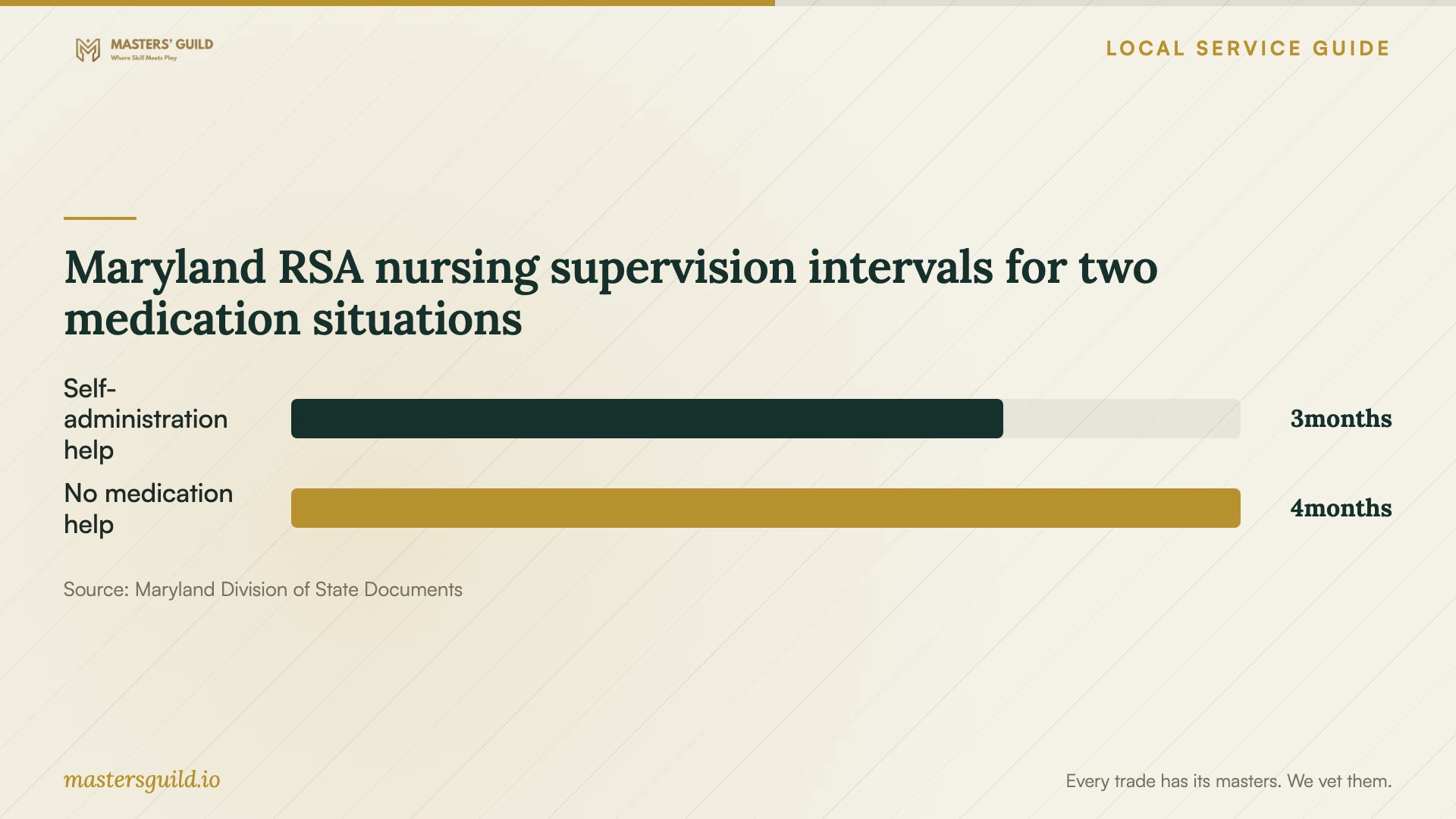
Maryland RSA nursing supervision intervals for two medication situations
Local details that affect your job
Use Baltimore City’s care-navigation contact
Call Baltimore City Maryland Access Point at 410-396-2273 for information and assistance with benefits screening, caregiver support, meals, transportation, medication management, and care options. Explain the care recipient’s address, daily needs, and immediate gaps. Use this conversation to identify assistance to investigate before committing your entire budget to private-pay visits. [4]
Check city respite assistance before budgeting
Baltimore City’s Family Caregivers Program lists non-emergency, non-expedited caregiver assistance of $300 to $600 per person annually from the processing date, subject to available funds. The care recipient must live in Baltimore City. If caregiver and recipient live in separate households, the distance between them cannot exceed 25 miles, and a notarized letter naming the primary caregiver is required. For the adults-60-plus grant route, the caregiver must be at least 18, and the recipient must need help with at least two daily living activities and obtain medical verification. Call 410-396-1337 for an application package; requests may take up to 90 days. Confirm eligibility and funding before assuming reimbursement. [3]
Match the need to the provider conversation
| Care need | Provider scope to discuss | Question before booking |
|---|---|---|
| Meals, light housekeeping, shopping, and errands | Household support only; Maryland exempts this scope from RSA licensure | Does your service stop at household support, and how would we arrange personal care if needed? |
| Bathing, dressing, toileting, or transfers | Personal care through an agency with appropriate service authorization and nursing oversight | Who assesses the need and decides the caregiver’s required qualifications? |
| Medication administration | Agency medication services under Maryland rules and the client’s care plan | Who administers each medication, and how do you document doses and errors? |
| Wound care, infusion therapy, or other skilled needs | Authorized skilled services with qualified clinical staff | Can you meet the discharge instructions and identify the supervising clinician? |
| Relief for a family caregiver | Respite arrangements and Baltimore City caregiver-support eligibility | What coverage can I arrange now, and what assistance requires an application? |
Your hiring checklist
- List daily tasks, preferred visit times, and gaps in family coverage with the person receiving care.
- Prepare discharge instructions and describe the exact medication assistance needed.
- Ask the provider to explain its applicable agency authorization and service scope.
- Request caregiver screening details and an explanation of task-specific training.
- Review the care plan with the supervisor and agree on how staff report changes.
- Get a written weekly total, extra-charge terms, and cancellation rules.
- Write down the missed-visit procedure and the after-hours contact.
- Ask the city programs about eligibility before including assistance in your budget.
Frequently Asked Questions
Does a household helper need a Maryland agency license?
An agency providing only household or family support services does not require Residential Service Agency licensure under COMAR 10.07.05. That exemption covers the defined household-support scope. If you need bathing, transfers, medication help, or clinical care, ask the provider to explain its applicable authorization and staff qualifications. [2]
Can I reject a caregiver the agency sends?
Maryland’s Residential Service Agency rules allow the client or an authorized representative to accept or reject a referred employee or contractor without fear of retaliation. Ask the coordinator how replacement arrangements work before the first visit. [2]
Will Baltimore City pay for urgent respite care?
The city describes its caregiver grant as non-emergency and non-expedited. It lists assistance of $300 to $600 per person annually from processing, subject to funding, with requests that may take up to 90 days to process. Call the program to discuss eligibility, and make a separate arrangement for urgent coverage. [3]
Where can I complain about an agency’s care?
Ask for the agency’s internal complaint process and keep dates, missed visits, and relevant communications. Maryland’s Office of Health Care Quality lists the RSA complaint hotline as 800-492-6005 for services an agency provided or failed to provide. [1] [2]
Sources and scope
This guide combines the sources below with practical planning guidance. Figures apply to the stated geography and period; request a written quote for your property.