
Local service guide
House Cleaning in Baltimore: Scope and Booking Guide
Arrange House Cleaning in Baltimore by defining the rooms, surfaces, and tasks you want completed, requesting written quotes, and agreeing on access and a completion review. Disclose renovation work before booking. For Commissioner-ordered lead abatement, Baltimore's regulations require the Department to issue a statement of completion before the owner or operator considers that abatement complete. [1]
Choose the tasks you want priced
Start with the result you need. For household upkeep, list kitchen surfaces, bathroom fixtures, accessible dusting, and floors. For detailed work, name baseboards, door faces, cabinet fronts, or other areas that need attention. Identify rooms to skip and give the cleaner care instructions for delicate finishes.
For a move-out appointment, explain whether the home will be empty. Specify refrigerator and oven interiors, inside cabinets, and closets. Assign packing, furniture moving, and hauling before scheduling cleaning. Share your handover deadline and leave time to inspect the agreed work before returning keys.
Compare quotes and control spending
Use quotes for your home and task list to set your budget. Give each candidate the same room and bathroom counts, condition photos, material information, and deadline. Ask each cleaner to identify included tasks, exclusions, and optional work. Arrange an inspection before accepting a total if the cleaner needs to see an area to price it.
For an hourly appointment, agree on a spending limit and rank your priorities. For a fixed quote, record the cleaner's assumptions about condition and access. Name the person who can approve extra work and choose how the cleaner should contact them. Decide what happens if the cleaner reaches the limit with tasks unfinished.
Discuss equipment, supplies, product preferences, and care instructions. Request information about liability coverage and damage reporting. Read cancellation and correction terms before choosing a provider. Keep those terms with the written scope so you can refer to the same agreement during the completion review.
Resolve lead-abatement status before cleaning
Tell candidates about sanding, paint removal, or lead-abatement work. If you suspect lead contamination, ask the owner or responsible project specialist to establish the cleanup requirements before arranging household cleaning. Describe what work occurred and which rooms it affected instead of requesting an unspecified post-renovation deep clean.
Under COMAR 26.02.07.08 section A, Maryland directs contractors performing interior lead-abatement cleanup to HEPA-vacuum work-area surfaces, wet wash them, and HEPA-vacuum them after drying until no visible residue remains. Section B addresses exterior cleanup; section G provides a different procedure for owners performing abatement in their own owner-occupied dwellings. Section H permits Department-approved alternatives. Ask the responsible specialist to identify the applicable procedure and the remaining project requirements. [2]
Under Baltimore's Childhood Lead Poisoning Prevention Program regulations, the Department determines abatement completion through clearance inspection, including visual inspection and lead dust testing. The owner or operator may not consider Commissioner-ordered abatement complete until the Department issues a statement of completion. Ask the project contractor for documentation of that status before planning household cleaning. [1]
Assign disposal before a move-out
Decide who will handle leftover products and unwanted belongings. Baltimore DPW's Recycle Right tool provides item-specific disposal guidance and directs residents to its Office of Waste Diversion for uncertain or unlisted items. Check that guidance before adding product removal to the cleaner's scope, and name the person responsible for the disposal trip. [3]
Baltimore DPW publishes household hazardous waste collections for the first consecutive Friday and Saturday of each month from June through December, with holiday adjustments. Its Recycle Right page identifies Sisson Street Residential Recycling Center, 2840 Sisson Street, as the collection location. Confirm the event date before arranging transport, especially if your handover deadline leaves little time. [3]
For lead-abatement waste, Baltimore's Childhood Lead Poisoning Prevention Program regulations require the person performing abatement to remove the waste from the site within 24 hours of abatement completion. The same regulations prohibit disposal through regular residential or commercial trash collection. Keep this disposal responsibility with the abatement project when arranging a household cleaning visit. [1]
Prepare access and review the work
Provide entrance instructions, stairs and parking details, and your building's access procedure. Agree on key or temporary code handling. Clear the surfaces you want cleaned, put away valuables, and point out fragile finishes. Arrange a place for pets and explain which areas the cleaner should leave alone.
Review the task list with the cleaner at completion if you can attend. Record missed areas and use the correction procedure you agreed to. For a move-out, keep completion photos with your handover records. If you cannot attend, agree before the visit on the photos or report you need and how you will request corrections.
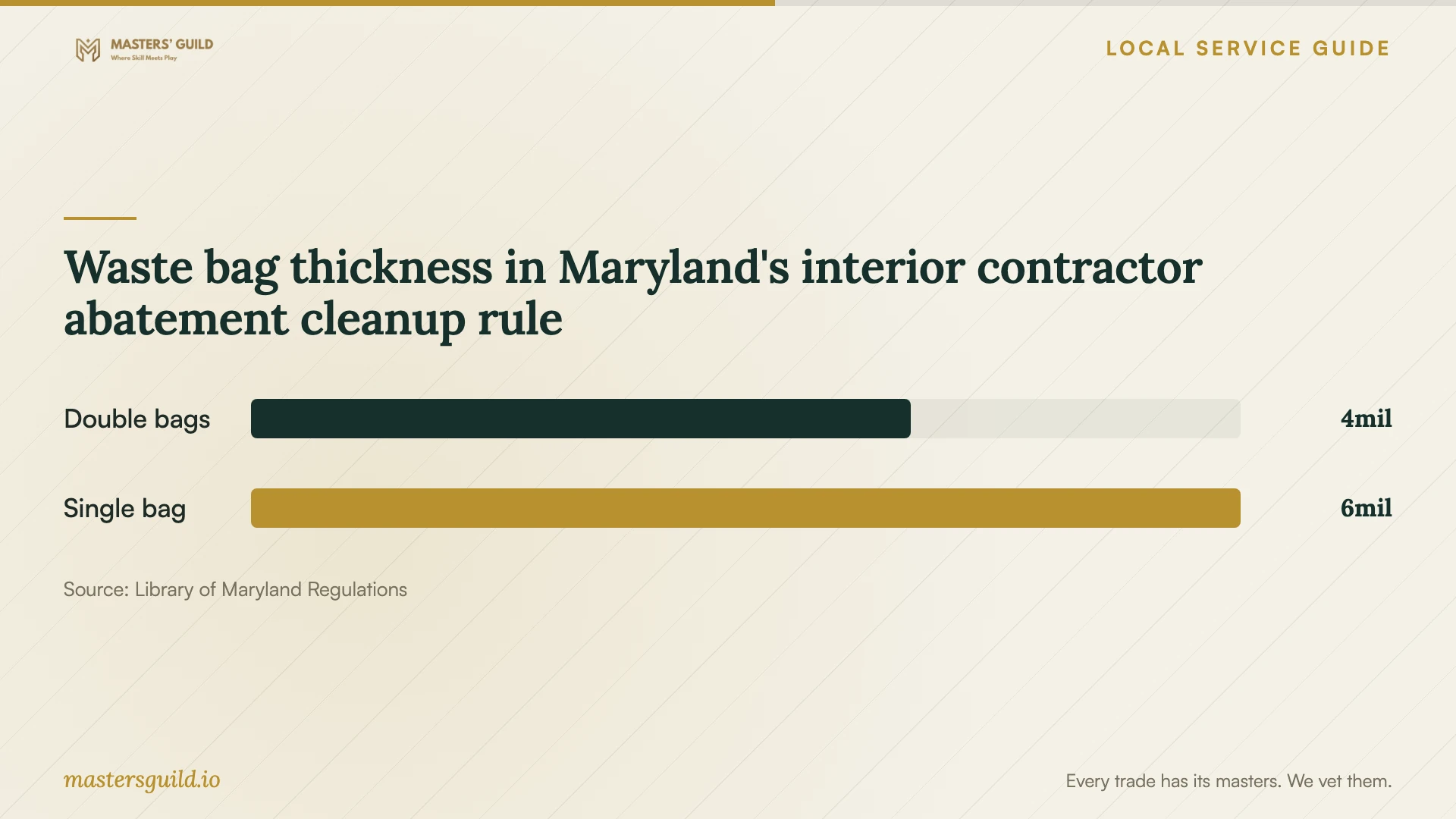
Waste bag thickness in Maryland's interior contractor abatement cleanup rule
Local details that affect your job
City-ordered abatement needs documented completion
Baltimore's Childhood Lead Poisoning Prevention Program regulations require clearance inspection by the Department or a third party accredited and in good standing with Maryland. The minimum lead dust sampling locations in each room where abatement occurred include the floor, windowsill, and window well. For Commissioner-ordered abatement, the owner or operator may not consider the work complete until the Department issues a statement of completion. Ask for that documentation when coordinating a later cleaning visit. [1]
Chemical collection requires original containers
Baltimore DPW's Recycle Right guidance limits household hazardous waste collection days at Sisson Street to residential use and requires all items in original containers. Before emptying your home, identify products needing disposal guidance and assign transport to a named person. Contact DPW about an unidentified container before changing its packaging or including it in removal work. [3]
Choose the booking approach
| Your situation | Approach | Resolve before booking |
|---|---|---|
| Household upkeep | Choose a maintenance task list | Rooms, surfaces, and priorities |
| Detailed cleaning | Request pricing for named areas | Condition assumptions and spending limit |
| Empty-home move-out | Coordinate cleaning with handover | Packing, appliance interiors, and hauling |
| Commissioner-ordered lead abatement | Coordinate with the abatement specialist | Baltimore clearance process and Department issuance of the completion statement |
| Leftover household chemicals | Consult Baltimore DPW disposal guidance | Original containers and the current residential collection date |
Your hiring checklist
- Choose rooms, surfaces, and appliance interiors for the task list.
- Gather condition photos and material care instructions.
- Set the visit price or hourly spending limit and approval procedure.
- Review supplies, liability coverage, cancellation terms, and damage reporting.
- Disclose renovation work and resolve suspected contamination with the responsible specialist.
- Assign packing, hauling, and product disposal.
- Arrange entry, pets, and the completion review.
Frequently Asked Questions
How can I keep an hourly clean within budget?
Agree on a spending limit and rank the tasks before work starts. Decide whether the cleaner should stop at that limit or contact you for approval. Put the arrangement in writing, including how you will handle unfinished tasks.
Can a deep clean complete a city-ordered lead-abatement project?
Baltimore's Childhood Lead Poisoning Prevention Program regulations require clearance inspection. The owner or operator may not consider Commissioner-ordered abatement complete until the Department issues a statement of completion. Ask the abatement contractor to coordinate the applicable cleanup and clearance process and provide completion documentation. [1]
How should I handle leftover products with unclear disposal instructions?
Baltimore DPW's Recycle Right page directs residents to its Office of Waste Diversion for uncertain or unlisted items. Contact that office and establish the disposal route before including those products in the cleaner's removal tasks. [3]
Sources and scope
This guide combines the sources below with practical planning guidance. Figures apply to the stated geography and period; request a written quote for your property.