
Local service guide
Plan flooring installation in Baltimore
Arrange flooring installation in Baltimore by asking for a repair assessment, defining the replacement scope and checking the contractor’s credentials for the complete job. For covered home improvement work in an existing home, Maryland requires an MHIC contractor license to install tile, wood or other flooring; carpet installation is an exception. Get a signed written contract and arrange professional inspection before disturbing tiles you suspect contain asbestos. [1] [2] [3]
Decide what you want repaired
Show the contractor the damaged area and describe what you have noticed: movement, loose pieces, gaps, damaged edges or water marks. Ask for a repair proposal if the contractor considers repair feasible. Have them explain what they need to inspect before committing to a price and whether they can match the existing material and appearance.
For replacement, list the rooms, closets, thresholds and stairs you want included. Identify the exact flooring product rather than accepting a description such as wood flooring. Ask how the installer will assess and prepare the surface underneath, handle transitions to adjoining rooms and finish the edges. Agree on how you will approve additional work if removal exposes a problem.
Check credentials for an existing-home project
For covered home improvement work in an existing home, the Maryland Home Improvement Commission requires a contractor license for tile, wood and other flooring installation. It excludes carpet installation and cleaning from its definition of home improvement. If you add tile or wood to a carpet job, check credentials for the expanded scope before signing. [1]
Ask the contracting business for its name and MHIC number, then confirm its current license with the commission. A covered home improvement contract must include the contractor’s name, address and license number. New-home construction follows a different framework: MHIC licensing does not cover it, and Maryland requires home builders to register with the Attorney General’s Home Builder Registration Unit. [1] [2]
Assess suspect tiles before removal
The Maryland Department of the Environment identifies floor tiles among materials that can contain asbestos in older homes. It warns that damage or disturbance can release dangerous fibers and recommends inspection by a licensed asbestos professional when you suspect asbestos. Arrange that inspection before authorizing destructive removal. [3]
Ask who will arrange the assessment, whether the installation quote excludes specialist work and when you can approve the next stage. Have the assessor explain which requirements apply to your property and proposed removal. Maryland advises homeowners to check local rules before starting work that could disturb asbestos-containing materials; this guidance does not establish a permit determination for your flooring project. [3]
Compare scope, payments and room access
Give bidders the same room list and product specification. Request separate entries for removal, disposal, preparation, installation, transitions, trim and furniture handling. Ask each bidder to identify exclusions and explain how they will price additional preparation. Compare the work you will receive before choosing an offer.
Maryland requires a legible written contract for covered home improvement work, signatures from both parties, a description of the work and materials, and approximate start and substantial completion dates. The homeowner must receive a signed copy before work begins. Use those requirements to make the agreed scope and schedule explicit. [2]
Negotiate later payments around agreed stages and record the arrangement in the contract. Maryland’s Home Improvement Law does not control the payment schedule beyond the initial deposit. For your own planning, agree on delivery access, room clearance, working hours and when you can return furniture. Walk through the finished work with the contractor and record any remaining items before making the final agreed payment. [2]
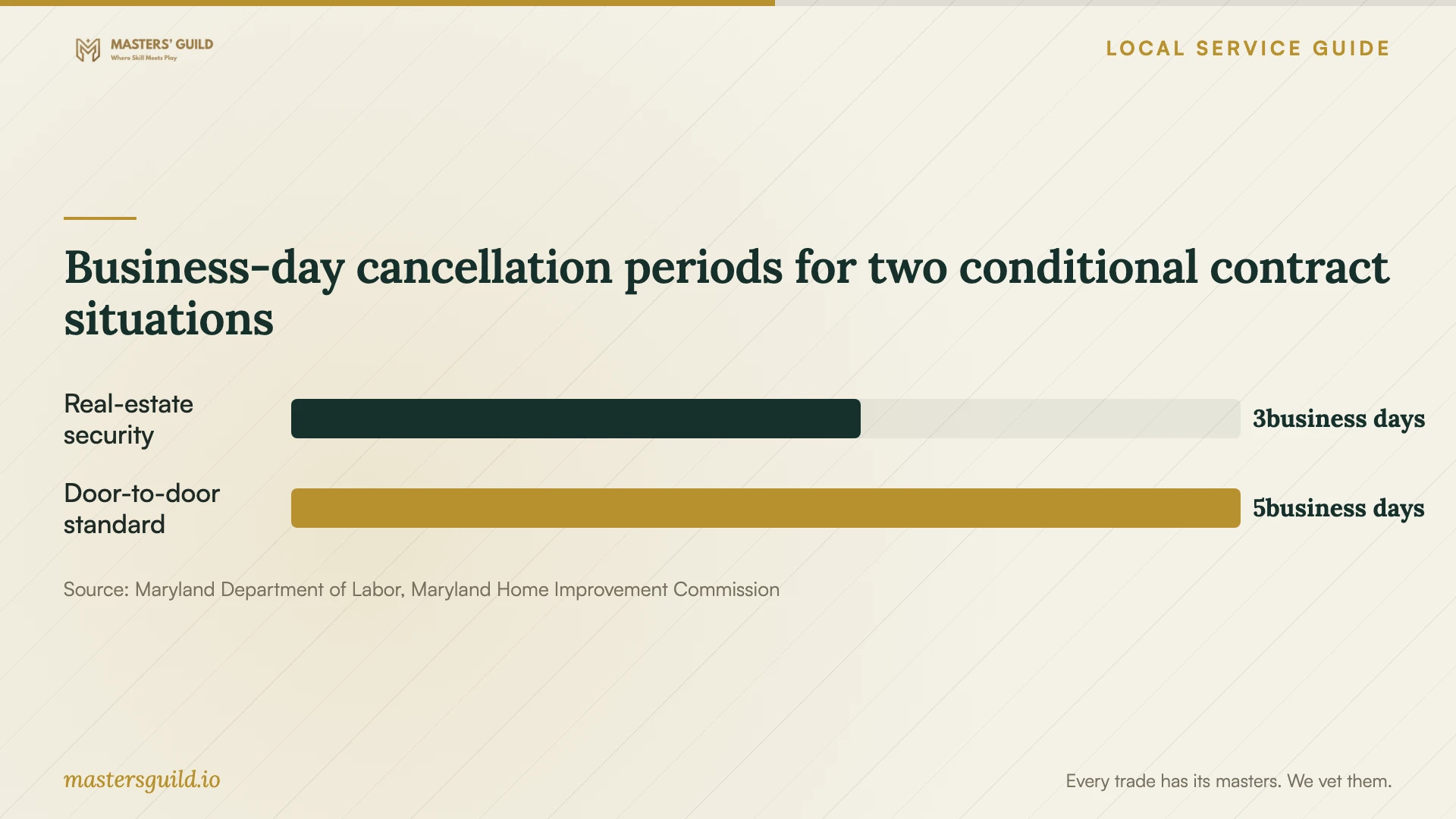
Business-day cancellation periods for two conditional contract situations
Local details that affect your job
Maryland’s carpet exception affects whom you hire
In Baltimore, apply Maryland’s existing-home improvement distinction to the full installation scope. Carpet installation and cleaning do not require an MHIC license under that definition; covered tile, wood and other flooring installation do. Ask the commission about a mixed or uncertain scope rather than assuming a carpet-only exception covers the entire project. [1]
Maryland limits upfront payment on covered work
For a covered home improvement contract, do not pay before signing or agree to a deposit above one-third of the contract price. You can negotiate a smaller deposit. This statewide protection gives a Baltimore homeowner a concrete payment check before reserving an installation date. [2]
Maryland recommends assessment of suspected asbestos
Contact a licensed asbestos professional if you suspect asbestos in the tiles you plan to remove. Maryland’s environmental agency identifies floor tiles as a possible asbestos-containing material. Ask the professional to define the assessment and any specialist removal scope before you authorize the flooring contractor’s tear-out. [3]
Choose your next hiring or preparation step
| Project situation | Next step | Maryland distinction |
|---|---|---|
| Carpet installation only | Define fitting, removal and finish work. | MHIC excludes carpet installation from home improvement licensing. |
| Covered tile or wood installation in an existing home | Confirm the contractor’s current MHIC license. | Maryland requires a home improvement contractor license for this installation. |
| Flooring within new-home construction | Confirm the applicable builder registration. | MHIC licensing does not cover new-home construction; Maryland requires home builder registration. |
| Suspected asbestos in existing tiles | Contact a licensed asbestos professional before disturbance. | Maryland recommends professional inspection when homeowners suspect asbestos. |
| Large deposit on covered home improvement work | Negotiate within the deposit limit before signing. | The maximum deposit is one-third; the contractor cannot accept payment before signing. |
Your hiring checklist
- Photograph the damage and list the rooms, closets, thresholds and stairs.
- Ask whether repair is feasible and request a separate replacement proposal.
- Check credentials against the complete scope and whether the project involves an existing home.
- Arrange professional assessment before disturbing tiles you suspect contain asbestos.
- Compare removal, disposal, preparation, installation and finish work across bids.
- Record the product, approximate dates, payment stages and approval process for extra work.
- Agree on furniture handling, delivery access and a final walkthrough.
Frequently Asked Questions
Can I get a reliable price before removing the old floor?
Ask the contractor what they can inspect before removal and which preparation items remain uncertain. Request a written base scope, exclusions and a method for approving extra work. The supplied official guidance provides no Baltimore installation prices, so obtain project-specific bids.
Does an installer need an MHIC license?
For covered tile, wood or other flooring installation in an existing home, yes. Maryland excludes carpet installation and cleaning from its home improvement definition. New-home construction follows the separate home builder registration framework. [1]
Should I remove old tiles myself before installation?
Discuss removal with the contractor before starting. If you suspect asbestos, contact a licensed asbestos professional for inspection and advice. Maryland warns that disturbing asbestos-containing materials can release dangerous fibers. [3]
Can I cancel a contract sold at my door?
If Maryland’s Door-to-Door Sales Act covers the transaction, MHIC guidance states midnight of the fifth business day after the transaction, or midnight of the seventh day for a buyer aged at least 65. It requires cancellation information and a separate completed cancellation form. Confirm coverage and counting rules before relying on a deadline; the supplied guidance does not explain how to count the seventh day. [2]
Sources and scope
This guide combines the sources below with practical planning guidance. Figures apply to the stated geography and period; request a written quote for your property.