
Local service guide
Door and Window Repair in Baltimore, MD
For Door and Window Repair in Baltimore, ask a contractor to inspect the problem and quote the specific glass, hardware, sash or frame work before you approve full replacement. Verify the contracting business through Maryland’s Home Improvement Commission, which lists doors and windows among work usually requiring its license. For exterior changes at a historic-district property, establish whether CHAP review applies before ordering materials. [1] [2] [3]
Describe the fault before asking for a price
Photograph the whole opening, the damaged area and any manufacturer label. Explain whether the door drags, the latch misses its strike, the window will not stay open, or you see moisture on a surface or between panes. Tell the contractor whether you want to retain the existing appearance. Ask them to diagnose the cause during the visit rather than price a replacement from a photograph alone.
Ask the estimate to separate the proposed work on glass, operating hardware, weatherstripping, sash and frame. For a replacement proposal, request an explanation of why the contractor recommends removing the existing assembly. Include interior trim, exterior finishing, disposal and any temporary protection in the discussion. You can then compare offers against the same scope.
Check the contracting business and property type
Maryland’s regulator includes residential repair and replacement in its definition of home improvement and lists doors, windows, screens and storm doors among work usually requiring MHIC licensing. Use the commission’s license-status resource to check the business that will sign your contract. Ask that business to identify any subcontractor who will measure, install or finish the work. [2] [3]
MHIC says its home-improvement coverage includes individual condominium units but excludes commonly owned condominium areas and buildings containing four or more single-family units. If your opening belongs to a shared exterior or a building in that excluded category, ask the association or property manager to establish responsibility and confirm the applicable requirements before you hire. [3]
Request evidence of current insurance alongside the license check. Maryland requires home-improvement contractors to maintain at least $500,000 in general liability insurance. Ask the contractor to explain who handles damage to surrounding finishes and how you should report a problem after completion. [3]
Resolve historic review before ordering
Baltimore’s code requires the Building Official to refer permit applications involving regulated alterations to CHAP. For a Historical Preservation District, the Director must issue an Authorization to Proceed before the official issues the permit. In a Historical Conservation District, the Director must issue that authorization or CHAP must determine that the exterior alteration does not require it. [1]
Before paying for replacement doors or windows, ask whether your property and proposed work fall under those rules. Give the reviewer photographs and the proposed product details, including dimensions and exterior appearance. CHAP can request additional plans, elevations and related information, and it cannot make its determination until it has a complete application and the information it needs. Do not treat the referral deadline as a project approval deadline. [1]
Compare replacement specifications without a savings promise
If you consider replacement, ask for the exact model and its rated performance. The Department of Energy explains that a lower U-factor means less heat flow through the window, while a lower solar heat gain coefficient means less transmitted solar heat. It recommends choosing residential products for the installation climate zone and considering air leakage, water resistance, durability and appearance alongside efficiency. [5]
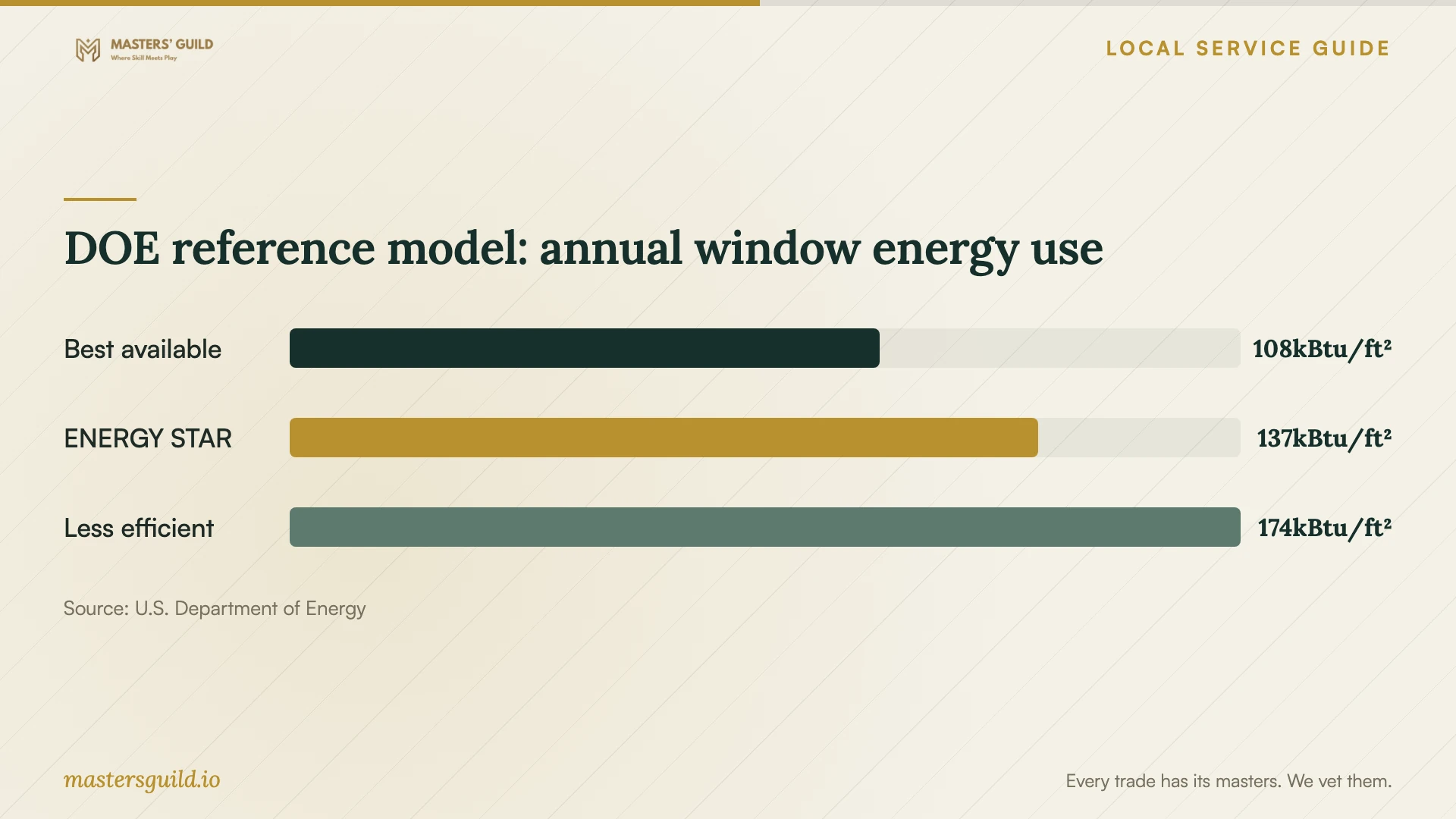
The chart uses DOE’s federal purchasing model to show how annual modeled energy use differs among window categories. It gives you a reason to ask for product ratings, but it does not establish your home’s energy use, repair cost or replacement payback. Request a separate explanation of the proposed installation and how the contractor will seal the opening. [5]
Put the scope and payment schedule in writing
Maryland requires a covered home-improvement contract to be written, legible and signed by both parties. It must describe the work and materials, identify the contractor’s name, address and MHIC license number, and include approximate start and substantial-completion dates. The homeowner must receive a signed copy before work starts. [4]
Ask for separate dates for measurement, ordering and installation, plus a process for approving extra work if the contractor discovers damage after opening the frame. Agree on the remaining payment milestones before signing. Maryland caps the initial deposit at one-third of the contract price and prohibits payment before signing; beyond that deposit, the parties can negotiate the payment schedule. [4]
DOE reference model: annual window energy use
Local details that affect your job
Baltimore historic-district permit sequencing
For regulated alterations, Baltimore requires the Building Official to forward the permit application and accompanying plans to CHAP within two days of receipt. That is a referral requirement, not an approval turnaround. Confirm whether your exterior door or window proposal needs an Authorization to Proceed, and settle the review requirements before committing to a product order. [1]
Maryland deposit protection applies to covered repairs
For covered residential home-improvement work here, a contractor cannot accept more than one-third of the contract price as a deposit or any payment before signing. Ask the contractor to reconcile a larger requested materials payment with this rule before you pay. Keep your signed contract and payment records together. [4]
Condominium owners need to establish responsibility
Maryland’s MHIC guidance distinguishes work on an individual condominium unit from work on commonly owned areas, which it excludes from home-improvement coverage. Before arranging an exterior opening repair, ask your association whether the opening belongs to your unit or the common property and who can authorize the work. [3]
Questions to settle before approving work
| Your situation | Request from the contractor | Next step |
|---|---|---|
| Door drags or latch misses | Inspect alignment and hardware; explain the proposed adjustment | Approve a defined repair scope after diagnosis |
| Glass is damaged or obscured | Identify which glass or assembly they propose to replace | Compare glass-only and assembly proposals where offered |
| Contractor proposes frame removal | Explain the diagnosis and include trim and exterior finishing | Request a written replacement alternative |
| Exterior change at a historic-district property | Establish whether the proposal is a regulated alteration | Resolve applicable CHAP authorization before the permit and product order |
| Condominium opening | Identify unit ownership or common-area responsibility | Obtain association authorization and confirm applicable requirements |
Your hiring checklist
- Photograph the opening, damage and product labels; describe how and when the problem occurs.
- Request an inspection and separate repair and replacement scopes where both merit consideration.
- Check the contracting business through MHIC and request current insurance documentation.
- Establish ownership and authorization if the opening serves a condominium or shared area.
- Ask whether historic review or a permit applies before approving materials.
- Specify glass, hardware, trim, sealing, disposal and finishing in the written scope.
- Agree on ordering, installation, extra-work approval and payment milestones.
- Before final payment, inspect operation, locking, finishes and cleanup with the contractor.
Frequently Asked Questions
Does a door or window repair contractor need an MHIC license?
For covered residential home-improvement work, Maryland requires the contractor who contracts with the homeowner to hold an MHIC license. The regulator lists doors and windows among work usually requiring licensing. A subcontractor may work under an MHIC-licensed contractor without holding that license. [2] [3]
Does every repair require CHAP approval?
The cited city rule addresses regulated alterations. It does not establish that every repair needs CHAP approval. Ask whether your property designation and proposed exterior work trigger review before you order materials or assume that a permit can proceed. [1]
How much deposit can the contractor request?
For a covered Maryland home-improvement contract, the contractor cannot take more than one-third of the contract price as a deposit and cannot accept payment before signing. Negotiate the remaining payment schedule and record it in the agreement. [4]
Can the energy chart tell me whether replacement will pay for itself?
No. DOE’s chart uses modeled window categories and federal purchasing assumptions published in guidance updated in December 2021. It does not measure your property. Compare the actual products, installed prices and proposed repair scope before making a replacement decision. [5]
Sources and scope
This guide combines the sources below with practical planning guidance. Figures apply to the stated geography and period; request a written quote for your property.