
Local service guide
Bricklaying and Masonry in Baltimore: Hiring Guide
For Bricklaying and Masonry in Baltimore, start by checking the contractor’s Maryland Home Improvement Commission license, clarifying any historic approval requirements, and requesting a written repair scope. Maryland lists residential bricklaying and masonry pointing among work usually requiring MHIC licensing. For an older brick wall, ask the contractor to explain the replacement mortar’s compatibility before you approve repointing. [1] [2] [3] [4]
Define the repair before requesting bids
Photograph the full wall and close views of the areas that concern you. Mark missing joints, damaged bricks, stains, and cracks on copies of the photos. Tell the contractor whether you want a localized repair, a broader assessment, or new masonry. Ask each bidder to identify the exact areas included in the price.
If you see a bulging wall, loose overhead masonry, or a crack that appears to be changing, keep people away from the affected area and request an assessment before arranging cosmetic work. Ask whether the contractor recommends a structural engineer. Avoid asking a mason to quote repointing alone before someone has assessed the movement.
Check who will sign the contract
Maryland’s home improvement guidance lists bricklaying, masonry pointing, and chimney repairs among residential work usually requiring an MHIC license. The Commission states that only MHIC licensed contractors may enter into home improvement contracts with homeowners. Use the Commission’s license-status resource to check the business you plan to hire, and match that business to the name on your quote. [1] [2]
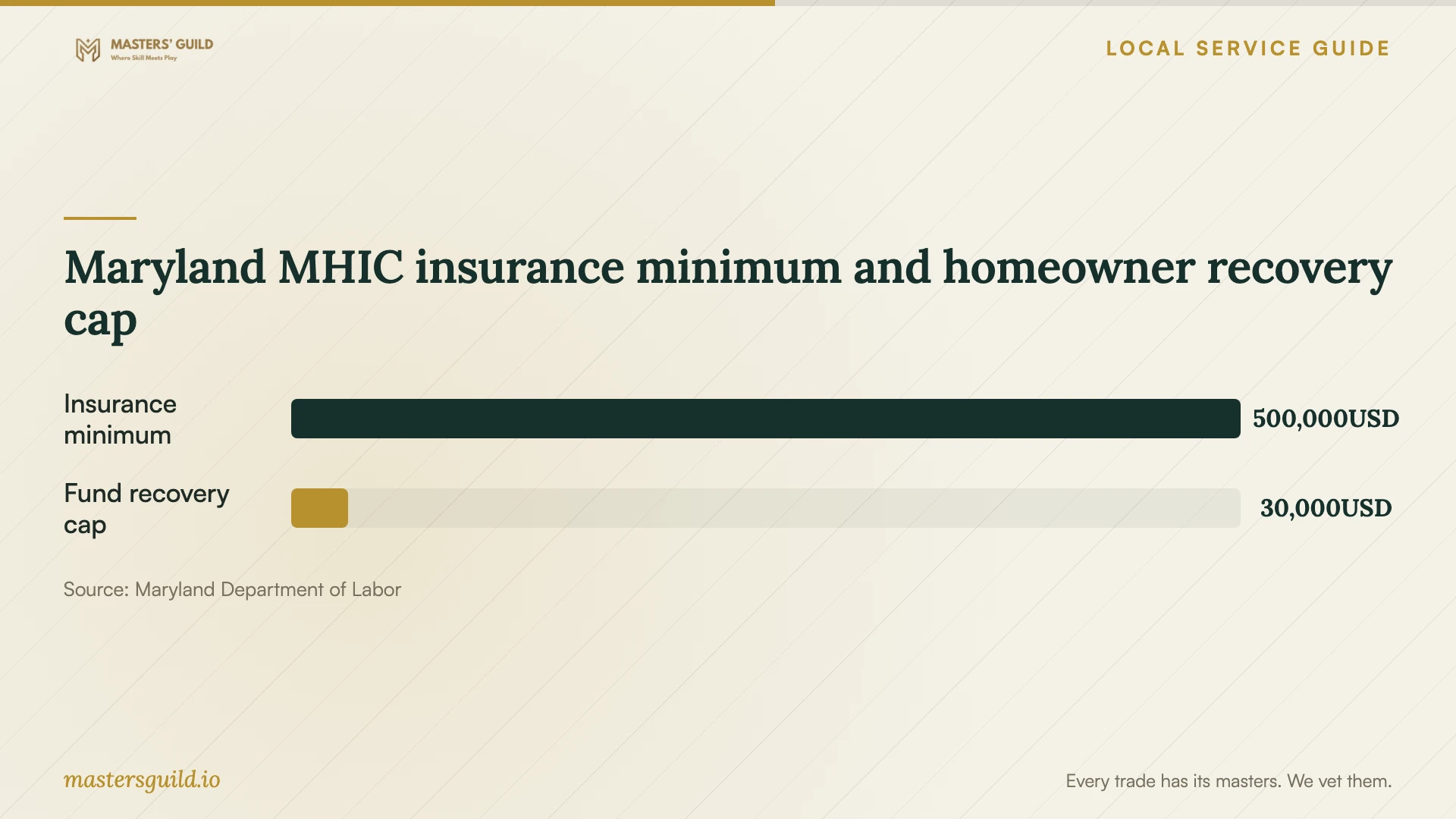
Ask for evidence of current liability insurance as well as the license number. The Commission states that Maryland home improvement contractors must maintain at least $500,000 in general liability insurance. Ask the contractor who will supervise the work and whom you should contact if you find a problem during the repair. [2]
Confirm the ownership and building arrangement before applying residential licensing guidance to a shared facade. MHIC includes work on individual condominium units within its scope, but excludes commonly owned condominium areas and buildings containing four or more single family units. For those situations, ask MHIC which requirements apply to your proposed contract. [2]
Resolve historic review before scheduling
Baltimore City’s code connects CHAP review to permit applications involving regulated alterations. The Building Official must forward the application and accompanying plans to the Commission within two days of receiving it. CHAP may request additional plans, elevations, or other information and cannot determine appropriateness until it has a complete application and the needed documents. [3]
Ask the city whether your property and proposed exterior masonry work fall under that process. Have the contractor describe the intended joint appearance, replacement bricks, mortar, and repair locations for your inquiry. Do not treat the two-day referral requirement as an approval deadline or assume that every repointing job requires the same review. [3]
Specify mortar and approve a sample
For historic masonry, choose a contractor who can explain material compatibility. The National Park Service describes historic mortar as sacrificial: it helps moisture move through joints while protecting the brick or stone. The agency warns that replacing historic mortar with harder, less permeable modern materials can force moisture into the masonry units and cause damage. [4]
Ask how the contractor will identify the existing mortar and whether sampling or analysis would help. NPS explains that analysis can guide a compatible replacement recipe, including the binder and aggregate. Request a written specification rather than choosing a mix by color alone. [4]
Include a small sample area in your agreement. Review its color, texture, and joint profile before approving the remaining work. Ask the contractor to explain the removal method, protection of surrounding brick, curing plan, and response to unsuitable weather. Record your approval and any changes in writing.
Compare the full scope and payment plan
Request separate descriptions for joint repair, brick replacement, and any rebuilding. Ask bidders to identify access equipment, debris removal, protection of windows and entrances, approval responsibilities, and excluded work. For a chimney or upper wall, discuss how the crew will reach the repair area and where equipment will stand.
Agree on how the contractor will document concealed damage and price additional work before proceeding. Request a payment schedule, completion criteria, and written warranty terms. For budgeting, obtain site-specific quotes for the same scope; the official sources used here do not establish Baltimore masonry prices.
Maryland MHIC insurance minimum and homeowner recovery cap
Local details that affect your job
Baltimore historic districts have different permit prerequisites
For a regulated alteration in a Historical Preservation District, the Building Official cannot issue the permit until the Director issues an Authorization to Proceed. In a Historical Conservation District, the code also allows CHAP to determine that the proposed exterior alteration does not require that authorization and notify the applicant and Building Official. Ask which district category and approval path apply to your address before finalizing the work schedule. [3]
Maryland distinguishes your contractor from the repair crew
For residential home improvement within MHIC’s scope, verify the contractor who will enter into your agreement. Maryland eliminated the subcontractor license category in 2016 and permits subcontractors to perform home improvements for an MHIC licensed contractor without their own license. Ask the contracting business to identify its subcontractors and supervisor rather than assuming every worker must carry an MHIC contractor license. [2]
Choose the next step for your masonry project
| Situation | Next step | Ask before agreeing |
|---|---|---|
| Residential bricklaying or pointing | Check the contracting business’s MHIC license | Who signs the contract and supervises the crew? |
| Regulated historic exterior alteration | Confirm the CHAP authorization path | Which district category applies, and what documents are needed? |
| Historic brick with failed mortar | Request a compatibility assessment and sample | How will you select the replacement binder and aggregate? |
| Shared condominium facade | Clarify the applicable requirements with MHIC | Does this work concern a commonly owned area? |
| Bulging wall or loose overhead masonry | Arrange an assessment and restrict access | Should a structural engineer assess the area before repair? |
Your hiring checklist
- Photograph the full repair area and mark the locations you want assessed.
- Match the contracting business name to its license record and insurance documentation.
- Confirm any historic review and permit requirements for the address and proposed work.
- Request a written mortar specification and agree on a sample area.
- Compare bids using the same repair boundaries, access plan, and cleanup scope.
- Agree on written approval and pricing for additional work.
- Record payment stages, completion criteria, and warranty terms.
Frequently Asked Questions
Does a residential masonry contractor need an MHIC license?
Maryland lists bricklaying and masonry pointing among work usually requiring MHIC licensing. For home improvement within its scope, only an MHIC licensed contractor may enter into the homeowner contract. Subcontractors may work under that licensed contractor without their own home improvement license. [1] [2]
Does CHAP approve a permit application within two days?
The two-day requirement concerns the Building Official’s referral to CHAP. It is not an approval deadline. CHAP must have a complete application and any additional documents it needs before determining whether the proposed regulated alteration is appropriate. [3]
Should I request the hardest mortar available?
Ask for mortar compatible with your masonry. NPS explains that harder, less permeable modern mortar can damage historic brick or stone by redirecting moisture into those materials. Ask the contractor how the proposed mix matches the existing construction. [4]
How can I compare two different repair quotes?
Ask both contractors to quote the same marked repair areas. Compare their mortar specifications, brick replacement allowances, access equipment, cleanup, and exclusions. Resolve differences in scope before comparing the totals, and require written approval for additional work.
Sources and scope
This guide combines the sources below with practical planning guidance. Figures apply to the stated geography and period; request a written quote for your property.