
Local service guide
Plumbing services in Bakersfield, CA: Hiring Guide
To arrange plumbing services in Bakersfield, describe the problem, ask for a written scope, and check the contractor’s license and insurance before agreeing to work. California’s C-36 plumbing classification covers water heaters, owner-side water and gas piping, and backflow equipment. For sewer repairs, identify your sewer provider first: North of River Sanitary District requires a permit and approved field inspection for work involving its system. [1] [2]
Describe the problem before requesting a quote
Give the plumber the property address, affected fixtures, and when you first noticed the problem. Say whether you have an active leak, a recurring blockage, weak flow, or a water-heater concern. Include photographs of accessible piping and equipment labels. Describe what you observed without naming a cause you have not confirmed.
Ask what the initial visit includes and what you owe if you decline the proposed repair. For a recurring drain problem, request the plumber’s reason for recommending clearing, camera inspection, or replacement. Agree on a spending limit for diagnosis and require approval before the contractor expands the work.
Check the contractor’s scope and responsibility
CSLB’s C-36 classification includes water and gas piping on the property owner’s side of the utility meter, water-heating equipment, waste disposal, and maintenance or replacement of backflow preventers and conditioning equipment. Use that scope as a starting point when checking the contractor’s credentials for your proposed job. [1]
Request the business name and license number, then check that the license record matches the contractor offering the work. Ask for evidence of insurance and identify who will perform the job. For work involving excavation, electrical connections, or wall repair, ask who handles each part and who carries responsibility for the finished result.
For a water-heater replacement, request the proposed model, capacity, fuel type, and installation scope in writing. Ask the contractor to identify the applicable permit authority and explain inspection arrangements before you approve the quote. Include removal of the old unit, connection work, and any proposed alterations in the agreement.
Plan sewer work around the serving district
North of River Sanitary District requires a sewer permit for any sewer improvement, repair, or new connection to its system. The process starts with a Sewer Permit Application and ends after the district performs and approves a field inspection. It prohibits connecting new sewer services before permit issuance. [2]
Confirm whether that district serves your property before applying its rules to your job. If it does, ask the contractor who will submit the application, pay the charges, and arrange the field inspection. The district places responsibility on property owners to obtain its permit before connecting to the sewer line, so request documentation rather than relying on a verbal assurance. [2]
Before approving excavation, ask the plumber to identify the repair location and explain the evidence for the proposed method. Include access, surface removal, backfill, and restoration in the quote. Ask what happens if the contractor discovers a different pipe condition after opening the ground.
Use local water data without assuming your tap’s hardness
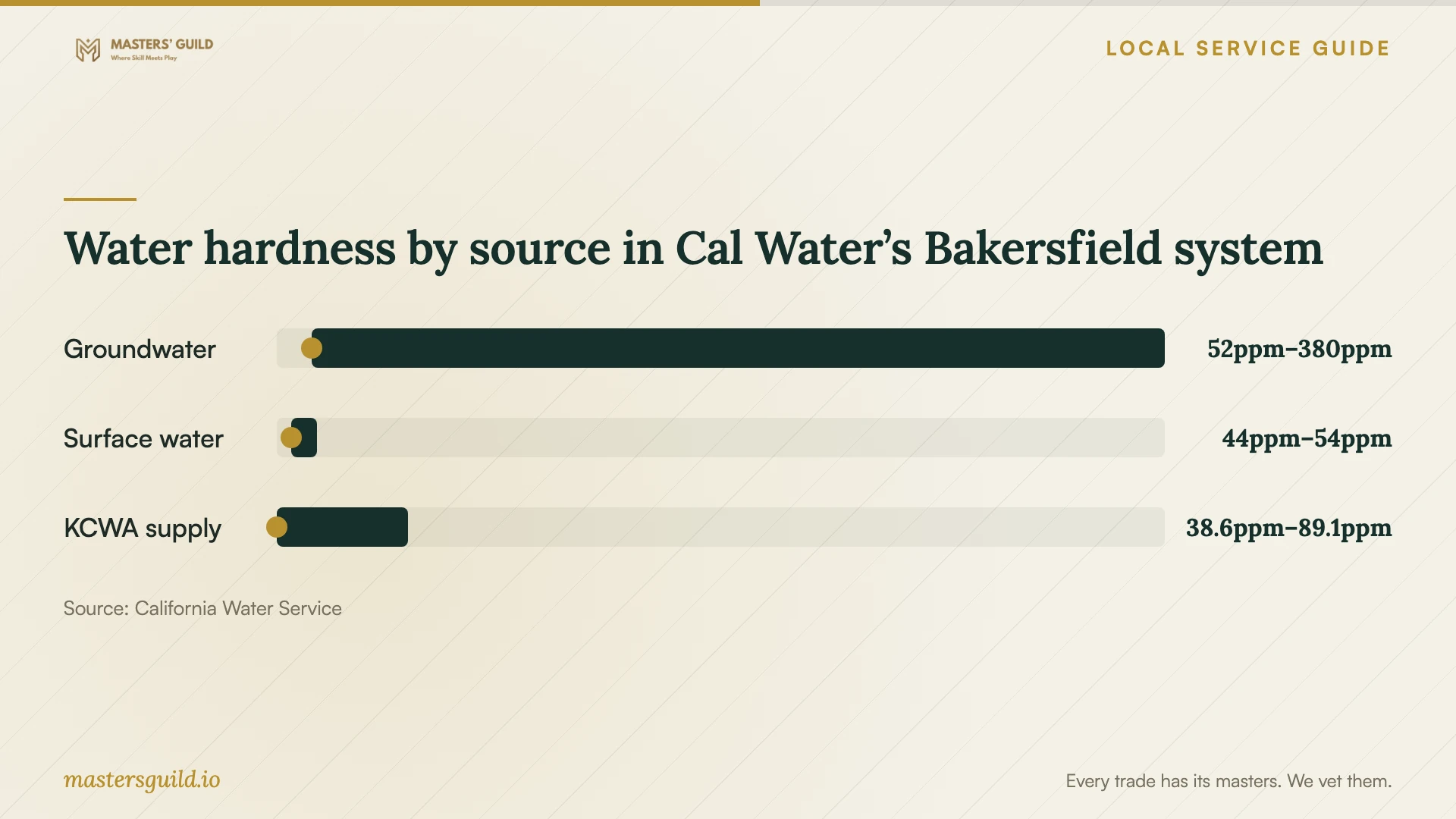
Cal Water supplies its Bakersfield system with local groundwater, treated Kern River surface water, and treated water purchased from the Kern County Water Agency. Its 2025 report lists different hardness ranges for those sources. These are system source measurements, not a test of the water at your address. [3]
Cal Water explains that hard water can contribute to mineral buildup in pipes or water heaters. If you notice scale or are considering a softener, ask for a hardness measurement at the home and a diagnosis of the affected equipment. Request separate recommendations for repair, maintenance, and optional conditioning so you can decide what to authorize. [3]
For irrigation or other connections that need backflow protection, confirm the utility’s requirements before buying equipment. Cal Water says its cross-connection staff determines whether customers need a backflow prevention assembly based on water use at the location. Its report also describes annual testing of existing assemblies. [3]
Compare the full job and agree on completion
Compare written totals for the same repair scope. Ask bidders to identify parts, labor, diagnostic charges, access work, disposal, and any permit or inspection charges. Have them state exclusions and explain how they will price changes. Treat an unresolved diagnosis as a question to settle before comparing replacement quotes.
Before scheduling, agree on access, expected water shutoff, cleanup, and how the plumber will demonstrate completion. Ask for warranty terms covering labor and supplied parts. Keep the final invoice, equipment information, and any permit or inspection records with your property documents.
Water hardness by source in Cal Water’s Bakersfield system
Local details that affect your job
North of River sewer permit sequence
For properties connected to North of River Sanitary District’s system, the district requires a permit for sewer repairs and improvements as well as new connections. Submit the application before work requiring that permit, and include the district’s approved field inspection in the completion plan. Its application requests the property address and Assessor’s Parcel Number; gather those details before arranging submission. [2]
Conditioning choices need an address-level check
Cal Water’s Bakersfield report lists groundwater hardness from 52 to 380 ppm, surface-water hardness from 44 to 54 ppm, and purchased KCWA water from 38.6 to 89.1 ppm for testing during 2018–2025. Confirm your water supplier and measure your home’s hardness before approving conditioning equipment. Cal Water also cautions that some softeners increase sodium in the water. [3]
Questions to settle before approving plumbing work
| Proposed work | Question to ask | Planning step |
|---|---|---|
| Water-heater replacement | Which model and connection work does the quote include? | Check credentials for the work; C-36 includes water-heating equipment. Ask about permits and inspection. |
| Sewer repair on a NORSD connection | Who submits the district application and arranges inspection? | Include the required sewer permit and approved field inspection in the job plan. |
| Water softener installation | What hardness did you measure at this home? | Use a home measurement alongside Cal Water’s source data when choosing equipment. |
| Backflow protection | Has the water supplier confirmed the required assembly? | For Cal Water customers, confirm requirements with its cross-connection staff before selecting equipment. |
Your hiring checklist
- Record the affected fixtures, symptoms, previous repairs, and photographs.
- Request the contractor’s business name, license number, and insurance information.
- Confirm the property’s water supplier and sewer provider.
- Ask who handles applicable permit applications and inspections.
- Get a written scope with diagnostic charges, exclusions, and change approval terms.
- For conditioning proposals, request a home water-hardness measurement.
- Agree on shutoff arrangements, restoration, completion checks, and warranty terms.
Frequently Asked Questions
Does North of River Sanitary District require a permit for a sewer repair?
Yes, for repairs involving its sewer system. The district requires a permit for any sewer improvement, repair, or new connection. Its process starts with an application and finishes after an approved field inspection. Confirm that the district serves your property before applying this requirement. [2]
Does the C-36 classification cover water heaters and softeners?
Yes. CSLB includes water-heating equipment and water conditioning equipment in the C-36 plumbing classification. Ask for the contractor’s license number and check the record for the proposed work. [1]
Does the local hardness report mean I need a softener?
The report alone cannot establish that need. Cal Water publishes hardness data for several sources supplying its Bakersfield system, rather than a measurement at your tap. Ask for a home hardness test and an explanation of the problem the proposed equipment would address. [3]
Sources and scope
This guide combines the sources below with practical planning guidance. Figures apply to the stated geography and period; request a written quote for your property.